.webp&w=384&q=75)

Loading, please wait...
Loading, please wait...

The clinical utilization of stereotactic radiosurgery for managing sporadic acoustic neuromas has expanded markedly across neurosurgical centers worldwide. While stereotactic radiosurgery achieves excellent local tumor control in most individuals, treatment failure occurs in approximately two to five percent of cases. In these challenging scenarios, clinicians frequently recommend salvage microsurgery vestibular schwannoma interventions to halt progressive tumor expansion and prevent impending neurological decline. A pivotal multicentric European retrospective investigation evaluated twenty-eight adult patients who underwent microsurgical salvage following primary radiosurgery failure across six referral institutions. Notably, documented radiological regrowth served as the definitive surgical indication in twenty-seven of the twenty-eight patients, demonstrating that objective volumetric enlargement drives reintervention decisions. The median interval from initial radiation treatment to salvage microsurgical resection spanned forty-eight months, with a broad range from twenty-four to one hundred twenty months. Furthermore, patient age at revision surgery averaged fifty-three years. These clinical timelines highlight that therapeutic failure often manifests several years after initial radiation delivery. Consequently, neurosurgeons and neurotologists must maintain rigorous, long-term radiological surveillance protocols for all radiated vestibular schwannoma patients. Identifying treatment failure early prevents extreme tumor enlargement and subsequent brainstem compression.
Radiation therapy fundamentally modifies the histopathological architecture of cerebellopontine angle lesions and neighboring neurovascular structures. In the multicenter cohort, tumor dimensions expanded substantially between primary radiation and secondary intervention. Specifically, median axial diameter increased from 18.5 millimeters prior to radiosurgery to 25.0 millimeters at salvage surgery. This pronounced anatomical growth frequently leads to brainstem distortion and ventricular obstruction. In addition, ionizing radiation generates intense fibrous adhesions, peritumoral scarring, and pronounced microvascular hyalinization. These histological alterations effectively obliterate normal arachnoid dissection planes that skull base surgeons routinely exploit during upfront resections. Therefore, separating the schwannoma capsule from delicate cranial nerves and brainstem parenchyma becomes exceedingly arduous. Surgeons repeatedly describe these salvage operations as technically unforgiving due to severe tissue friability and vascular changes. In contrast to treatment-naive neoplasms, post-radiosurgical lesions exhibit variable consistency, alternating between dense collagenous matrix and soft necrotic areas. Consequently, surgical teams must anticipate altered anatomical relationships and prepare tailored microsurgical strategies. Employing meticulous sharp dissection rather than blunt traction proves essential for minimizing mechanical injury to adjacent critical brainstem structures.
Achieving complete tumor extirpation while safeguarding neurological integrity represents the principal surgical dilemma during salvage resections. In the European cohort, surgeons accomplished gross total resection in thirteen of twenty-eight patients, representing 46.4 percent of the cohort. The remaining patients underwent near-total or subtotal resection to protect adherence-compromised cranial nerves. These surgical metrics confirm that complete capsule excision is achievable in less than half of post-radiation patients. Furthermore, contemporary skull base literature increasingly endorses near-total resection when dense adhesions jeopardize vital neural pathways. Leaving a micro-thin remnant over the facial nerve dramatically reduces the probability of permanent severe paresis without compromising mid-term oncological control. In addition to resection extent, perioperative safety remains a primary benchmark for salvage skull base interventions. Encouragingly, major complications occurred in only three of the twenty-eight patients, establishing a favorable overall complication rate of 10.7 percent. This relatively low morbidity profile indicates that microsurgical salvage is safe when performed in specialized tertiary skull base units. Nevertheless, teams must maintain vigilance for cerebrospinal fluid fistulas, postoperative hematomas, and meningitis. Rigorous multilayered skull base reconstruction and diligent wound care significantly reduce postoperative cerebrospinal fluid leakage risks.
Preserving facial nerve continuity and functional motor performance remains a premier goal during cerebellopontine angle operations. Prior to salvage surgery, twenty-five of twenty-eight patients exhibited intact House-Brackmann grade I facial function. This finding demonstrated that initial radiosurgical failure rarely paralyzed the nerve upfront. However, surgical manipulation amidst radiation-induced fibrosis carries substantial immediate functional risks. At hospital discharge, only fourteen of twenty-seven evaluated individuals maintained good facial function of House-Brackmann grade I or II. This outcome represented an immediate rate of 51.9 percent. This acute postoperative motor deficit reflects surgical traction, neural ischemia, and localized edema. Fortunately, the study revealed significant delayed functional recovery over extended longitudinal follow-up. At twelve months postoperatively, eleven of fifteen monitored patients, or 73.3 percent, attained good facial nerve outcomes. Conversely, three of fifteen patients, or 20.0 percent, suffered permanent severe facial impairment with House-Brackmann grade V or VI. These empirical results emphasize that facial paresis often improves gradually throughout the first postoperative year. Therefore, clinicians should reassure anxious patients regarding dynamic recovery while utilizing comprehensive corneal protection regimens. In addition, continuous multi-channel intraoperative electromyography and threshold stimulation provide indispensable guidance during hazardous capsular dissection.
While facial nerve function often demonstrates substantial long-term recovery, auditory outcomes present a distinctly discouraging trajectory. Before primary stereotactic radiosurgery, ten of twenty evaluable patients maintained serviceable hearing classified as AAO-HNS class A or B. However, disease progression and radiation effects reduced serviceable hearing to only four of twenty-four patients prior to salvage microsurgery. Subsequently, all fourteen patients with postoperative audiological follow-up experienced complete serviceable hearing loss. Every patient converted entirely to AAO-HNS class D. These findings unequivocally show that serviceable hearing preservation is not a realistic surgical objective in salvage cases. Multiple pathophysiological factors drive this irreversible sensory decline. Primary ionizing radiation induces microvascular endarteritis within the internal auditory canal, depriving the cochlea and acoustic nerve of critical perfusion. Furthermore, tumor regrowth stretches the fragile cochlear nerve fibers across the expanding tumor capsule. Consequently, the surgical manipulation required to disentangle the mass from the internal auditory canal invariably compromises residual cochlear transmission. Skull base teams must transparently convey these realities during preoperative discussions to eliminate false hope. Accordingly, clinicians should direct preoperative rehabilitation toward hearing aids, contralateral routing devices, or cochlear implantation options whenever clinically feasible.
Stereotactic radiosurgery induces severe perineural fibrosis, tissue scarring, and vascular alterations within the cerebellopontine angle. Consequently, these radiation-induced tissue changes obscure critical arachnoid dissection planes and increase tumor adherence to adjacent cranial nerves. Surgeons face significantly higher technical complexity during salvage resection, which often limits the feasibility of aggressive gross total resection.
Functional hearing preservation is virtually impossible during salvage microsurgical operations after failed radiosurgery. Tumor progression and previous ionizing radiation typically cause profound cochlear nerve ischemia and severe neural degeneration. Consequently, clinicians must counsel patients preoperatively that serviceable hearing is rarely salvageable, and profound postoperative ipsilateral sensorineural hearing loss represents the universal expected outcome.
Although acute facial nerve dysfunction frequently occurs immediately after salvage surgery, long-term recovery remains favorable for most patients. Studies indicate that approximately seventy-three percent of individuals regain good facial function within twelve months. Nevertheless, persistent severe paresis affects up to twenty percent of patients due to intense scarring and intimate tumor adhesion.
Disclaimer: This content is for informational and educational purposes only... Refer to the latest local and national guidelines for clinical practice.
References

Read summarized clinical updates, watch expert medical content, and earn CME certifications right from your smartphone.
Open your smartphone camera to scan and install.





Multicenter data reveal outcomes of salvage microsurgery for vestibular schwannoma after stereotactic radiosurgery failure. While hearing preservation is rare, gross or near-total resection is achievable with low complication rates and favorable long-term facial nerve functional recovery.
Today

A crossover study demonstrates that locally deployed large language models with exact-match knowledge augmentation significantly elevate outpatient prescription review accuracy to 97.2%, curbing hallucinations and securing patient data without requiring complex cloud infrastructure.
Today

A new scoping review protocol systematically maps global evidence on how climatic shifts, ambient heat, and pollution impact human fertility. Discover key physiological mechanisms, clinical preconception strategies, and critical public health alignments under Sustainable Development Goals 3 and 13.
Today

Pharmacogenomics and artificial intelligence are revolutionizing cardiology by tailoring therapies to individual genetic profiles and clinical data, reducing adverse drug events, and improving cardiovascular patient outcomes.
Today
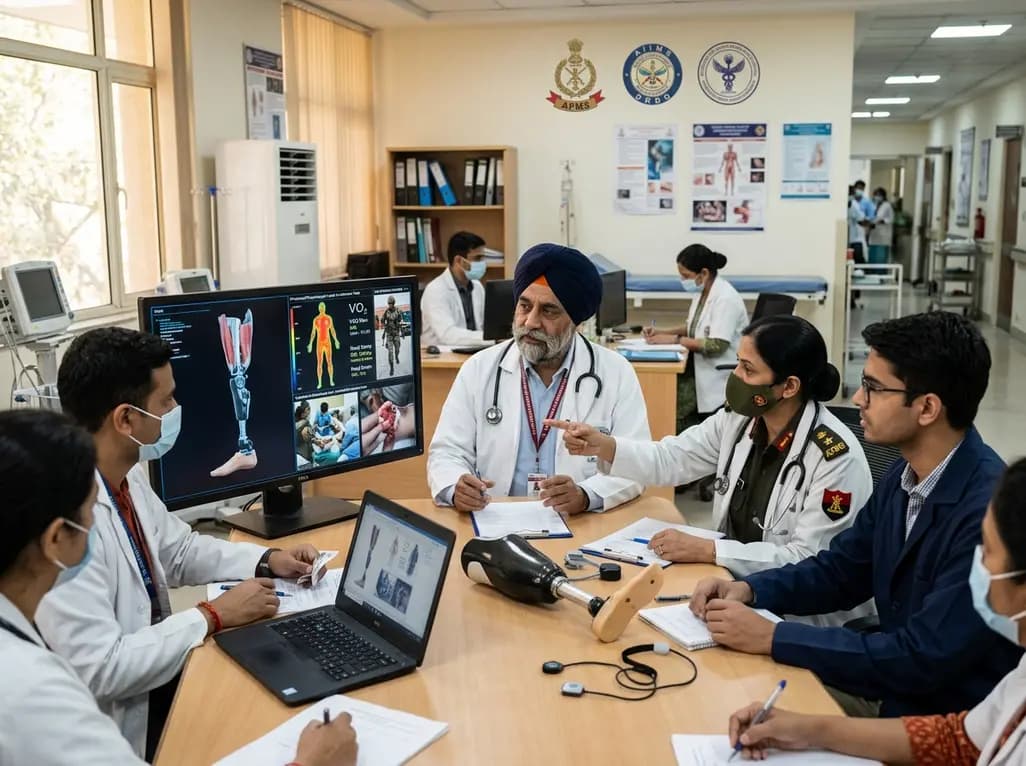
India's premier scientific bodies have joined the Armed Forces Medical Services to solve unique physiological and operational challenges faced by soldiers. The national collaboration covers combat casualty care, artificial intelligence diagnostics, bionic prosthetics, and extreme-environment physiological resilience.
Today

A retrospective cohort study evaluates the short- and long-term impacts of SARS-CoV-2 infection on patients with Graves' disease receiving antithyroid drug therapy, highlighting thyroid status destabilization, clinical symptom exacerbations, and post-viral sequelae.
Today
