.webp&w=384&q=75)

Loading, please wait...
Loading, please wait...
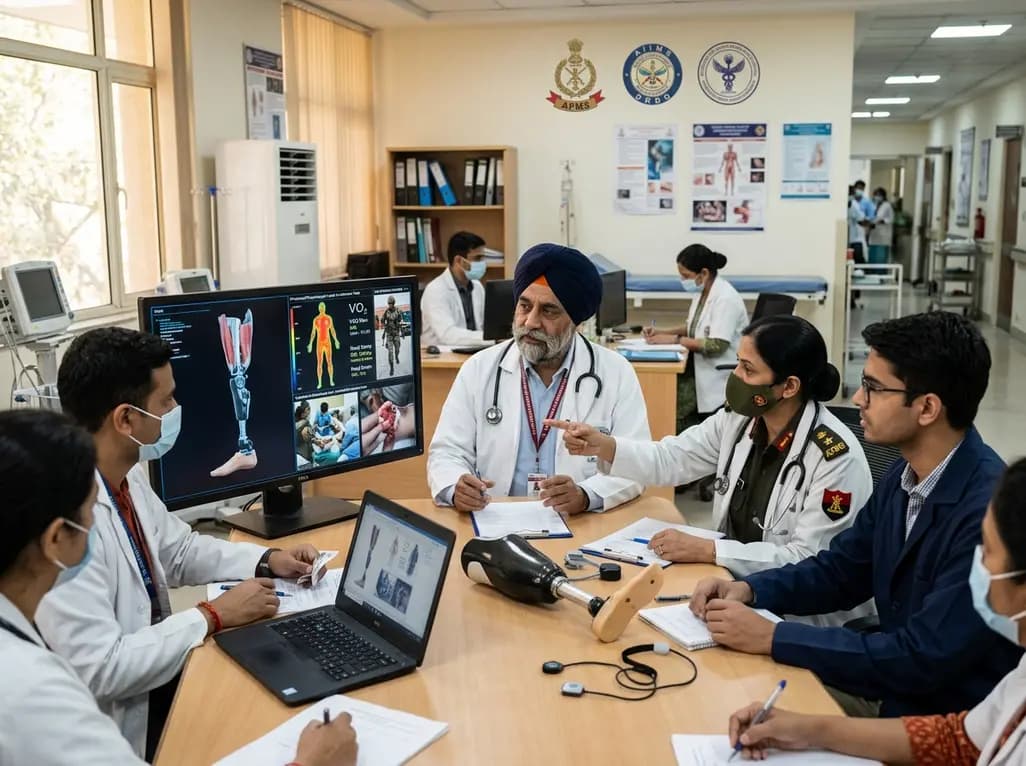
Indian armed forces operate across diverse geographical regions, ranging from icy Himalayan peaks to arid desert landscapes. Consequently, managing health challenges in these extreme operational settings demands cutting-edge solutions tailored to Indian personnel. In a major strategic advancement, premier national institutions have allied with the Armed Forces Medical Services to expand defence-oriented military medical research. These collaborations unite clinical specialists and engineering researchers to transform combat health support through indigenous technologies.
For decades, global armed forces have integrated operational planning with biomedical science to preserve personnel vitality. Therefore, Indian policymakers are now championing a similar paradigm to strengthen strategic national defence capabilities. Member of Parliament Dr. Ajeet Madhavrao Gopchade recently highlighted this critical imperative in communication with the central government. Specifically, he urged policymakers to replicate global innovation benchmarks demonstrated by international military health systems.
Accordingly, the Ministry of Defence responded by outlining comprehensive joint research frameworks currently underway across the country. Prestigious institutions like AIIMS New Delhi, the Indian Institutes of Technology, and the Indian Institute of Science are partnering with military surgeons. Furthermore, the Indian Council of Medical Research and the Defence Research and Development Organisation are lending extensive institutional support. Together, these entities are studying operational physiological stresses and indigenous health parameters.
Consequently, this interdisciplinary coalition ensures that tactical research directly addresses real-world operational challenges. Clinicians no longer rely solely on Western physiological datasets to manage extreme thermal and barometric shifts. Instead, researchers are collecting domestic biological metrics from military volunteers. Thus, this integrated approach delivers highly tailored operational doctrines for front-line deployment.
Severe trauma remains the most urgent cause of preventable mortality during tactical armed conflicts. Consequently, collaborative initiatives place combat casualty care at the absolute forefront of their biomedical agenda. Blast injuries and penetrating ballistic trauma generate catastrophic tissue disruption that requires immediate intervention during the golden hour. Therefore, researchers are engineering rapid hemostatic dressings and novel vascular shunts to arrest severe exsanguinating hemorrhage in field conditions.
Additionally, military medical teams are prioritizing early neurotrauma management for blast-induced traumatic brain injury. Modern protective headgear reduces penetrating fragmentation, yet blast shockwaves still transmit immense kinetic energy through cranial bones. As a result, neurological resilience protocols are evolving to detect microscopic axonal disruption before irreversible encephalopathy emerges. Field units are evaluating lightweight diagnostic modalities to screen symptomatic soldiers right on the battlefield.
Furthermore, remote battlefield environments demand portable critical care systems that function reliably under austere logistical constraints. Clinicians are developing miniaturized ventilators and automated fluid resuscitation devices designed specifically for prolonged field care scenarios. Consequently, these robust devices empower combat medics to stabilize severely injured personnel during protracted evacuation delays. This tactical resilience ultimately preserves countless lives during forward combat missions.
Improvised explosive devices and landmines frequently inflict devastating musculoskeletal damage on front-line soldiers. Therefore, rehabilitative surgery and advanced extremity restoration constitute another essential pillar of this multi-institutional partnership. Orthopedic surgeons from military hospitals are collaborating directly with biomechanical engineers at leading technology institutes. Together, they design next-generation bionic prostheses and motorized orthotic systems tailored to active amputees.
Notably, traditional mechanical prostheses often impose significant metabolic penalties on injured soldiers during basic daily locomotion. However, modern myoelectric limbs interpret residual neuromuscular signals through microprocessors to generate intuitive joint articulation. Furthermore, advanced osseointegration techniques now permit direct skeletal attachment of prosthetic devices, eliminating chronic soft-tissue skin irritation. Biomedical engineers are also employing novel lightweight carbon composites to reduce device mass and fatigue.
Consequently, these technological upgrades enable injured soldiers to regain exceptional functional independence and mobility. In addition, surgeons are exploring dynamic muscle reinnervation procedures to diminish post-amputation phantom limb pain. These holistic surgical innovations combine reconstructive surgery with cutting-edge robotic engineering. Ultimately, such interdisciplinary breakthroughs restore soldier morale while re-establishing physical capability following devastating combat extremity trauma.
Geographical isolation poses a profound logistical hurdle during combat medical evacuations across high-altitude borders. Hence, researchers are leveraging digital health architectures and secure battlefield telemedicine to bridge tactical healthcare disparities. Specialized communication satellites now transmit real-time physiological telemetry from frontline field ambulances to tertiary military command hospitals. Consequently, senior trauma surgeons can guide young medical officers through intricate emergency procedures from thousands of miles away.
Moreover, artificial intelligence is revolutionizing triage decision-making during catastrophic mass-casualty incidents. Machine learning algorithms analyze continuous vital sign streams to detect early signs of hemorrhagic shock. Because automated diagnostic algorithms assess systemic hypoperfusion before clinical blood pressure drops, medics can initiate targeted resuscitation promptly. Therefore, these digital assistants prevent fatal decompensation during chaotic field triage encounters.
Additionally, academic institutions are deploying rugged wearable sensors to monitor troop hydration, core temperature, and physical fatigue. These compact dermal biosensors continuously relay biometric data through secure battlefield networks. As a result, field commanders receive instant warnings before severe heat exhaustion or hypothermia incapacitates squad members. Incorporating artificial intelligence into preventative military health substantially bolsters overall tactical readiness.
Indian border regions expose troops to some of the world's most forbidding climatic extremes. For instance, personnel stationed along the Siachen Glacier confront lethal hypothermia, acute hypoxia, and frostbite. Conversely, personnel patrolling Thar Desert outposts face extreme hyperthermia, heat stroke, and dehydration. Therefore, scientists are investigating novel pharmacological countermeasures to mitigate severe high-altitude pulmonary edema and systemic environmental stress.
Furthermore, armed forces operating in dense tropical border jungles encounter virulent vector-borne pathogens and emerging infections. To counter these endemic biological hazards, researchers are deploying portable next-generation sequencing platforms directly into tactical field hospitals. Consequently, medical epidemiologists can identify novel bacterial strains and viral outbreaks within hours of clinical onset. Rapid genomic characterization prevents widespread troop morbidity during crucial operational deployments.
Additionally, military researchers are studying indigenous genetic variations that regulate human physiological adaptation to chronic hypobaric hypoxia. These genetic insights allow medical boards to identify soldiers possessing superior biological tolerance for high-altitude posts. Meanwhile, targeted nutritional supplements are enhancing physical stamina and cellular resilience under oxygen-deprived conditions. Thus, holistic environmental health research safeguards military personnel against formidable environmental and infectious dangers.
Q1: Why are premier civilian institutes collaborating with military medical services?
Civilian institutions like AIIMS, IITs, and ICMR possess state-of-the-art engineering laboratories and biomedical research facilities. However, military healthcare settings present unique operational demands, such as blast trauma, extreme altitudes, and rugged logistics. Therefore, uniting civilian engineering expertise with military medical experience accelerates the development of specialized solutions. This synergistic partnership produces advanced diagnostic devices, trauma care technologies, and bionic prosthetics tailored specifically to the physiological challenges of Indian soldiers.
Q2: How does artificial intelligence improve combat casualty care on the battlefield?
Artificial intelligence processes complex clinical parameters from wearable biometric sensors to detect physiological deterioration before vital signs collapse. In chaotic combat scenarios, automated algorithms assist medics with rapid triage decisions and identify soldiers at risk of occult hemorrhagic shock. Furthermore, AI-driven battlefield telemedicine systems enable tertiary specialists to guide remote frontline medical officers through complex resuscitation steps, thereby significantly decreasing preventable combat mortality during delayed evacuation windows.
Q3: How do indigenous climatic factors influence military medical research priorities?
Indian troops deploy across drastic environmental extremes, ranging from sub-zero Himalayan altitudes to scorching desert environments. Consequently, generic Western medical guidelines do not adequately address the physiological adaptations and genetic backgrounds of Indian soldiers. Military researchers therefore study domestic biological metrics to formulate tailored clinical protocols for altitude sickness, frostbite, and heat stroke. Furthermore, genomic surveillance detects regional tropical pathogens, ensuring front-line personnel receive optimized prophylactic and therapeutic interventions.
Disclaimer: This content is for informational and educational purposes only. It does not constitute medical advice or replace professional judgment. Refer to the latest local and national guidelines for clinical practice.
References

Read summarized clinical updates, watch expert medical content, and earn CME certifications right from your smartphone.
Open your smartphone camera to scan and install.





India's premier scientific bodies have joined the Armed Forces Medical Services to solve unique physiological and operational challenges faced by soldiers. The national collaboration covers combat casualty care, artificial intelligence diagnostics, bionic prosthetics, and extreme-environment physiological resilience.
Today

Non-invasive imaging techniques have revolutionized liver fibrosis assessment. This clinical review evaluates vibration-controlled transient elastography, ultrasound shear wave elastography, and MR elastography to optimize clinical decision-making and longitudinal care pathways for chronic liver disease.
Today
A comprehensive meta-analysis of over 278,000 women demonstrates that maternal atopic dermatitis significantly increases risks of premature rupture of membranes and low birth weight. Discover essential clinical insights on disease mechanisms, serial antenatal growth monitoring, and safe therapeutic interventions.
Today
Over 60 international public health researchers have advised FSSAI to mandate front-of-pack warning labels for any packaged product high in even one critical nutrient: sugar, saturated fat, or sodium. This reform counters phased rollouts to accelerate consumer protection and address India's chronic disease burden.
Today
A cross-sectional study reveals that elevated METS-IR is independently associated with higher myopia odds in adolescents, showing biological synergy with obesity and highlighting the need for metabolic screening in pediatric eye care.
Yesterday
