.webp&w=384&q=75)

Loading, please wait...
Loading, please wait...

Initiating mechanical circulatory support during profound cardiopulmonary collapse demands rapid decision-making and meticulous technical execution. Recent evidence provides critical insights into the real-world deployment of emergency ECMO cannulation across diverse acute care settings. Clinicians often face the pressing dilemma of whether to initiate venoarterial extracorporeal membrane oxygenation immediately within the emergency resuscitation room or transfer the patient to the intensive care unit. A newly published observational cohort study evaluates these clinical pathways. Consequently, understanding how procedural setting influences patient survival helps acute care teams optimize their rapid resuscitation protocols and resource allocation.
Critically ill patients requiring venoarterial extracorporeal support often present with extreme hemodynamic instability. Consequently, clinicians must balance the speed of bedside initiation against the perceived safety of controlled intensive care settings. In a comprehensive single-center investigation, researchers analyzed 105 patients undergoing venoarterial support across distinct hospital environments. Specifically, the team compared outcomes between patients cannulated in the emergency resuscitation room and those cannulated in the intensive care unit.
To account for inherent confounding, investigators applied inverse probability of treatment weighting. Initially, patients in the resuscitation room presented with significantly worse baseline physiological parameters. For instance, these individuals exhibited higher Acute Physiology and Chronic Health Evaluation II scores, deeper metabolic acidosis, and higher rates of ongoing extracorporeal cardiopulmonary resuscitation. Unadjusted data initially indicated higher three-day mortality in the resuscitation room cohort. However, rigorous statistical weighting attenuated this difference completely. Therefore, the physical location of cannulation does not inherently dictate patient survival.
Multivariable analyses revealed that underlying physiological compromise determines early survival far more than procedural geography. In particular, profound pre-cannulation acidemia and the necessity for mechanical ventilation independently predicted short-term mortality. Severe metabolic acidosis reflects prolonged hypoperfusion and widespread tissue hypoxia prior to mechanical circulatory initiation. Thus, patients presenting in extremis carry a heavy biological burden regardless of where cannulation occurs.
Furthermore, procedural timing metrics, including time from collapse to pump flow, showed no significant independent correlation with early death after adjusting for baseline illness severity. While rapid deployment remains essential during active cardiac arrest, biological reserve ultimately dictates the patient recovery trajectory. Clinicians should recognize that severe metabolic derangements reflect delayed presentation or refractory shock rather than institutional delay. Consequently, risk stratification models must prioritize objective pre-cannulation biomarkers such as arterial lactate and blood pH over the physical cannulation setting.
Many practitioners express concern that emergency resuscitation rooms lack the sterile infrastructure and specialized staffing found in modern intensive care units. Nevertheless, empirical data show that complication rates remain remarkably similar across both environments. Specifically, incidence rates of major vascular injury, post-procedural bleeding, acute thrombosis, and catheter-related infections did not differ between settings.
These safety outcomes highlight that strict procedural fidelity mitigates environmental risks. When skilled clinicians utilize ultrasound guidance and standardized equipment kits, cannulation proceeds safely even in chaotic resuscitation bays. Moreover, early circuit management, anticoagulation titration, and perfusion monitoring achieve comparable efficacy across locations. Therefore, acute care teams need not delay life-saving cannulation simply to move unstable patients to an intensive care unit. Transporting an unstable patient without circulatory support frequently introduces substantial risks that far outweigh the theoretical benefits of an intensive care environment.
Establishing a successful emergency cannulation service requires structured multidisciplinary collaboration and rigorous institutional protocols. Emergency physicians, intensivists, cardiologists, and perfusion specialists must align their operational workflows to ensure seamless bedside execution. Standardized cannulation bundles, pre-assembled equipment carts, and designated roles streamline cannulation during high-stress scenarios.
Additionally, continuous simulation training reinforces technical competence and crisis resource management. Teams that rehearse vascular access, circuit priming, and rapid troubleshooting minimize cannulation time while maintaining strict aseptic technique. Standardized post-cannulation protocols also ensure prompt neurological assessment, targeted temperature management, and appropriate distal limb perfusion monitoring. Consequently, standardizing clinical processes eliminates operational variance between hospital departments. By maintaining uniform technical standards, healthcare systems can reliably deploy life support across both emergency bays and intensive care units without compromising quality or safety.
These findings offer practical guidance for acute care institutions designing or refining extracorporeal resuscitation programs. Clinicians should prioritize rapid patient selection and immediate physiological stabilization over logistical transfers. When a patient deteriorates into refractory shock or cardiac arrest in the emergency resuscitation room, clinicians should initiate cannulation immediately on-site if trained personnel are present.
Delaying cannulation to facilitate transport to the intensive care unit may worsen tissue hypoxemia and accelerate organ failure. Furthermore, post-resuscitation care must focus aggressively on correcting severe metabolic acidosis and mitigating reperfusion injury. Intensivists and emergency physicians must collaborate closely to maintain hemodynamic stability and optimize ventilator settings after establishing extracorporeal flow. Ultimately, building robust, adaptable multidisciplinary teams ensures that critically ill patients receive timely, safe, and effective mechanical circulatory support across every acute care environment.
No, current clinical evidence indicates that emergency ECMO cannulation performed in the emergency resuscitation room does not increase complication rates compared to intensive care unit placement. Specifically, studies demonstrate comparable rates of major bleeding, arterial thrombosis, vascular injury, and systemic infections between both settings. Adhering to standardized cannulation protocols, bedside ultrasound guidance, and experienced multidisciplinary workflows ensures high procedural safety regardless of the physical hospital location.
Pre-cannulation physiological severity most strongly determines early mortality following venoarterial extracorporeal support. Specifically, severe arterial acidemia, marked hyperlactatemia, elevated APACHE II scores, and the pre-procedural requirement for invasive mechanical ventilation independently predict early death. These objective parameters reflect prolonged hypoperfusion, end-organ ischemia, and severe metabolic exhaustion before circulatory support initiation, representing the primary drivers of short-term patient survival rather than procedural environment or timing.
Crude early mortality appears higher in emergency resuscitation room cohorts because these patients typically present with much greater physiological instability. Resuscitation room cohorts contain a significantly higher proportion of active extracorporeal cardiopulmonary resuscitation cases, profound metabolic acidosis, and refractory circulatory collapse. When statistical models adjust for these severe baseline imbalances using propensity weighting, the mortality difference between the resuscitation room and the intensive care unit disappears.
Disclaimer: This content is for informational and educational purposes only and does not constitute medical advice. Consult qualified healthcare professionals for diagnosis, treatment, and clinical decision-making. Refer to the latest local and national guidelines for clinical practice.
References

Read summarized clinical updates, watch expert medical content, and earn CME certifications right from your smartphone.
Open your smartphone camera to scan and install.





A retrospective study compares venoarterial ECMO cannulation in the emergency resuscitation room versus the ICU, showing baseline physiological collapse drives mortality rather than the procedural environment.
last month

A recent clinical report identifies a novel GDF2 frameshift mutation in a patient with hereditary hemorrhagic telangiectasia presenting with acute cerebral infarction secondary to microscopic pulmonary arteriovenous malformations, emphasizing the necessity of comprehensive screening and genetic evaluation.
Today

India experiences an exponential rise in robotic-assisted procedures, with Delhi NCR leading system installations and clinical volume. Discover how multidisciplinary surgical adoption, remote telesurgery breakthroughs, and standardized international consensus guidelines are shaping surgical care nationwide.
Today
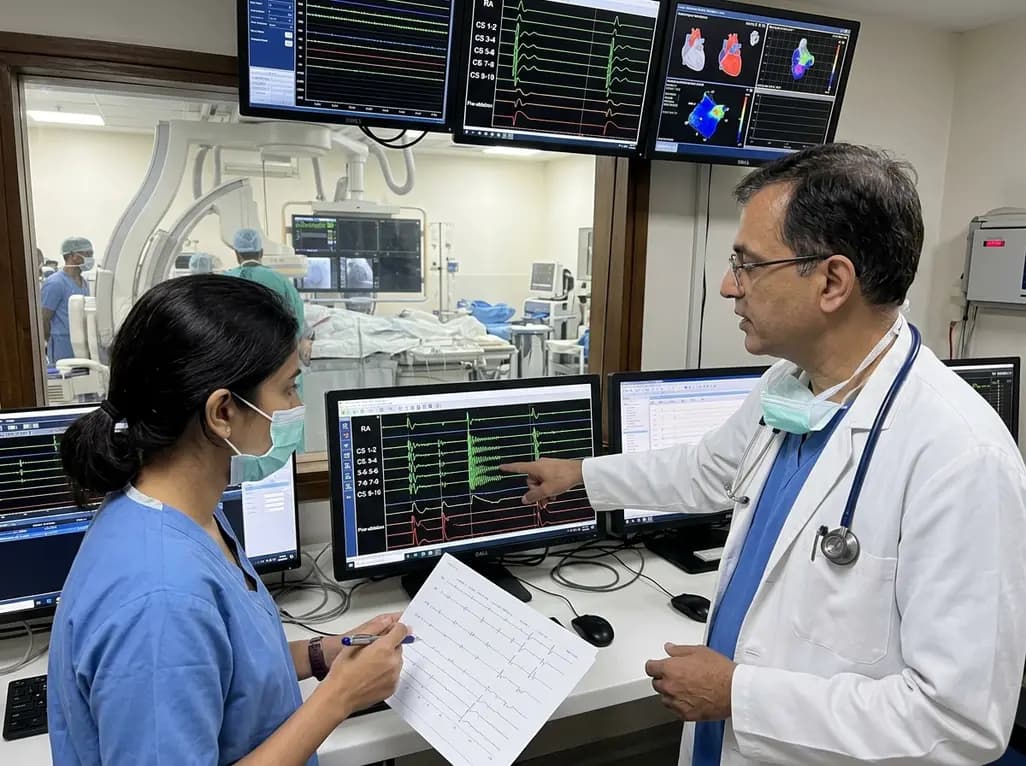
Radiofrequency catheter ablation of the cavotricuspid isthmus successfully terminates typical atrial flutter. This article reviews the mechanisms driving coronary sinus electrogram changes, wavefront activation pathways, and clinical criteria to verify bidirectional block during electrophysiology studies.
Today

A media-based study of 278 European professional football players finds no clear association between time to return-to-play after ACL reconstruction and the hazard of a first additional injury or matches missed, reinforcing the need for criteria-based clearance over calendar timelines.
Today

A breakthrough study leverages natural language processing to accurately identify incident medication-related osteonecrosis of the jaw and track antiresorptive drug holidays from clinical narratives in electronic health records, advancing osteoporosis pharmacovigilance and dental safety.
Today
