.webp&w=384&q=75)

Loading, please wait...
Loading, please wait...
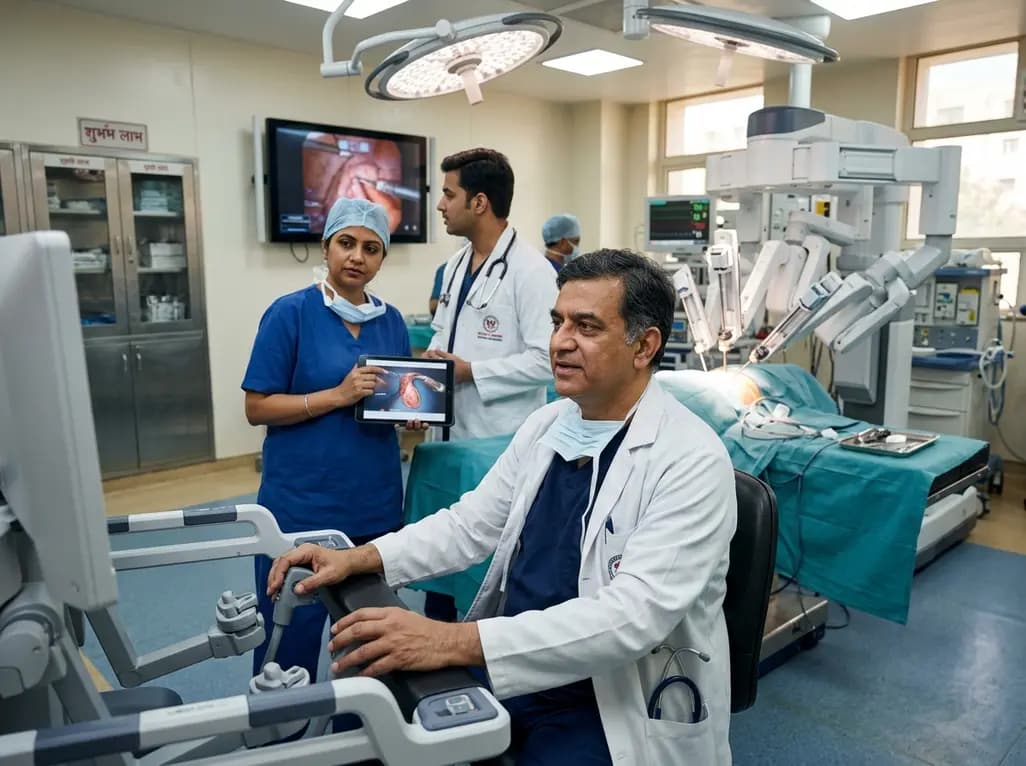
Robotic surgery in India is experiencing unprecedented momentum as modern healthcare systems rapidly transition from initial exploration toward widespread clinical integration. Surgical teams across the country increasingly leverage computerized mechanical arms, high-definition three-dimensional visualization, and wristed instrumentation to execute complex interventions. Notably, recent data revealed at the Society of Robotic Surgery India 2026 conference clearly underscores this technological evolution. Healthcare administrators, academic surgeons, and policymakers now view surgical robotics not merely as a novelty, but as a foundational pillar of modern healthcare delivery. Consequently, medical centers are scaling their infrastructure to deliver superior clinical outcomes, minimal tissue trauma, and expedited recovery across diverse patient cohorts.
Over the past five years, robotic surgery in India has expanded at an astonishing trajectory. Across the nation, robotic-assisted surgical volumes escalated from 8,912 documented procedures in 2021 to an impressive 44,857 operations in 2025. This remarkable fivefold increase reflects widespread institutional buy-in and growing patient demand for minimally invasive alternatives. Furthermore, healthcare networks in major urban centers have recognized the long-term clinical and economic benefits of high-throughput robotic theaters. Government leaders and healthcare ministers emphasize that India now stands at an extraordinary crossroads of medical innovation and artificial intelligence. Rather than serving merely as technology consumers, domestic surgical institutions actively generate clinical evidence and evaluate novel robotic platforms. Moreover, competitive market entry by diverse equipment manufacturers has begun to diversify device availability and reduce capital expenditure barriers. Consequently, tertiary hospitals find it increasingly viable to procure surgical consoles and multi-arm units for routine operative use. Additionally, standardized residency fellowships and structured simulation modules allow emerging surgeons to achieve technical competency rapidly without compromising patient safety. As a result, surgical robotics is expanding beyond elite centers, establishing a robust clinical footprint throughout the Indian subcontinent.
Delhi National Capital Region has definitively emerged as the undisputed leader in India's surgical robotics ecosystem. Recent conference data reveals that 39 hospitals in Delhi NCR now house functional robotic consoles. Furthermore, 11 facilities across the capital territory operate multiple robotic systems simultaneously. Annual procedure numbers in the capital region surged from 2,257 in 2021 to 10,937 in 2025. This steep upward curve represents an almost five-fold regional growth over just four calendar years. Notably, integrated delivery networks account for sixty-nine percent of the installed robotic platforms in the capital territory. Meanwhile, private standalone hospitals represent twenty-three percent, while public tertiary institutions hold the remaining eight percent. In addition, multidisciplinary collaboration among leading academic clinicians has transformed the capital into an international training hub. Consequently, complex referral cases from northern India and neighboring states consistently arrive at Delhi NCR institutions for precision robotic care. Hospital administrations continue to invest heavily in multi-specialty consoles to maximize theater efficiency and reduce surgical wait times. Therefore, the region provides a repeatable operational blueprint for other Indian metropolitan centers seeking to scale high-density robotic infrastructure successfully while upholding uncompromising clinical standards.
The adoption of robotic assistance spans multiple surgical disciplines, reflecting versatile clinical utility across varied anatomical spaces. Specifically, data from 2025 indicates that benign general surgical procedures accounted for thirty-three percent of regional robotic operations. These cases prominently include complex ventral hernia repairs, advanced bariatric surgeries, and intricate gastrointestinal reconstructions. In addition, urology followed closely, generating thirty point two percent of the total procedural volume. Urological surgeons utilize robotic consoles extensively for radical prostatectomies, partial nephrectomies, and reconstructive pyeloplasties, where microvascular precision preserves vital functional outcomes. Furthermore, gynecological surgeries comprised twenty-two point one percent of cases, enabling precise management of deep infiltrating endometriosis and complex myomectomies. Malignant general surgical oncology procedures contributed ten percent, providing superior nodal clearance and excellent oncological margins. Additionally, surgical teams increasingly perform robotic procedures in thoracic, head and neck, and cardiac surgery. Robotic platforms offer magnified three-dimensional visualization and tremor elimination, allowing surgeons to operate safely within confined anatomical spaces. Consequently, patients experience substantially reduced intraoperative blood loss, lower infection rates, and accelerated discharge timelines compared to traditional open surgical approaches.
The rapid evolution of surgical robotics in India is actively breaking physical distance constraints through telesurgery. Specialist surgeons have recently demonstrated that remote operative interventions can bridge vast geographic divides safely and effectively. For instance, urology specialists in Gurugram successfully performed remote robotic surgery on a patient 1,600 kilometers away in Hyderabad. Furthermore, surgical teams from Vaishali performed cross-border demonstrations by remotely maneuvering consoles nearly 5,000 kilometers away in Chengdu, China. These pioneering milestones showcase the practical viability of ultra-low-latency networks, surgical-grade data pipelines, and advanced robotics. Historically, specialized surgical expertise has remained concentrated within tier-1 metropolitan cities, forcing rural patients to undertake arduous journeys for advanced treatment. However, telesurgery offers a transformative pathway to deliver expert surgical care directly to community hospitals in tier-2 and tier-3 regions. Moreover, experienced mentors can provide live, intraoperative tele-mentoring to junior colleagues stationed at peripheral hospitals without leaving their home institutions. Therefore, long-distance robotic surgery holds extraordinary promise for democratizing specialized surgical care across underserved populations throughout the nation, mitigating historic healthcare inequities.
While clinical advancements in surgical robotics remain inspiring, widespread adoption requires stringent safety protocols and regulatory oversight. International consensus recommendations published in the World Journal of Surgery in 2026 outline critical standards for remote robotic-assisted procedures. Specifically, these international guidelines emphasize the absolute necessity of robust network cybersecurity, fail-safe communication links, and emergency intraoperative conversion protocols. Furthermore, hospitals must implement structured credentialing and standardized simulation-based training before granting independent console privileges to operating surgeons. Dedicated bedside surgical teams must maintain continuous preparedness to take over open or laparoscopic procedures should technical communication falter. Additionally, Indian healthcare authorities are developing localized frameworks to govern data privacy, device maintenance, and liability allocation in telesurgical settings. However, overcoming high capital costs and consumable instrument pricing remains essential for expanding equitable access across public health networks. Consequently, the collaborative efforts of academic societies, innovators, and government ministries position India as a global surgical robotics hub. Ultimately, Indian surgeons will continue to refine clinical techniques, author authoritative guidelines, and train the next generation of international robotic practitioners with dedication.
Q1: What factors explain the rapid expansion of robotic surgery in India?
Several critical factors drive the expansion of advanced surgical robotics across Indian healthcare institutions. Primarily, healthcare systems recognize that robotic platforms offer superior optical magnification, enhanced ergonomic precision, and reduced patient blood loss. Furthermore, expanding clinical training programs and growing private infrastructure investments allow high-volume centers to adopt robotic systems rapidly. Consequently, surgeons can perform intricate oncological and reconstructive procedures with significantly reduced complication rates and accelerated patient recovery times.
Q2: Which surgical specialities currently perform the most robotic procedures?
General surgery for benign conditions currently leads procedural volumes in key regions, representing approximately one-third of total robotic cases. Furthermore, urology constitutes nearly thirty percent of these interventions, particularly benefiting complex prostate and renal surgeries. Gynecological procedures also represent more than twenty percent of robotic operations, followed by general surgical oncology, thoracic surgery, and head and neck operations. Consequently, diverse surgical teams are integrating robotic arms into their daily clinical routines.
Q3: What regulatory and technical safeguards govern long-distance telesurgery?
Long-distance telesurgery requires strict technical, logistical, and ethical protocols to protect patient safety during operative procedures. According to international consensus guidelines, institutions must establish ultra-low-latency network connectivity, robust cybersecurity encryption, and redundant power systems. Additionally, hospitals must ensure on-site surgical teams possess comprehensive credentialing to intervene immediately if technical communication fails. Therefore, formal governance frameworks protect patient welfare while allowing remote specialists to deliver expert care across geographical boundaries.
Disclaimer: This content is for informational and educational purposes only. It does not constitute medical advice or replace professional judgment. Refer to the latest local and national guidelines for clinical practice.
References

Read summarized clinical updates, watch expert medical content, and earn CME certifications right from your smartphone.
Open your smartphone camera to scan and install.





India experiences an exponential rise in robotic-assisted procedures, with Delhi NCR leading system installations and clinical volume. Discover how multidisciplinary surgical adoption, remote telesurgery breakthroughs, and standardized international consensus guidelines are shaping surgical care nationwide.
Today
A recent clinical report identifies a novel GDF2 frameshift mutation in a patient with hereditary hemorrhagic telangiectasia presenting with acute cerebral infarction secondary to microscopic pulmonary arteriovenous malformations, emphasizing the necessity of comprehensive screening and genetic evaluation.
Today

Radiofrequency catheter ablation of the cavotricuspid isthmus successfully terminates typical atrial flutter. This article reviews the mechanisms driving coronary sinus electrogram changes, wavefront activation pathways, and clinical criteria to verify bidirectional block during electrophysiology studies.
Today
A media-based study of 278 European professional football players finds no clear association between time to return-to-play after ACL reconstruction and the hazard of a first additional injury or matches missed, reinforcing the need for criteria-based clearance over calendar timelines.
Today
A breakthrough study leverages natural language processing to accurately identify incident medication-related osteonecrosis of the jaw and track antiresorptive drug holidays from clinical narratives in electronic health records, advancing osteoporosis pharmacovigilance and dental safety.
Today
