.webp&w=384&q=75)

Loading, please wait...
Loading, please wait...

Antiresorptive therapies, including oral bisphosphonates, intravenous zoledronic acid, and subcutaneous denosumab, provide substantial protection against debilitating osteoporotic fractures. However, rare adverse reactions can compromise patient care. Among these complications, medication-related osteonecrosis of the jaw presents substantial clinical dilemmas for physicians and dental surgeons alike. Managing therapy requires balancing skeletal protection against the risk of unhealed exposed bone in the maxillofacial region.
Medication-related osteonecrosis of the jaw remains a severe and distressing adverse event associated with prolonged antiresorptive exposure. Clinicians typically diagnose the condition when exposed necrotic jawbone persists for more than eight weeks without prior radiation exposure. While incidence rates among patients treated for osteoporosis remain notably low, clinical concerns frequently lead to premature medication cessation. Consequently, physicians often struggle to balance skeletal fracture prevention against potential oral complications. In rheumatology and geriatric practice, comorbid autoimmune diseases and concomitant glucocorticoid therapy amplify these risks significantly. Furthermore, local factors such as invasive dentoalveolar extractions, poorly fitting dentures, and active periodontal disease strongly elevate individual vulnerability. When exposed alveolar bone fails to heal, patients experience persistent pain, recurrent soft tissue infections, and significant functional morbidity. Therefore, clinicians must carefully stratify individual risks prior to initiating therapy. Collaborative care pathways between dental specialists and medical doctors remain critical for ensuring comprehensive patient assessment.
To reduce osteonecrosis risks before dental extractions, clinicians frequently consider an antiresorptive drug holiday. However, the evidence supporting these temporary medication interruptions remains contentious and inconsistent across clinical guidelines. Bisphosphonates incorporate deeply into skeletal hydroxyapatite, maintaining biological activity for years despite oral cessation. Therefore, withholding a bisphosphonate for several weeks prior to a minor dental procedure rarely changes bone biology. Conversely, denosumab exerts a completely reversible biological mechanism. Discontinuing denosumab causes a rapid rebound in bone turnover within several months of discontinuation. As a result, sudden interruptions in denosumab therapy dramatically elevate the risk of multiple vertebral fractures. In addition, administrative billing codes consistently fail to document informal drug pauses. Patients frequently stop medications based on verbal advice from oral surgeons without official prescription discontinuation. Because structured pharmacy records do not capture these informal pauses, researchers have struggled to evaluate whether drug holidays truly mitigate osteonecrosis risks.
Electronic health records contain vast amounts of valuable information buried in unstructured narrative text. Clinical notes from primary care visits, dental consultations, rheumatology reviews, and hospital discharge summaries capture vital clinical details. Unfortunately, conventional epidemiological investigations rely heavily on diagnostic International Classification of Diseases codes. These administrative billing codes exhibit notoriously poor sensitivity and specificity for rare conditions like jaw osteonecrosis. To address this methodological obstacle, investigators developed a sophisticated natural language processing framework. Using data from the United States Veterans Health Administration, researchers evaluated adults aged fifty and older prescribed bisphosphonates or denosumab. The team engineered an extensive natural language processing codebook containing eleven primary clinical targets and sixteen descriptive attributes. Moreover, domain experts curated a dedicated clinical vocabulary comprising over one thousand three hundred terms. This systematic computational approach enabled automated algorithms to scrutinize unstructured narratives and identify subtle clinical descriptions of jaw bone exposure.
The machine learning algorithm demonstrated remarkable accuracy across independent validation datasets. Researchers trained a decision-tree model utilizing features extracted by the natural language processing system to accurately classify true cases. Across rigorous testing, the model achieved a precision of 1.00 and a recall of 0.96 for classifying osteonecrosis events. Furthermore, the overall F-measure reached 0.95, confirming that the tool rarely misidentifies unrelated oral conditions. In parallel, the natural language processing model directly extracted explicit mentions of drug holidays from clinical progress notes. In the held-out validation cohort, the algorithm identified antiresorptive interruptions with a precision of 0.90 and a recall of 0.98. These metrics yielded an impressive F-measure of 0.94 for holiday detection. Consequently, this computational model successfully overcomes the longstanding limitation of administrative claims data. By accurately extracting both clinical outcomes and therapeutic decisions, the algorithm creates unprecedented opportunities for robust observational research.
Patients managing systemic rheumatic conditions face unique vulnerabilities regarding skeletal fragility and oral health complications. Inflammatory arthritis, systemic lupus erythematosus, and chronic glucocorticoid administration accelerate bone loss while simultaneously impairing mucosal tissue repair. Because systemic inflammation alters bone turnover, these patients exhibit a higher baseline vulnerability to oral complications. Furthermore, systemic immunosuppression dampens localized defense mechanisms against oral microbial pathogens. When dental extractions become inevitable, clinicians often hesitate, debating whether pausing antiresorptives improves healing or risks catastrophic fractures. The validated algorithm allows scientists to perform large-scale retrospective studies specifically within these high-risk cohorts. By extracting granular narrative notes, researchers can accurately differentiate true drug holidays from unintended medication non-adherence. Therefore, future studies can definitively quantify whether withholding therapy alters jaw healing in vulnerable rheumatology populations. Ultimately, these clinical insights will refine evidence-based treatment algorithms for complex multimorbid patients.
The successful deployment of automated language models signifies a pivotal transformation for long-term pharmacovigilance. Historically, monitoring rare adverse events required labor-intensive manual chart review that limited sample sizes. Now, natural language processing provides an efficient, scalable solution to monitor drug safety across national healthcare systems. In clinical practice, these tools could soon operate within electronic platforms to provide real-time decision support. For instance, automated surveillance could alert clinicians when a vulnerable patient reports oral pain following invasive extractions. Additionally, health systems can systematically monitor whether patients resume denosumab following dental treatments, preventing catastrophic rebound fractures. Enhanced cross-specialty communication between dental professionals, rheumatologists, and endocrinologists remains essential. By replacing anecdotal clinical assumptions with large-scale computational evidence, healthcare systems can optimize bone protection while actively safeguarding oral integrity.
Medication-related osteonecrosis of the jaw represents an uncommon adverse condition characterized by exposed necrotic jawbone persisting for over eight weeks. Clinicians diagnose the disorder in patients receiving antiresorptive or antiangiogenic therapies without prior craniofacial radiation therapy. While incidence remains low during standard osteoporosis treatment, invasive dental extractions, chronic periodontal infection, and concomitant systemic corticosteroid therapy significantly elevate individual susceptibility.
The clinical benefit of antiresorptive drug holidays remains unproven and controversial. Bisphosphonates persist in bone matrix for years, meaning short pauses before dental extractions do not rapidly reduce tissue exposure. Conversely, pausing denosumab causes rapid bone loss and increases rebound vertebral fracture risks. Prescribing physicians and dental surgeons must carefully coordinate decisions rather than interrupting therapy arbitrarily.
Standard administrative billing codes perform poorly when identifying rare conditions like jaw osteonecrosis, frequently missing true clinical diagnoses. Furthermore, structured pharmacy databases cannot document informal treatment interruptions recommended verbally by dental providers. Natural language processing parses unstructured clinical progress notes, enabling researchers to accurately identify documented bone exposures and extract nuanced therapeutic decisions across massive patient records.
Disclaimer: This content is for informational and educational purposes only... Refer to the latest local and national guidelines for clinical practice.
References
Budde E et al. Identifying incident medication-related osteonecrosis of the jaw and antiresorptive drug holidays using natural language processing on clinical notes in men and women prescribed bisphosphonates or denosumab for fracture prevention. Arthritis Care Res (Hoboken). 2026 Oct 03. doi: 10.1002/acr.80173. PMID: 42827373.
Ruggiero SL, Dodson TB, Aghaloo T, et al. American Association of Oral and Maxillofacial Surgeons' Position Paper on Medication-Related Osteonecrosis of the Jaws-2022 Update. J Oral Maxillofac Surg. 2022;80(5):920-943.
Khosla S, Bilezikian JP, Dempster DW, et al. Benefits and risks of bisphosphonate therapy for osteoporosis. J Clin Endocrinol Metab. 2012;97(7):2272-2282.

Read summarized clinical updates, watch expert medical content, and earn CME certifications right from your smartphone.
Open your smartphone camera to scan and install.





A breakthrough study leverages natural language processing to accurately identify incident medication-related osteonecrosis of the jaw and track antiresorptive drug holidays from clinical narratives in electronic health records, advancing osteoporosis pharmacovigilance and dental safety.
Today
Explore the therapeutic promise of TLR7 and TLR8 inhibitors in managing systemic lupus erythematosus and monogenic autoimmune diseases. Learn how targeting endolysosomal single-stranded RNA sensing and regulatory checkpoints like UNC93B1 and PLD4 offers precision treatment without broad immunosuppression.
Today

A pharmacometric and machine learning study reveals that specific vaginal bacteria alter cervical antiretroviral exposure, highlighting the need for precision HIV PrEP strategies.
Today

Abdominal aortic aneurysm rupture remains a catastrophic vascular emergency. Groundbreaking research reveals that USP53 accelerates aneurysm progression by reprogramming smooth muscle cell metabolism toward aerobic glycolysis, highlighting a promising target beyond conventional diameter-based surveillance.
Today
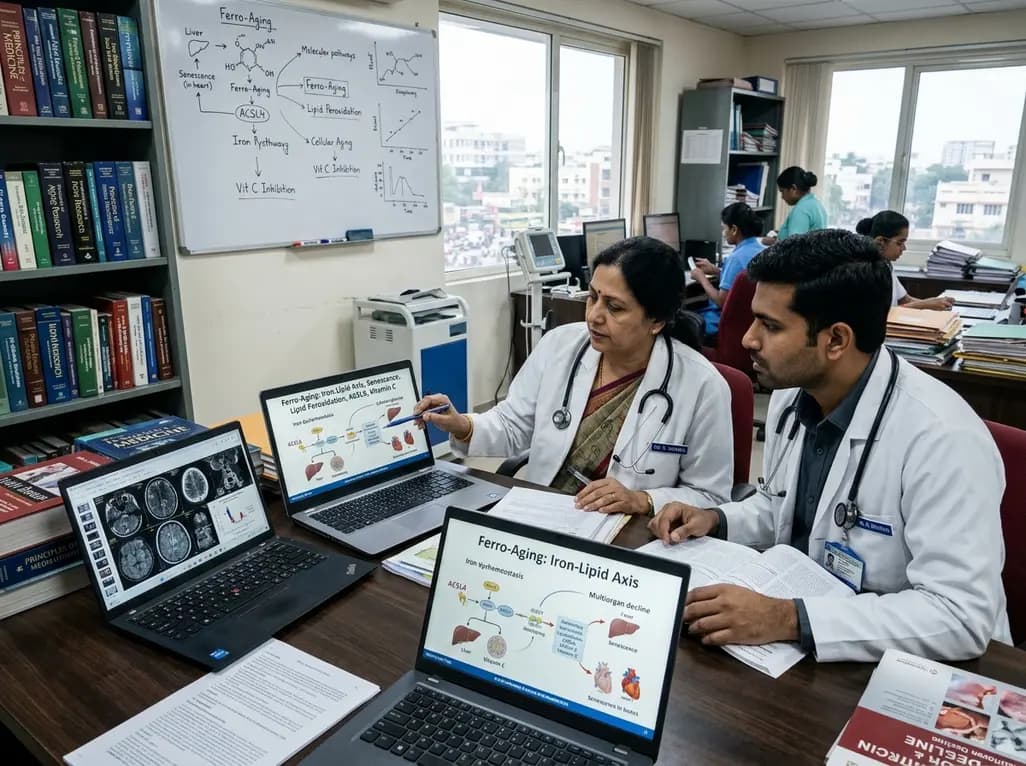
Recent research defines ferro-aging as a conserved iron-lipid axis driving organ decline across primates. Age-related iron dyshomeostasis stimulates ACSL4-mediated lipid peroxidation, promoting cellular senescence. Notably, vitamin C directly inhibits ACSL4, suppressing phospholipid oxidation and multi-organ decay.
Today
