

Loading, please wait...
Loading, please wait...

Autism spectrum disorder (ASD) poses substantial diagnostic challenges globally, leading to critical delays in early clinical assessment. Consequently, many vulnerable children miss early neurodevelopmental intervention windows that optimize long-term cognitive and behavioral outcomes. To bridge this diagnostic gap, investigators increasingly explore artificial intelligence and computer vision to analyze naturalistic child behaviors. Specifically, digital autism diagnostics utilizing home video analysis offer a scalable path toward decentralized developmental surveillance. However, autonomous deep learning architectures frequently struggle with subtle facial expressions and ambiguous behaviors during early childhood. A proof-of-concept study published in JMIR AI addresses this limitation through a human-in-the-loop machine learning model. By strategically combining automated neural network feature extraction with human crowdsourced annotation, the investigators substantially elevated overall diagnostic accuracy.
Traditional autism evaluations depend heavily on comprehensive, direct observations conducted by trained clinicians using standardized diagnostic instruments. Nevertheless, these conventional assessments remain resource-intensive, geographically restricted, and constrained by waiting lists that often exceed one year. Digital health innovators aimed to address these bottlenecks by deploying automated computer vision algorithms on brief smartphone video recordings. Despite remarkable advancements in convolutional neural networks, fully autonomous systems face persistent hurdles in pediatric behavioral medicine. First, young children routinely shift head positions, generate motion blur, and express subtle, fleeting emotions. Second, facial affect in neurodivergent populations does not always conform to stereotypical emotional classification archetypes. Consequently, purely automated models frequently generate low-confidence predictions or fail entirely on unresolved video frames. When algorithms misinterpret ambiguous facial cues, screening reliability drops and false negatives increase within clinical referral streams. Therefore, standalone artificial intelligence cannot yet independently untangle the nuanced social behaviors that experienced pediatricians observe.
To overcome the limitations of autonomous computer vision, researchers engineered an innovative human-in-the-loop diagnostic pipeline. The study evaluated 100 high-quality video recordings captured through the GuessWhat? digital therapeutic mobile app. The dataset included balanced cohorts of 50 autistic children and 50 neurotypical control participants. The investigators initially deployed deep learning algorithms to extract seven-class facial emotion features across video frames. Crucially, the architecture introduced a dynamic confidence threshold mechanism applied to the model's emitted probability distribution. Whenever the automated algorithm produced low-confidence predictions or failed to resolve facial expressions, the system flagged those specific frames. Vetted crowd workers then performed targeted behavioral annotations, replacing uncertain machine estimates with human perceptual judgment. Furthermore, the investigators systematically tested decision thresholds from 0.1 to 0.9 using five-fold cross-validation. This rigorous design demonstrated how increasing human intervention altered the volume of replaced frames and enhanced predictive accuracy.
The empirical findings revealed a striking relationship between human feature replacement and diagnostic classification performance. Under an autonomous, AI-only baseline, the feature extractor achieved an aggregate area under the receiver operating characteristic curve of 0.54. In contrast, incorporating human-in-the-loop annotations substantially elevated model discrimination, propelling the multimodal framework to an aggregate AUROC of 0.76. Furthermore, diagnostic sensitivity exhibited remarkable improvements as the confidence threshold shifted toward greater human involvement. At a low threshold of 0.1, the system demonstrated a mean sensitivity of 0.51. However, adjusting the threshold to 0.9 prompted human annotation for 59.7% of video frames. At this 0.9 threshold, mean sensitivity climbed to 0.66, reflecting an absolute increase of approximately 15 percentage points. Although performance improved overall, fluctuations occurred nonmonotonically at intermediate thresholds, reflecting complex interactions between machine confidence and human input. Importantly, the authors emphasized that these exploratory findings represent a proof-of-concept without establishing definitive clinical diagnostic validity.
Integrating crowdsourced human judgment directly into automated computer vision pipelines marks an important evolution for digital autism diagnostics. Rather than pursuing complete automation or relying solely on manual scoring, hybrid architectures leverage the distinct advantages of both approaches. Automated algorithms rapidly process extensive video streams, successfully classifying straightforward social interactions that machine learning readily handles. Meanwhile, human annotators resolve complex edge cases, discerning ambiguous emotional cues that automated systems misinterpret. This synergistic collaboration minimizes the likelihood of algorithmic errors in primary developmental screening. Furthermore, selectively deploying human reviewers only on low-confidence frames optimizes labor efficiency and controls operational costs. Consequently, this balanced approach provides a sustainable foundation for scalable digital diagnostic aids in pediatric healthcare. Clinicians gain access to objective, quantified behavioral metrics captured within natural home environments before scheduling formal diagnostic consultations.
The clinical implications of scalable, hybrid digital diagnostics are particularly profound for low- and middle-income regions like India. In resource-constrained healthcare environments, families frequently travel long distances to tertiary centers, only to encounter lengthy diagnostic waitlists. By introducing reliable video-based screening tools into community clinics, healthcare providers can rapidly triage children showing early developmental differences. Moreover, identifying neurodevelopmental divergence before three years of age dramatically broadens the window for early behavioral intervention. Timely occupational therapy, speech support, and parent-mediated behavioral strategies foster neural plasticity and enhance long-term developmental trajectories. Although regulatory approval and prospective clinical validation remain necessary, this human-in-the-loop framework highlights a practical path forward. Ultimately, embracing human-AI collaboration empowers pediatricians to bridge diagnostic divides and support underserved pediatric populations effectively.
A standard artificial intelligence model processes video frames autonomously without external intervention, often faltering when confronted with poor lighting, rapid movement, or ambiguous pediatric expressions. In contrast, a human-in-the-loop framework flags low-confidence or unresolved machine outputs and routes them to trained human reviewers. Consequently, this hybrid approach combines computational processing speed with human contextual comprehension, markedly improving overall diagnostic sensitivity and classification reliability while mitigating algorithmic errors in complex clinical scenarios.
Children with neurodevelopmental vulnerabilities frequently experience anxiety or sensory overload within unfamiliar, rigid clinical environments, which can suppress spontaneous social communication or provoke atypical behaviors. Conversely, naturalistic home videos capture authentic behavioral phenotypes during routine daily play with family members. This comfortable home setting allows clinicians and machine learning models to observe genuine social interactions, reciprocal emotional responses, and nuanced nonverbal gestures that might otherwise remain obscured during formal office assessments.
Digital screening tools cannot currently replace formal, multidisciplinary clinical evaluations conducted by developmental pediatricians, child psychiatrists, or clinical psychologists. Instead, these digital platforms serve as validated decision-support systems designed to identify developmental delays earlier and triage high-risk children for priority clinical assessment. Therefore, clinicians must continue utilizing established diagnostic criteria, caregiver developmental interviews, and comprehensive direct observations before establishing an authoritative autism spectrum disorder diagnosis or prescribing long-term interventions.
Disclaimer: This content is for informational and educational purposes only and should not be considered medical advice. Always consult a qualified healthcare professional regarding any medical condition or treatment. Refer to the latest local and national guidelines for clinical practice.
References

Read summarized clinical updates, watch expert medical content, and earn CME certifications right from your smartphone.
Open your smartphone camera to scan and install.





A recent JMIR AI study highlights how a human-in-the-loop machine learning framework improves digital autism diagnostics from home videos, combining deep learning with human annotation to lift AUROC from 0.54 to 0.76.
Today
A national cross-sectional survey reveals marked disparities in infectious disease diagnostic capacity across hospital tiers, underscoring the urgent need for integrated referral networks and enhanced point-of-care testing to improve outbreak detection and patient outcomes.
Today

The GESS-AEEM consensus establishes a clear clinical implementation framework for testosterone therapy in postmenopausal women with hypoactive sexual desire disorder, focusing on transdermal dosing, precise laboratory monitoring, and safety communication.
Yesterday
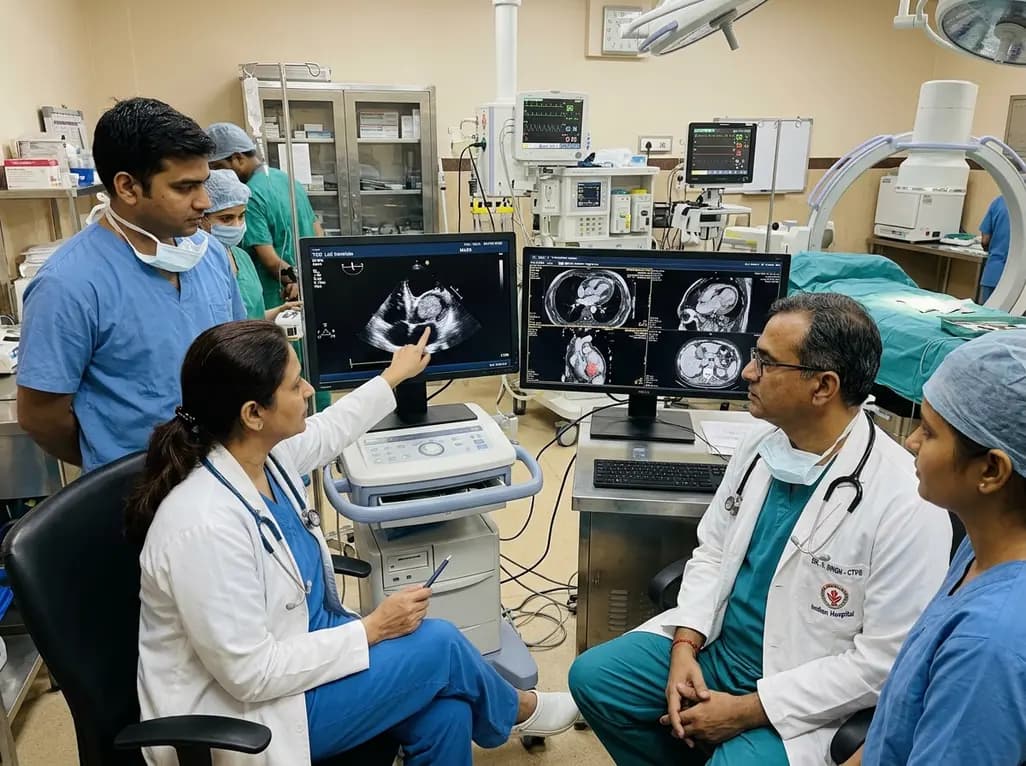
A rare case of an asymptomatic left ventricular hemangioma highlights the vital role of multimodal imaging in differentiating vascular tumors from thrombus. Complete surgical resection under transesophageal echocardiography guidance prevents thromboembolism and delivers optimal outcomes.
Today
A landmark study evaluates long-term quality of life in adolescents and adults with brachial plexus birth injury. Severe functional limitation and limited access to care significantly worsen outcomes, underscoring the urgent need for persistent, multidisciplinary management across adult healthcare transitions.
Today
An analysis of 1,000 posts by macro- and mega-influencers on Instagram and TikTok revealed that 78.5% contained nutrition misinformation, while only 24% of creators held valid credentials. This article examines the clinical risks of viral dietary fads and provides actionable guidance for healthcare professionals.
Today
