.webp&w=384&q=75)

Loading, please wait...
Loading, please wait...
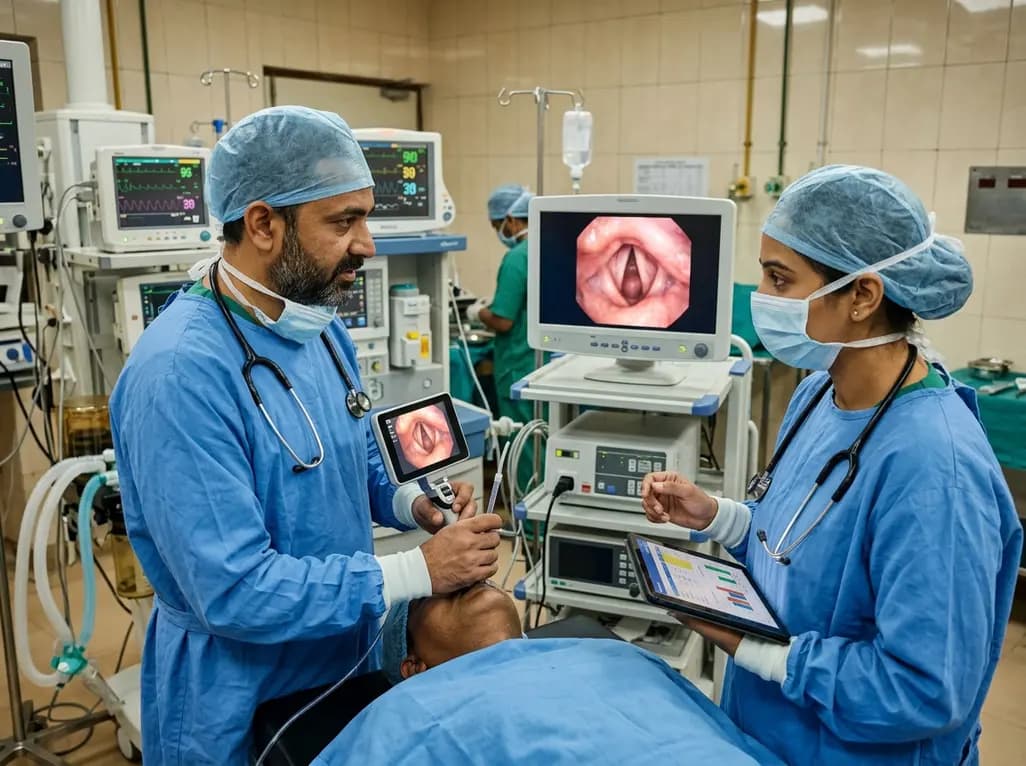
Videolaryngoscopy has transformed modern airway management across operating rooms, emergency departments, and critical care units globally. However, standardized clinical documentation and communication have struggled to match rapid technological advancements. Clinicians traditionally relied on direct laryngoscopy grading systems, yet these metrics often overlook critical visual and mechanical complexities of indirect laryngoscopy. Consequently, establishing an accurate classification of videolaryngoscopy is essential for predicting difficult intubations, standardizing documentation, and planning subsequent airway procedures safely.
A recent comprehensive systematic review evaluated the diagnostic accuracy, clinical performance, and inter-rater reliability of existing videolaryngoscopy grading frameworks. The authors searched major medical databases to identify original studies assessing classification systems in adult and pediatric populations. Although reliable classification tools help airway operators convey critical anatomic findings during handovers, the existing evidence base demonstrates substantial methodological heterogeneity. Many hospital registries and clinical protocols have integrated these classification models without rigorous validation against patient outcomes. Therefore, airway practitioners must critically evaluate current grading systems to enhance patient safety during acute airway management.
The systematic review identified thirteen eligible studies evaluating seven distinct classification systems across adult and pediatric cohorts. These scoring frameworks included traditional systems like the Cormack-Lehane classification, the percentage of glottic opening (POGO) score, and the intubation difficulty scale (IDS). In addition, modern videolaryngoscopy-specific scoring tools were evaluated, including the Fremantle score, the video classification of intubation (VCI) score, the videolaryngoscopic intubation and difficult airway classification (VIDIAC) score, and the paediatric difficult airway classification (PeDiAC) score.
Eight reviewed publications presented findings derived from prospective clinical patient studies, while remaining studies focused on simulation or retrospective image reviews. Notably, the Cormack-Lehane classification remains widely utilized despite its design for line-of-sight direct laryngoscopy. Meanwhile, newer tools incorporate parameters beyond glottic exposure. For instance, the Fremantle score assesses visual quality, tube delivery, and operator difficulty. Similarly, the VIDIAC and PeDiAC scores evaluate both visualization and tube passage mechanics. Nevertheless, few tools have undergone rigorous evaluation regarding their ability to predict intubation success, time to intubation, or procedural complications.
A rigorous appraisal using the QUADAS-2 tool revealed substantial methodological limitations and high risk of bias across the reviewed studies. Major concerns centered on reference standards, patient flow, timing, and clinical applicability. Many investigated publications reported only inter-rater reliability or observer concordance rather than formal diagnostic accuracy. As a result, the clinical utility and generalizability of most classification systems remain uncertain in routine airway practice.
Diagnostic accuracy metrics were reported for only three tools: the Cormack-Lehane classification, the VIDIAC score, and the PeDiAC score. Even among these, the traditional Cormack-Lehane grading exhibited limited diagnostic performance when applied to videolaryngoscopy screens. Furthermore, empirically derived cut-off thresholds for predicting intubation failure were noticeably absent for the remaining four systems. This absence of validated thresholds prevents clinicians from establishing reliable triggers for escalating airway interventions. Additionally, the high risk of bias across flow and timing domains indicates inconsistent application of reference standards. Consequently, while observer agreement appears acceptable for basic visual scoring, diagnostic robustness remains largely unproven in high-stakes clinical scenarios.
The findings of this systematic review carry direct practical implications for anesthesiologists, intensivists, and emergency physicians who frequently perform endotracheal intubations. In modern airway practice, an unobstructed laryngeal view on a video monitor does not guarantee effortless tracheal tube placement. Devices with hyperangulated blades frequently yield an excellent Cormack-Lehane Grade 1 view while presenting extreme resistance during tube advancement. Therefore, relying solely on line-of-sight grading tools can create a false sense of security during airway handovers.
Clinical teams should adopt multidimensional documentation strategies that record both optical glottic visibility and the mechanics of tracheal tube delivery. When sharing airway records across clinical departments, providers must specify the exact videolaryngoscope blade geometry, the grading system utilized, and any adjuncts required, such as rigid stylets or bougies. Furthermore, critical care and emergency units should train staff to recognize that published classification tools possess variable predictive validity. Standardizing institutional protocols with tools like VIDIAC or Fremantle can improve communication consistency, but clinicians must remain prepared for unanticipated tube delivery challenges.
To overcome current clinical uncertainties, the airway management research community must prioritize large-scale, prospective validation studies. Future research should evaluate videolaryngoscopy grading tools against robust, patient-centered reference standards, including first-pass intubation success, procedural duration, and adverse airway events. Moreover, investigators must establish empirically derived thresholds that accurately discriminate between straightforward intubations and genuinely difficult airways.
In addition, researchers should examine the impact of artificial intelligence algorithms and automated image recognition software on grading consistency. Machine learning models integrated into videolaryngoscope processors could soon provide objective, real-time scoring of glottic views and tube trajectories. However, clinical researchers must rigorously validate these technological innovations across diverse patient populations, including pediatric patients, morbidly obese individuals, and patients with craniofacial anomalies. Furthermore, professional airway societies should collaborate to establish international consensus guidelines for videolaryngoscopy reporting. Standardized reporting will eliminate terminology confusion and enhance global airway registry quality. Until comprehensive validation data emerge, clinicians should interpret existing classification scores cautiously, integrating visual grades with comprehensive clinical assessments.
The Cormack-Lehane classification was developed specifically for direct line-of-sight laryngoscopy, focusing solely on visible vocal cord anatomy. In videolaryngoscopy, particularly with hyperangulated blades, an operator can obtain an excellent glottic view while still experiencing significant difficulty advancing the endotracheal tube. Because Cormack-Lehane grading overlooks tube passage mechanics, stylet requirements, and camera optics, it fails to accurately predict overall procedural difficulty or intubation success during videolaryngoscopic procedures.
The VIDIAC and PeDiAC scores were designed specifically for videolaryngoscopy in adult and pediatric populations, respectively. Unlike traditional grading scales that only evaluate anatomic visualization, these scores assess both glottic view quality and the mechanical difficulty encountered during tracheal tube advancement. By combining visual exposure with procedural dynamics and required airway adjuncts, they provide a more comprehensive assessment of intubation difficulty and clinical risk than older single-parameter scales.
Clinicians should document the specific videolaryngoscope device and blade type utilized, distinguishing standard geometry from hyperangulated blades. In addition to recording the glottic view grade, the documentation should detail the ease of tracheal tube delivery, the use of specialized adjuncts like rigid stylets or bougies, and any external laryngeal manipulation applied. Providing these detailed technical specifics ensures clear handover communication and facilitates safer airway planning for future procedures.
Disclaimer: This content is for informational and educational purposes only and does not constitute medical advice, diagnosis, or treatment recommendations. Refer to the latest local and national guidelines for clinical practice.
References

Read summarized clinical updates, watch expert medical content, and earn CME certifications right from your smartphone.
Open your smartphone camera to scan and install.





A systematic review evaluates seven videolaryngoscopy classification tools, revealing that most lack diagnostic accuracy data and validated clinical thresholds. Clinicians must understand these limitations to optimize airway management documentation and patient safety.
last month

Evidence from resource-constrained settings reveals critical differences between new ART initiates and re-initiators returning after treatment interruption. Tailored counseling that addresses mental health, alcohol use, and mobility is essential to maintain viral suppression and patient retention in HIV care programs.
Today

India's national digital health service achieved a historic milestone of fifty crore virtual consultations. Notably, female patients account for over fifty-seven percent of utilisation, demonstrating improved healthcare accessibility for remote communities, chronic disease management, and primary triage.
Today
A large UK Biobank study identified four routine biomarker subtypes that predict cardiometabolic disease progression to multimorbidity. Integrating multi-state modelling, metabolomics, and proteomics revealed distinct biological pathways, offering new avenues for tailored clinical risk stratification.
Today

Dual-nanofiber interpenetrating network scaffolds combining silica and PLLA/gelatin nanofibers with sodium alginate achieve complementary mechanical stability, immunomodulatory M2 macrophage polarization, and enhanced osteogenesis for advanced bone repair.
Today

Researchers at IISER Berhampur have engineered a covalent organic framework immunosensor that detects urinary NGAL. This novel nanotechnology platform distinguishes diabetic nephropathy from other renal conditions, enabling rapid, minimally invasive stratification and earlier clinical intervention for patients.
Today
