.webp&w=384&q=75)

Loading, please wait...
Loading, please wait...

Male infertility remains a significant medical challenge in India, affecting millions of men. Specifically, recent data suggests that nearly 27.5 million Indian men suffer from various reproductive health issues. Among these, asthenospermia—characterized by poor sperm motility—stands as a primary culprit. Historically, clinicians have relied on kinematic parameters for diagnosis. However, these traditional methods often lack the sensitivity required to evaluate the complex intracellular microenvironment. Consequently, researchers have developed a groundbreaking asthenospermia detection probe known as QSi-OBA.
The newly synthesized QSi-OBA probe represents a major leap in reproductive technology. This near-infrared fluorescent tool utilizes a silicon-xanthene scaffold. Notably, the probe responds synergistically to changes in pH and viscosity. Because the sperm microenvironment is highly sensitive to these factors, real-time monitoring becomes essential. Furthermore, the probe is wash-free, allowing for more efficient laboratory workflows. Therefore, clinicians can observe dynamic physiological changes without the interference of traditional staining artifacts.
Additionally, the QSi-OBA probe demonstrates exceptional photostability and anti-interference capabilities. During testing, the probe effectively distinguished between healthy sperm and asthenospermic samples. Importantly, this differentiation does not depend solely on routine semen parameters. Instead, it focuses on functional impairment at the molecular level. Moreover, this tool provides a reliable imaging solution for assessing sperm function in real-time. Consequently, it offers hope for more precise diagnoses in male infertility clinics.
It is a specialized fluorescent tool designed to monitor the intracellular microenvironment of sperm cells. By detecting changes in pH and viscosity, the probe helps identify sperm with functional impairments that cause low motility.
A wash-free probe eliminates the need for multiple rinsing steps during imaging. This saves time and preserves the delicate cellular environment, allowing for more accurate real-time observations of sperm behavior.
Sperm motility is highly sensitive to acid-base balance. An acidic microenvironment typically inhibits movement, while alkaline conditions generally enhance it. The QSi-OBA probe tracks these fluctuations to evaluate sperm viability.
Disclaimer: This content is for informational and educational purposes only. It does not constitute medical advice or a substitute for professional healthcare consultation. Refer to the latest local and national guidelines for clinical practice.
References
Zhang R et al. A Wash-Free Fluorescent Probe with Synergistic Signal Amplification for Sperm Microenvironment Evaluation and Asthenospermia Detection. Anal Chem. 2026 May 18. doi: 10.1021/acs.analchem.6c02547. PMID: 42145203.
Lavanya et al. Microenvironment of the male and female reproductive tracts regulate sperm fertility: Impact of viscosity, pH, and osmolality. Andrology. 2022 Jan;10(1):92-104.
Agarwal A, et al. Male Infertility: A Global Perspective on Diagnosis and Management. Lancet. 2021.

Read summarized clinical updates, watch expert medical content, and earn CME certifications right from your smartphone.
Open your smartphone camera to scan and install.





Researchers have developed a new near-infrared fluorescent probe, QSi-OBA, for real-time monitoring of sperm microenvironments to improve infertility diagno...
4 months ago
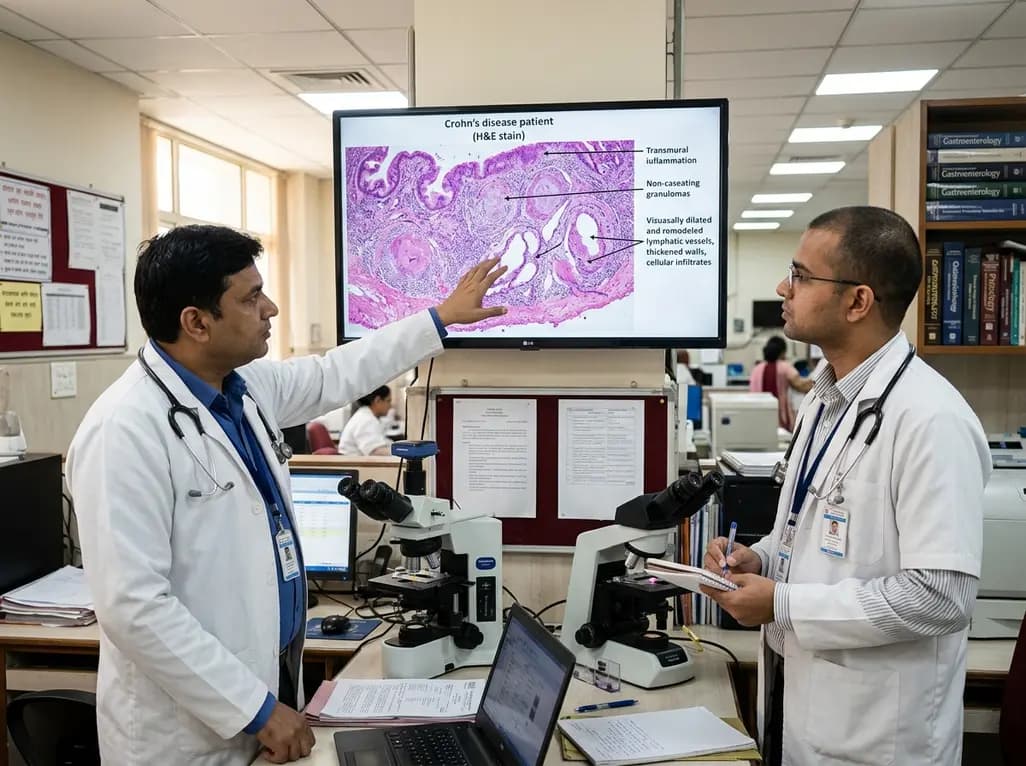
Intestinal lymphatic dysfunction is re-emerging as a fundamental driver of Crohn's disease pathogenesis. Explore how structural remodeling, lymphangitis, and defective clearance shape transmural inflammation and offer novel therapeutic targets.
Today

A school-based intervention using the Health Action Process Approach (HAPA) significantly enhanced adolescents' perceived benefits of consulting healthcare providers and promoted proactive menstrual health behaviors, offering key clinical insights for managing adolescent dysmenorrhea and endometriosis.
Today

A comprehensive analysis of the Translational Maturity Framework for nanomedicine-device combination products, evaluating regulatory complexity, manufacturing hurdles, and clinical readiness across oncology, cardiology, and orthopedics.
Today

A cross-sectional study reveals that sarcopenic obesity independently increases functional impairment and severe disc degeneration in patients with degenerative lumbar spinal stenosis, highlighting the need for body composition assessment.
Today

A landmark dose-response meta-analysis of 8.8 million adults reveals that high ultra-processed food intake significantly elevates risks for cardiovascular disease, cancer, diabetes, depression, and all-cause mortality, highlighting urgent needs for clinical lifestyle interventions.
Today
