.webp&w=384&q=75)

Loading, please wait...
Loading, please wait...
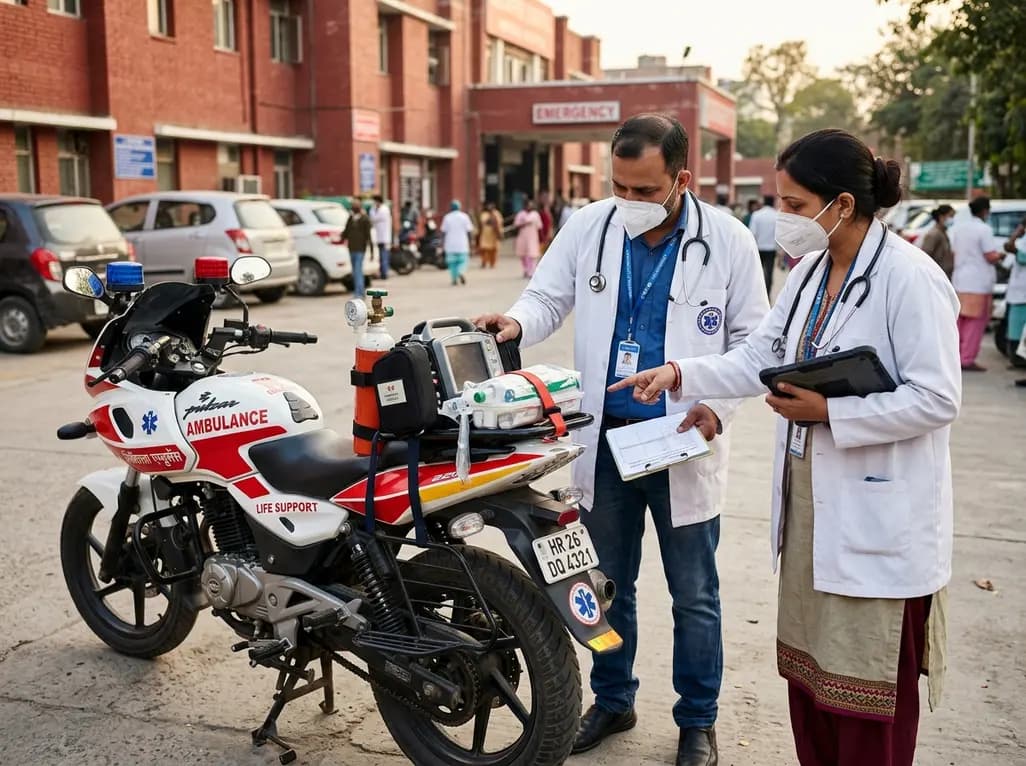
The Ministry of Road Transport and Highways has proposed a landmark regulatory structure for emergency transport. Consequently, the two-wheeled road ambulance will soon operate as a standardized vehicle class across India. Beginning October 1, 2027, newly manufactured L2-category motorcycle ambulances must comply with strict national standards under the Central Motor Vehicles Rules. This policy initiative addresses a critical gap in pre-hospital care. Furthermore, it promises to enhance emergency medical access in congested cities, rural belts, and remote mountain terrains.
Currently, motorcycle emergency vehicles operate without uniform national regulations across Indian states. Consequently, manufacturers lack clear guidelines regarding patient handling, functional safety, and structural design. To resolve this gap, the ministry introduced Automotive Industry Standard AIS-209 (Part 1):2026. This comprehensive standard defines specific technical requirements for life-support motorcycle units. Furthermore, the new standard establishes rigorous engineering criteria for vehicle stability and braking efficiency. It mandates precise parking brake capability and gradeability performance for steep inclines. Additionally, manufacturers must ensure optimal rear visibility, robust coupling integrity, and durable patient conveyance attachments. These measures guarantee that fast-moving response units maintain complete balance during high-speed transit. Moreover, the framework addresses environmental exposure and patient safety during transport. The standards require protective enclosures to shelter vulnerable patients from harsh weather elements. In addition, integrated patient restraint systems and secure stretcher locking mechanisms prevent dangerous displacement on uneven roads. By standardizing construction practices, the government ensures that emergency responders deliver high-quality pre-hospital life support without compromising patient stability.
Under the proposed Central Motor Vehicles Amendment Rules, bike ambulances will receive classification as transport vehicles. Therefore, every two-wheeled road ambulance must undergo mandatory fitness testing every two years. Authorized inspection centers will perform dedicated safety evaluations before renewing operational certificates. Consequently, healthcare providers must maintain strict vehicle maintenance schedules to ensure continuous legal compliance. Specifically, the fitness inspection evaluates structural mounting brackets, fasteners, and side-mounted patient units for fatigue or cracks. Furthermore, inspectors rigorously evaluate tyre tread depth, rim integrity, and inflation levels to maintain road grip. Warning lights and sirens also undergo thorough functional testing to ensure high conspicuity in dense traffic. Additionally, official inspectors verify that fire extinguishers remain fully charged, accessible, and valid. Moreover, operational control remains tied to localized regional planning. State governments will determine specific operational zones for these specialized emergency units. For instance, authorities can deploy them in narrow urban lanes or rugged rural districts where heavy vehicles face severe access constraints. As a result, regional health authorities can strategically integrate motorcycle units into their existing emergency dispatch networks.
Conventional four-wheeled ambulances frequently encounter severe mobility challenges in congested cities and mountainous regions. Consequently, traffic congestion and narrow pathways delay critical medical interventions during life-threatening emergencies. The deployment of agile motorcycle fleets effectively solves this persistent healthcare delivery bottleneck. Indeed, rapid two-wheeler navigation significantly reduces response times during golden-hour medical emergencies. Furthermore, these specialized life-support motorcycles carry trained paramedics equipped with essential resuscitation gear. Paramedics can deliver immediate oxygen therapy, administer life-saving medications, and stabilize trauma patients on site. Meanwhile, larger four-wheeled transport units can maneuver toward accessible rendezvous points. Therefore, bike ambulances bridge the vital gap between initial distress calls and definitive hospital admission. Additionally, rural communities stand to gain immense benefits from standardized mobile emergency units. Rural healthcare infrastructure often struggles with sparse road networks and difficult terrain. Consequently, light two-wheelers can navigate unpaved rural tracks that halt standard vehicles. Thus, expectant mothers, trauma victims, and acute cardiac patients receive timely stabilization before long-distance transfer.
The Ministry of Road Transport and Highways established a phased transition period for regulatory compliance. Specifically, top-mounted emergency warning lights on bike ambulances must conform to AIS-209 standards by October 1, 2026. Subsequently, all newly manufactured L2-category motorcycle ambulances must fully comply with AIS-209 (Part 1):2026 starting October 1, 2027. This clear timeline allows vehicle manufacturers sufficient opportunity to redesign vehicle structures effectively. Furthermore, the regulation mandates emergency conspicuity devices to alert surrounding traffic effectively. Flashing top beacons, high-decibel sirens, and retroreflective body markings improve visibility during daytime and night operations. Additionally, ergonomic loading mechanisms ensure smooth patient transfer without risking caregiver injury or stretcher jamming. Therefore, these engineering upgrades safeguard both emergency personnel and transit patients. Moreover, standardizing patient conveyance accessories ensures uniform training for paramedic crews across India. Responders will operate identical locking devices, restraint belts, and life-support mounts regardless of state jurisdiction. Consequently, national healthcare workers can transition seamlessly across regional emergency medical services. Ultimately, these technical safety features create a reliable ecosystem for pre-hospital care delivery.
The formalization of motorcycle ambulance regulations marks a crucial step forward for Indian emergency medicine. Historically, informal motorcycle ambulances lacked standardized medical equipment mounts and safety certifications. However, national regulations now guarantee that every active bike ambulance provides a safe environment for critical care interventions. Consequently, emergency medical teams can deliver standardized trauma care across diverse geographic regions. Furthermore, this regulatory framework encourages public-private partnerships in healthcare delivery. Private ambulance operators, non-governmental organizations, and state health missions can confidently invest in certified fleets. Because clear compliance criteria exist, investors face reduced regulatory uncertainty. Additionally, uniform manufacturing standards reduce production costs through economies of scale, making emergency response networks more affordable. Finally, integrating standardized motorcycle ambulances strengthens broader health system resilience. During natural disasters or mass casualty events, agile two-wheelers can navigate debris-strewn roads to deliver vital medical supplies. Moreover, they provide rapid triage capabilities when traditional access routes remain blocked. Therefore, the implementation of AIS-209 standards fundamentally elevates India's capacity to manage acute health emergencies efficiently.
Q1: What is the main objective of the AIS-209 (Part 1):2026 standard for two-wheeled road ambulances?
The AIS-209 (Part 1):2026 standard establishes mandatory construction, structural safety, and functional requirements for life-support two-wheeled road ambulances in India. Consequently, it standardizes vehicle stability, braking, patient restraint systems, emergency lighting, and environmental protection. This national framework ensures that all motorcycle ambulances operate safely and effectively while delivering rapid last-mile medical care in hard-to-reach or congested locations across Indian states.
Q2: When will the new regulatory framework for two-wheeled ambulances take effect in India?
According to the draft notification, compliance follows a structured phased schedule. Top-mounted emergency warning lights fitted on two-wheeled ambulances must comply with AIS-209 standards starting October 1, 2026. Furthermore, all newly manufactured L2-category two-wheeled road ambulances manufactured on or after October 1, 2027, must fully comply with the complete AIS-209 (Part 1):2026 standard to receive registration and operational approvals.
Q3: How often must a two-wheeled road ambulance undergo fitness inspection under the proposed rules?
Under the proposed amendments to the Central Motor Vehicles Rules, two-wheeled road ambulances will be classified as transport vehicles. Consequently, each vehicle must undergo mandatory fitness testing every two years to renew its certificate of fitness. Dedicated fitness inspections evaluate structural mountings, stretcher locking mechanisms, tyre conditions, warning lights, patient restraint systems, and valid fire extinguisher availability to guarantee operational safety.
Disclaimer: This content is for informational and educational purposes only. It does not constitute medical advice or replace professional judgment. Refer to the latest local and national guidelines for clinical practice.
References

Read summarized clinical updates, watch expert medical content, and earn CME certifications right from your smartphone.
Open your smartphone camera to scan and install.





India's Ministry of Road Transport and Highways has issued draft rules introducing AIS-209 standards for two-wheeled road ambulances starting October 1, 2027. This framework establishes safety norms, fitness inspection protocols, and operational guidelines for life support motorcycle ambulances.
last month

The PRIME-MR registry reveals that baseline severe tricuspid regurgitation significantly increases two-year mortality after transcatheter edge-to-edge repair for primary mitral regurgitation, highlighting the critical importance of early right heart assessment and comprehensive valvular management.
Today

A multicentre RCT in China shows that the PAICS AI system significantly boosts sonographer sensitivity in detecting fetal intracranial malformations by 8.7% without compromising specificity, offering promising diagnostic support for prenatal neurosonography.
Today
Groundbreaking multiomics research reveals that adipose-derived miR-30e-5p travels via exosomes to vascular endothelial cells, silencing SLC7A11 and accelerating atherosclerosis. This discovery highlights novel therapeutic avenues within cardiovascular-kidney-metabolic syndrome.
Today

A retrospective cohort study demonstrates that patients with anorexia nervosa and bulimia nervosa face significantly higher risks of lower extremity soft tissue injuries, including ACL tears and ligament sprains, along with heightened rates of orthopedic revision surgery, highlighting the need for systemic screening.
Today
A recent study highlights the differential impact of type 1 diabetes on pediatric skeletal architecture, revealing significant cortical deficits over trabecular loss and underscoring the protective role of lean muscle mass in bone accrual.
Today
