

Loading, please wait...
Loading, please wait...

Traumatic brain injury presents an ongoing triage dilemma in acute emergency settings worldwide. Clinicians must rapidly differentiate benign concussions from life-threatening intracranial hemorrhage while minimizing unnecessary radiation and healthcare costs. The integration of objective traumatic brain injury biomarkers offers an evidence-based pathway to refine clinical decision-making. Emerging evidence from the landmark Collaborative European NeuroTrauma Effectiveness Research in Traumatic Brain Injury study sheds light on this diagnostic frontier. Specifically, researchers evaluated how serum biomarkers perform within the 2023 National Institute for Health and Care Excellence guidelines. By providing biological precision, these circulating proteins help resolve clinical equipoise in patients who fall into intermediate-risk categories.
Emergency clinicians frequently rely on clinical decision rules to determine whether acute head trauma warrants neuroimaging. The updated NICE NG232 guideline stratifies patients into high-, medium-, and low-risk categories based on presenting features. Patients in high-risk categories require rapid non-contrast computed tomography scans within one hour. In contrast, medium-risk patients present subtle indicators, such as post-traumatic amnesia or high-energy injury mechanisms, prompting an eight-hour imaging window. However, this intermediate group displays marked heterogeneity, and normal computed tomography findings frequently emerge. Consequently, unnecessary imaging strains hospital throughput and exposes individuals to ionizing radiation. Researchers evaluated 1,979 adult participants from the multicenter CENTER-TBI registry to address this diagnostic challenge. Among these individuals, 385 patients fulfilled the criteria for medium-risk categorization under the NICE rules. The investigators sought to evaluate whether objective serum markers could safely rule out traumatic intracranial injury. Ultimately, incorporating blood-based diagnostics into existing risk-stratification algorithms could revolutionize head injury triage in emergency departments worldwide.
The investigators analyzed a comprehensive panel comprising six circulating neurotrauma biomarkers. These analytes included glial fibrillary acidic protein, ubiquitin C-terminal hydrolase L1, neurofilament light, total tau, neuron-specific enolase, and S100 calcium-binding protein B. Blood samples obtained within 24 hours of injury revealed significant elevations across five markers in patients with confirmed intracranial abnormalities. Neuron-specific enolase alone failed to reach statistical significance, reflecting its known susceptibility to confounding hemolysis. Glial fibrillary acidic protein emerged as the standout diagnostic performer, achieving an area under the receiver operating characteristic curve of 0.81. Meanwhile, neurofilament light, total tau, and ubiquitin C-terminal hydrolase L1 demonstrated moderate discriminative capacity. Astrocytic markers like glial fibrillary acidic protein reflect acute parenchymal shear and astrocytic disruption, making them exceptionally sensitive indicators of intracranial trauma. Neuronal and axonal markers complement this signal by indicating early cytoskeletal degradation. Therefore, measuring targeted biochemical pathways provides clinicians with quantitative insights into structural brain injury that simple clinical examinations cannot capture.
Beyond diagnostic discrimination, the primary utility of fluid biomarkers lies in their negative predictive power. Clinicians prioritize high sensitivity to ensure that acute intracranial pathology, such as epidural or subdural hematomas, is never missed. When researchers established biomarker cutoffs to maintain a ninety-five percent sensitivity threshold, the panel exhibited specificities ranging between eighteen and thirty-three percent. Consequently, applying glial fibrillary acidic protein, neurofilament light, or ubiquitin C-terminal hydrolase L1 could reduce computed tomography scans by fourteen to twenty-three percent among medium-risk individuals. This clinical reduction translates into significant resource savings without compromising patient safety. For overcrowded emergency services, avoiding unnecessary neuroimaging accelerates emergency throughput and lowers total procedural expenditures. In addition, reducing scan volume eliminates unnecessary exposure to ionizing radiation, an essential consideration across adult age cohorts. Thus, using blood biomarkers as an initial rule-out gatekeeper empowers physicians to discharge low-risk individuals with enhanced diagnostic confidence.
Biomarker release kinetics vary significantly based on cellular origin and molecular half-life. To explore this dynamic, the study examined a sub-cohort sampled within six hours of initial injury. Interestingly, S100 calcium-binding protein B and ubiquitin C-terminal hydrolase L1 exhibited substantially higher diagnostic accuracy during this early hyperacute window. Because ubiquitin C-terminal hydrolase L1 rapidly clears from peripheral circulation, early sampling captures its physiological peak before renal filtration and systemic breakdown occur. Similarly, S100 calcium-binding protein B exhibits a rapid biological half-life of roughly ninety minutes, demanding early venipuncture to preserve diagnostic utility. In contrast, glial fibrillary acidic protein concentrations remain robustly elevated over twenty-four hours, offering an extended operational window for clinical triage. Therefore, emergency departments must consider injury-to-draw intervals when selecting specific biomarker testing platforms. Point-of-care whole-blood assays deployed at patient arrival could capitalize on early kinetics, delivering decisive results within minutes.
Acute alcohol and substance intoxication commonly complicates emergency neurotrauma evaluation. Intoxicated patients frequently present with a fluctuating Glasgow Coma Scale score of thirteen or fourteen, triggering automatic head imaging under conventional decision rules. However, clinicians often struggle to determine whether depressed consciousness stems from intracranial pathology or transient chemical suppression. The CENTER-TBI analysis specifically evaluated intoxicated individuals exhibiting persistent consciousness deficits. Notably, biomarker concentrations remained significantly elevated in intoxicated patients with proven computed tomography abnormalities compared to those with negative scans. This finding confirms that acute alcohol exposure does not falsely elevate astroglial or axonal injury markers. Consequently, fluid biomarkers provide objective diagnostic certainty in cases where clinical neurological examinations prove unreliable. By mitigating confounding behavioral factors, biomarker testing helps clinicians bypass speculative imaging and focus critical resources on patients harboring genuine structural pathology.
While clinical validation demonstrates undeniable promise, integrating circulating biomarkers into mainstream practice faces several real-world barriers. First, hospital facilities require rapid point-of-care laboratory platforms capable of delivering validated results within thirty to forty-five minutes. Without rapid turnaround times, waiting for laboratory reports could paradoxically prolong emergency department stays. Second, healthcare systems must define standardized decision cutoffs tailored to distinct patient demographics and co-morbidities. For instance, elderly patients with baseline neurodegenerative disease frequently present mildly elevated neurofilament light concentrations, necessitating age-adjusted interpretation thresholds. Moreover, widespread adoption demands structured guideline endorsement from regulatory authorities and professional trauma colleges. As health systems modernize trauma workflows, combining rapid fluid biomarkers with clinical decision rules will establish a new paradigm in neurotrauma. Ultimately, this precision-based triage strategy promises to reduce unneeded imaging, alleviate healthcare expenditures, and optimize patient outcomes across diverse clinical settings.
Glial fibrillary acidic protein demonstrated the highest diagnostic accuracy, achieving an area under the curve of 0.81 within 24 hours of injury. Its sustained elevation accurately identifies acute astrocytic disruption and intracranial lesions, outperforming other circulating biomarkers in ruling out computed tomography abnormalities among medium-risk trauma patients.
Yes, circulating biomarkers provide objective diagnostic clarity in intoxicated patients with depressed consciousness. The study showed that biomarker concentrations were significantly elevated only in intoxicated individuals with traumatic neuroimaging abnormalities, confirming that alcohol intoxication itself does not falsely elevate astroglial injury markers or confound clinical triage decisions.
Early sampling within six hours substantially enhances the performance of ubiquitin C-terminal hydrolase L1 and S100B due to their rapid clearance and short half-lives. Conversely, glial fibrillary acidic protein maintains stable elevation across 24 hours, making it exceptionally reliable across broader emergency admission timeframes.
Disclaimer: This content is for informational and educational purposes only... Refer to the latest local and national guidelines for clinical practice.
References

Read summarized clinical updates, watch expert medical content, and earn CME certifications right from your smartphone.
Open your smartphone camera to scan and install.





A CENTER-TBI analysis shows that serum traumatic brain injury biomarkers like GFAP and UCH-L1 can identify intracranial lesions and safely reduce head CT scans by up to 23% in medium-risk adult patients.
Today

A retrospective study of 6,113 adults shows that combining GLP-1 receptor agonists with digital health apps nearly doubles the odds of achieving significant weight loss. Frequent progress logging serves as a primary behavioral driver of long-term metabolic success.
Today

Sexual dysfunction affects a high proportion of reproductive-age females with multiple sclerosis. This comprehensive review highlights multi-tier etiologies, proactive clinical screening tools, preconception counseling considerations, and integrated therapeutic options across multidisciplinary care pathways.
Today
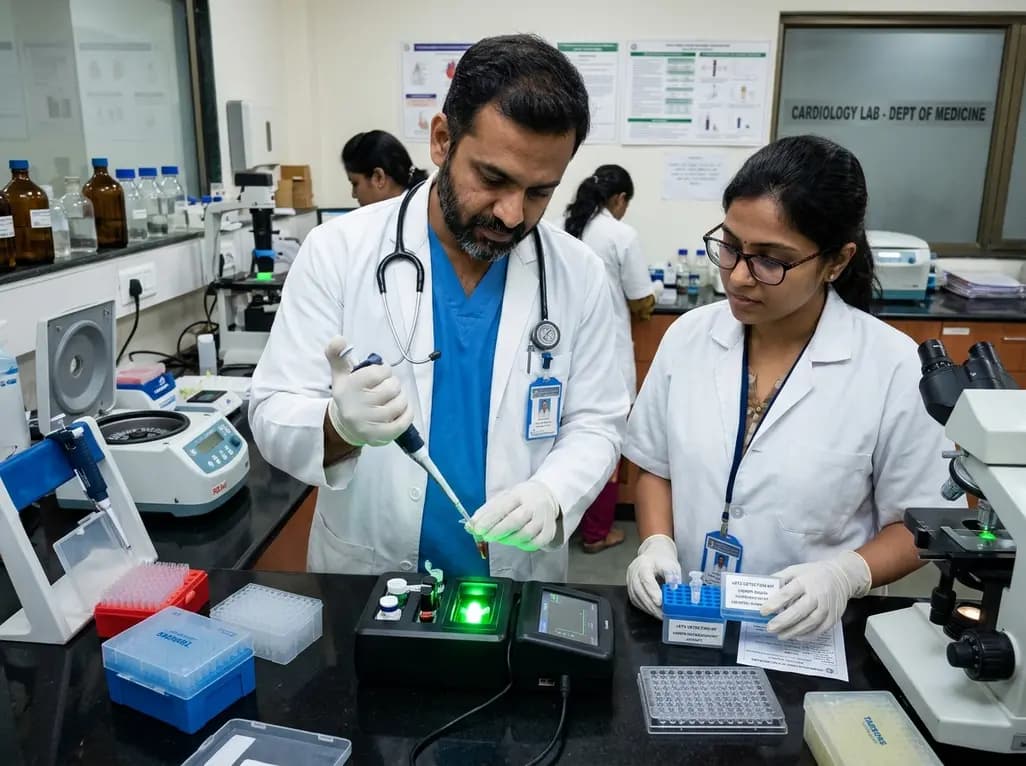
Researchers have engineered an innovative CRISPR-Cas12a fluorescent diagnostic kit for clinical sST2 detection. By combining nanotechnology with enzymatic trans-cleavage, this platform enables rapid, ultrasensitive heart failure diagnosis and risk stratification, outperforming conventional laboratory ELISA methods.
Today

Non-union fractures occur in 2-5% of cases, causing significant disability and cost. Conservative modalities such as LIPUS, PEMF, and focused ESWT offer non-surgical healing options for defects up to 5-10 mm when adequate mechanical stability exists without infection.
Today

India is poised to transform chronic disease management through wearable health technology. Discover how continuous remote monitoring and predictive algorithms empower clinicians to detect early cardiovascular signals, personalize metabolic interventions, and deliver equitable preventive care across populations.
Yesterday
