.webp&w=384&q=75)

Loading, please wait...
Loading, please wait...
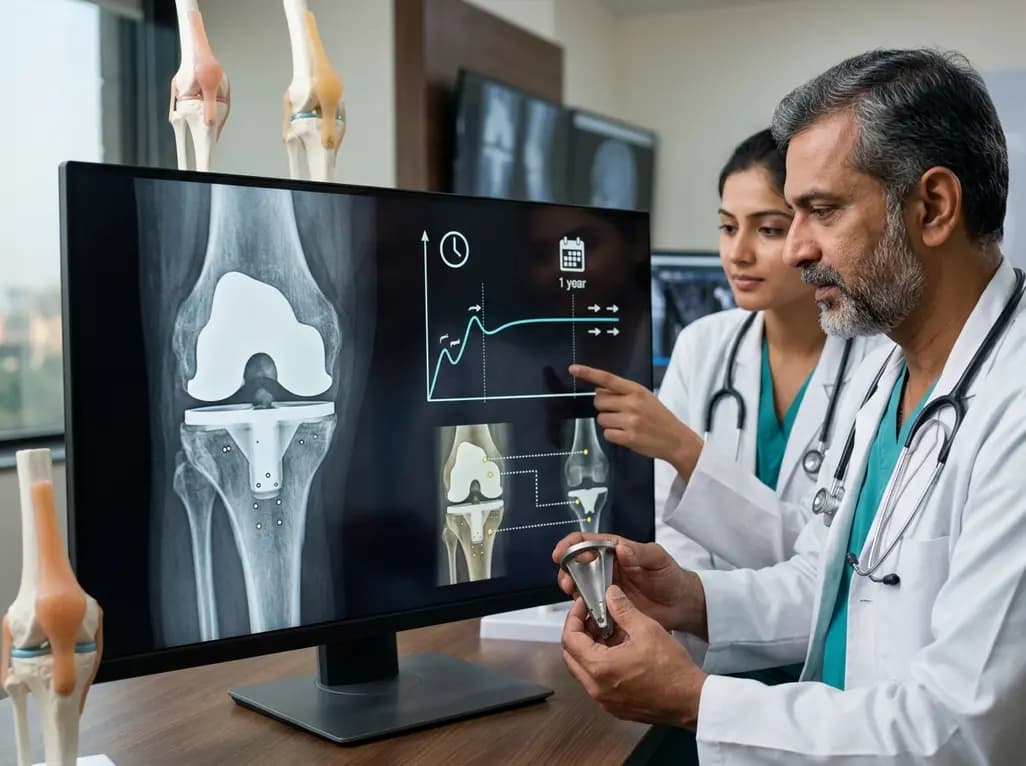
Managing bone loss remains a primary hurdle in revision total knee arthroplasty (rTKA). Surgeons often turn to tibial metaphyseal cones to enhance mechanical stability when bone quality is suboptimal. These porous constructs are designed to promote osseointegration and provide a solid foundation for the revision implant. However, understanding their long-term fixation requires precise measurement of early implant movement.
A recent prospective cohort study followed 25 patients undergoing rTKA to assess the stability of these constructs. The research team utilized model-based radiostereometric analysis (MB-RSA), the gold standard for tracking implant migration. By placing tantalum markers in the cancellous bone, they measured total translation (TT) and total rotation (TR) at multiple intervals over two years. Consequently, this method provided a detailed look at how tibial metaphyseal cones behave during the critical early postoperative period.
The findings revealed a mean total translation of 0.59 mm and a total rotation of 0.76° at the 2-year mark. While the group averages suggested stability, the data showed significant inter-individual variability. Most migration occurred within the first six months, followed by a stabilization phase between years one and two. Furthermore, most patients reported improved functional scores and reduced pain during the follow-up period.
Although the majority of tibial metaphyseal cones demonstrated excellent fixation, three patients exhibited translation greater than 1 mm. This heterogeneity suggests that while cones are effective, they do not guarantee absolute stability in every case. One patient in the study required a re-revision for aseptic loosening, highlighting the need for continued vigilance. Therefore, clinicians should monitor patients closely during the first year to identify those at higher risk for potential long-term failure.
Metaphyseal cones provide immediate structural support and avoid the risks associated with bone graft resorption or non-union. They offer a highly porous surface that facilitates rapid biological fixation through osseointegration.
Research indicates that early migration, particularly within the first six to twelve months, is a strong predictor of future aseptic loosening. Radiostereometric analysis allows surgeons to detect these subtle movements long before they are visible on standard X-rays.
Patients with Type II or Type III Anderson Orthopaedic Research Institute (AORI) bone defects typically benefit the most. These cones provide the necessary metaphyseal filling to stabilize the revision construct when peripheral bone support is lacking.
Disclaimer: This content is for informational and educational purposes only. It does not constitute medical advice or establish a doctor-patient relationship. Refer to the latest local and national guidelines for clinical practice.
References
1. Mills K et al. Early migration following revision total knee arthroplasty with tibial metaphyseal cones: a 2-year prospective RSA cohort study of 25 patients. Acta Orthop. 2026 Jun 10. doi: 10.2340/17453674.2026.45964. PMID: 42267510.
2. Divano S, et al. Metaphyseal cones in revision total knee arthroplasty: a systematic review of clinical and radiological outcomes. Archives of Orthopaedic and Trauma Surgery. 2021.
3. Namba RS, et al. Evaluation of Metaphyseal Cones in Revision Total Knee Arthroplasty. The Journal of Arthroplasty. 2020.
"
Read summarized clinical updates, watch expert medical content, and earn CME certifications right from your smartphone.
Open your smartphone camera to scan and install.





This study evaluates the stability of tibial metaphyseal cones in revision total knee arthroplasty using radiostereometric analysis. Results show heterogeneous early migration that generally stabilizes after one year, offering insights into long-term implant fixation for complex knee revisions.
4 months ago

Following regulatory scrutiny from FSSAI regarding promotional representations and lean muscle preservation claims, Dr. Reddy's Laboratories and Nestlé Health Science are currently reviewing the branding and marketing strategy for their joint nutritional supplement Celevida GLP+.
Today

A comprehensive scoping review synthesises evidence linking prenatal maternal mental health to long-term offspring neurodevelopment, evaluating neuroendocrine, inflammatory, and epigenetic pathways while highlighting clinical screening and future research priorities.
Today

The Directorate General of Health Services directs Indian states to halt the hazardous reuse and reprocessing of single-use medical devices. Discover regulatory implications under the Drugs and Cosmetics Act, critical infection risks, legal liabilities, and operational changes required across clinical specialties.
Today

A 25-year multi-institutional cohort reveals high recurrence rates in pediatric giant cell tumor of bone, particularly in patients with open physes and bone marrow edema on preoperative MRI. Early surveillance and careful balance between growth plate preservation and tumor clearance are essential.
Today

India is advancing preventive healthcare by integrating genomics, artificial intelligence, and quantum technologies. With the SANGAM programme sequencing one million Indian genomes, clinicians can unlock personalized therapies, detect cardiometabolic risks early, and curb the burden of diabetes and heart disease.
Today
