.webp&w=384&q=75)

Loading, please wait...
Loading, please wait...
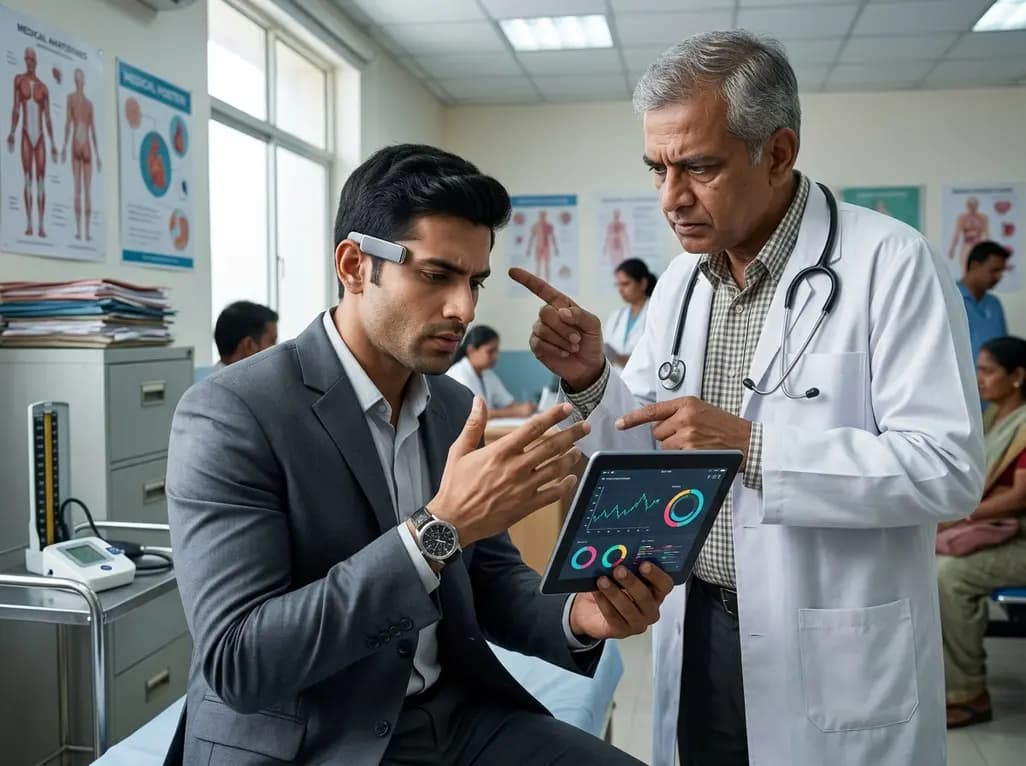
The consumer wellness technology landscape is evolving rapidly, shifting from basic fitness metrics to sophisticated physiological tracking. Recently, Deepinder Goyal, the co-founder of India's prominent tech conglomerate Eternal Ltd (formerly Zomato), announced his entry into the wellness space. He plans to launch the Temple wellness device, a wearable forehead sensor designed to measure real-time metabolic states. Although the market features high-end trackers, this gadget bypasses indirect indicators to evaluate real-time metabolic activity. Consequently, medical professionals are closely examining this device to understand its potential clinical relevance and scientific validity. Understanding these digital health developments will help doctors advise health-conscious patients effectively.
In recent years, consumer health technology has shifted dramatically from simple step counting to complex bio-monitoring. Initially, early smartwatches relied purely on accelerometers to estimate physical activity levels. Subsequently, manufacturers introduced optical heart rate sensors, which allowed users to track cardiovascular responses during exercise and rest. Today, modern wearables can record electrocardiograms, measure blood oxygen saturation, and even monitor peripheral skin temperature. Despite these advancements, most commercial devices still rely on heart rate as a surrogate marker for metabolic activity. This limitation means that users do not receive direct, real-time measurements of cellular energy expenditure or cerebral metabolic changes. As metabolic disorders rise globally, there is a growing demand for devices that provide deep physiological insights. Consequently, entrepreneurs and researchers are exploring novel biosensors to bridge this gap. This paradigm shift represents a move from general fitness tracking to highly personalized, real-time physiological profiling. Therefore, the upcoming wave of wellness tech targets metabolic changes directly. This approach offers a clearer picture of systemic health than traditional cardiovascular proxies. Furthermore, healthcare systems increasingly emphasize preventive strategies over reactive care. This shift highlights the clinical necessity of validating new metrics before recommending them to patients.
The Temple wellness device features a unique bean-shaped design worn directly on the side of the forehead. Unlike wristbands or rings, this device focuses on monitoring biological metrics directly from the temporal region. According to Goyal, the project originated from personal research exploring cerebral blood flow and cognitive performance. Specifically, the development team discovered a novel proprietary biomarker termed "entropy," which allegedly correlates with the body's metabolic rate. By measuring cerebral circulation changes, the device aims to offer insights into stress, recovery, sleep, and fatigue. The manufacturing team specifically positions this high-end wellness tool for high-performing individuals like athletes, executives, and founders. However, the team does not currently intend the device for the mass market. Furthermore, the product lacks medical regulatory clearance. This lack limits its classification to a wellness tracker rather than a diagnostic medical instrument. As the launch approaches, researchers remain curious about how this compact sensor will perform under real-world conditions. To bridge this gap, the developers must conduct independent trials. These trials are crucial to demonstrate that the forehead sensor reliably tracks physiological stress and recovery metrics.
Understanding the relationship between cerebral blood flow and metabolic rate is crucial for evaluating the claims of this new wearable. The brain requires a constant, highly regulated supply of oxygen and glucose to maintain optimal cognitive function. Historically, researchers studied cerebral hemodynamics using massive, non-portable imaging modalities like functional magnetic resonance imaging. Therefore, capturing these metrics continuously in daily, real-world environments has remained an engineering and physiological challenge. The developers claim that measuring localized metabolic changes can reflect stress, recovery, and overall energy expenditure. However, measuring metabolism from the forehead region involves complex vascular variables that can easily introduce noise into the data. For instance, changes in external temperature, physical movement, and superficial blood flow can interfere with delicate sensor readings. While real-time metabolism tracking is appealing, establishing a consistent correlation between forehead readings and systemic metabolic state is scientifically complex. Thus, medical professionals remain cautious about accepting these metrics without transparent, peer-reviewed clinical trials demonstrating accuracy. Consequently, clinicians must advise patient-users that these numbers contain significant margins of error.
Unsurprisingly, the announcement of this forehead-worn sensor has sparked significant debate and scepticism among the medical community. Several Indian physicians and research scientists have pointed out the lack of peer-reviewed clinical studies validating the device’s claims. In particular, the underlying "Gravity Ageing Hypothesis" proposed by the developers has faced substantial criticism from medical experts. This hypothesis suggests that gravity pulls blood away from the brain, accelerating cognitive decline over time. However, medical specialists emphasize that complex autoregulatory mechanisms tightly control cerebral blood flow, regardless of gravity's pull. Furthermore, clinical experts state that ageing involves multifactorial processes. These processes include genetics, lifestyle, and systemic inflammation, rather than a simple blood deficit. Consequently, physicians warn that without rigorous independent clinical validation, such wellness devices risk appearing as expensive novelty items. To establish credibility, the manufacturing team must publish robust data. This data must prove that their proprietary biomarker reflects actual metabolic states. Until such scientific evidence is made available, healthcare professionals should advise patients to view these metrics with healthy scientific scepticism. Moreover, self-treatment based on unverified parameters could delay proper diagnostic processes for patients.
To understand the market positioning of this new device, it is useful to compare it with established consumer health technology. Standard smartwatches primarily monitor autonomic nervous system activity. They analyze heart rate variability, resting heart rate, and sleep cycles. While these parameters are valuable, they represent systemic, indirect reactions to stress, exercise, and recovery. In contrast, the forehead-worn sensor attempts to capture localized metabolic and circulatory changes directly at the source. This direct measurement could theoretically provide more immediate feedback during cognitive tasks, meditation, or intense physical exertion. Nevertheless, established trackers benefit from years of clinical validation, large-scale user datasets, and general medical consensus regarding their metrics. On the other hand, the forehead-worn device relies on a completely new, unvalidated biomarker, creating a steep hurdle for user trust. Additionally, the premium price point of $1,000 places it beyond the average consumer. This cost limits its utility to a niche group. Ultimately, traditional trackers offer reliable health insights, whereas this new device currently lacks a robust scientific foundation.
Q1: What is the primary function of the Temple wellness device?
The primary function of the Temple wellness device is to monitor the body's metabolic state and cerebral blood flow in real time. Placed on the forehead, it utilizes proprietary sensors to measure localized physiological changes, offering insights into stress, recovery, and sleep. Unlike standard wearables that rely on heart rate, this device aims to provide a direct assessment of metabolic rate, though these scientific claims await validation.
Q2: Has the Temple wellness device received medical regulatory approval?
No, the Temple wellness device has not received medical regulatory approval from agencies like the CDSCO or FDA. It is currently developed and marketed strictly as a wellness and consumer health-tracking device rather than a clinical diagnostic tool. Consequently, healthcare providers and consumers should not use its metrics or readings to diagnose, treat, or monitor any medical conditions.
Q3: Who is the target audience for this premium forehead-worn wearable?
The target audience for this device is primarily high-performing individuals, including elite athletes, corporate executives, and startup founders. With an estimated retail price of around $1,000, the wearable is positioned as a premium self-optimization tool. This niche targeting allows the development team to gather focused feedback from early adopters while continuing to refine the underlying sensor technology.
Disclaimer: This content is for informational and educational purposes only. It does not constitute medical advice or replace professional judgment. Refer to the latest local and national guidelines for clinical practice.
References

Read summarized clinical updates, watch expert medical content, and earn CME certifications right from your smartphone.
Open your smartphone camera to scan and install.





Zomato co-founder Deepinder Goyal is entering health tech with Temple, a forehead-worn device tracking real-time metabolic states. While targeting elite performers with a $1,000 price tag, the unapproved device sparks debate among clinicians due to its unvalidated Gravity Ageing Hypothesis.
3 months ago
Following Nigeria's first recorded Ebola case linked to regional travel, the Africa CDC has convened an emergency ministerial summit. This alert underscores critical clinical priorities for healthcare professionals, including differentiating early viral infection from malaria, implementing barrier nursing, and triage.
Today

Leucine Rich Bio has introduced South Asia's first comprehensive vaginal microbiome test, BugSpeaks. By profiling microbial dysbiosis, pathogens, and antimicrobial resistance, this next-generation diagnostic platform provides clinicians with deeper insights into recurrent infections, fertility, and reproductive health.
Today

Review how tailored exercise programs benefit frail older patients with heart failure. Explore pathophysiological mechanisms, individualized training prescriptions, and strategies to overcome adherence barriers in clinical practice.
Today

This comparative study evaluates posterior labral tears with and without glenohumeral instability, highlighting distinct demographic patterns, MRI underestimation in stable shoulders, and successful arthroscopic repair outcomes.
Today

A clinical study demonstrates that early intervention with tocilizumab, either as monotherapy or bridged with corticosteroids, achieves significant proptosis reduction and resolves active inflammation in treatment-naive thyroid eye disease.
Today
