

Loading, please wait...
Loading, please wait...

Deep brain stimulation targeting the subthalamic nucleus has revolutionized the management of advanced Parkinson's disease. Clinicians continuously adjust stimulation intensity to control motor fluctuations and disabling dyskinesias. However, determining optimal STN-DBS energy requirements remains a complex task because patient responses vary widely. Total electrical energy delivered serves as an objective metric summarizing voltage, frequency, pulse width, and tissue impedance over time. Recent longitudinal findings demonstrate that distinct clinical motor phenotypes require markedly different electrical dosing strategies over long-term follow-up.
Parkinson's disease presents with substantial clinical heterogeneity, which clinicians categorize into distinct motor phenotypes. The Movement Disorder Society Unified Parkinson's Disease Rating Scale classifies patients into tremor-dominant, postural instability and gait difficulty, or mixed subtypes. Historically, programming protocols treated these clinical phenotypes with uniform initial settings. However, neural circuit pathophysiology differs fundamentally between these groups. Tremor-dominant disease involves prominent cerebello-thalamo-cortical loops, whereas axial symptoms stem from multisystem degeneration involving non-dopaminergic pathways. Consequently, standardized stimulation parameters frequently yield variable symptom control across different cohorts. A rigorous prospective study followed 39 surgical candidates over six years to evaluate longitudinal parameter evolution. Investigators quantified total electrical energy delivered to understand subtype-specific demands. The data revealed that stimulation demands do not remain static. Instead, total energy demands increase steadily over time across all cohorts. More importantly, baseline motor phenotypes strongly dictate the overall stimulation energy that clinicians must deliver to preserve motor function.
Over the six-year surveillance window, electrical delivery exhibited significant temporal progression across all cohorts. Statistical modeling using linear mixed-effects frameworks revealed a significant main effect of elapsed time on energy accumulation. Patients consistently required incremental voltage or frequency adjustments to counter natural disease progression and neurobiological adaptation. However, energy demands diverged dramatically when researchers stratified patients by motor subtype. Patients with tremor-dominant disease demonstrated the highest total electrical energy requirements compared to mixed and gait-impaired cohorts. Postural instability and gait difficulty patients also exhibited significantly higher energy demands than individuals presenting with the mixed subtype. Therefore, clinicians must recognize that tremor suppression demands substantial energetic input over prolonged intervals. By contrast, the mixed subtype demonstrated the lowest overall stimulation intensity requirements. These findings challenge the assumption that axial gait disorders demand the highest stimulation energy. Instead, refractory resting and action tremors necessitate robust electrical suppression within the subthalamic target zone.
The calculation of energy consumption incorporates stimulation voltage, pulse width, frequency, and circuit impedance. Detailed biophysical evaluations revealed divergent parameter combinations underlying total energy expenditure in each motor subgroup. Specifically, tremor-dominant patients achieved clinical benefit using higher stimulation frequencies combined with shorter pulse widths and lower recorded impedance. Higher frequency settings effectively disrupt synchronized pathological oscillations within the subthalamic tremor network. However, high frequencies inherently drive up total electrical delivery. Conversely, patients presenting with postural instability and gait disorder exhibited shorter pulse widths and lower impedance, but clinicians programmed them at reduced frequencies. Lower stimulation frequencies often prevent stimulation-induced gait freezing and speech deterioration in axial disease. Nevertheless, their overall energy requirements remained elevated relative to the mixed cohort. These distinct biophysical profiles demonstrate that different neural substrates require tailored pulse architecture rather than simple voltage increases.
Longitudinal neuromodulation inherently interacts with background pharmacological regimens in Parkinson's disease. In the prospective evaluation, researchers tracked levodopa equivalent daily dose adjustments throughout the postoperative period. Postoperative medication requirements differed noticeably between the motor subtypes. Specifically, patients with the postural instability and gait difficulty subtype required higher postoperative levodopa dosages than other groups. This pharmacological reliance reflects the progressive degeneration of non-dopaminergic locomotor centers that electrical stimulation cannot fully remediate. In contrast, researchers observed no significant medication dosage differences between tremor-dominant and mixed groups. Despite divergent stimulation energies and medication burdens, functional independence scores remained remarkably comparable across all three subtypes. Activities of daily living assessments demonstrated equivalent preservation of daily functionality. Therefore, individualized programming adjustments successfully compensated for phenotypic differences, maintaining overall quality of life across the entire surgical cohort.
These empirical insights provide actionable guidance for movement disorder specialists and functional neurosurgeons. When managing tremor-dominant Parkinson's disease, clinicians should anticipate greater total energy consumption and higher battery depletion rates. Using shorter pulse widths can expand the therapeutic window, avoiding capsular side effects while allowing adequate frequency elevation. For patients with prominent postural instability and gait difficulty, clinicians must approach parameter titration with caution. High frequencies frequently exacerbate freezing of gait, making lower frequency paradigms advantageous. Because gait-predominant patients demonstrated higher postoperative dopaminergic needs, clinicians must optimize medical therapies alongside device adjustments. Furthermore, modern directional leads and pulse generators provide segmented stimulation fields. Practitioners can leverage these features to shape the volume of tissue activation precisely. Monitoring impedance trends longitudinally also helps clinicians maintain consistent current delivery as electrode-tissue interfaces mature over decades.
Total electrical energy delivered represents a standardized mathematical calculation measuring the overall stimulation intensity delivered to neural tissue. The equation incorporates stimulation voltage or current, pulse width, frequency, and contact impedance. This single metric allows clinicians to quantify and compare stimulation dosing accurately across different programming settings and patient populations over extended timelines.
Tremor-dominant patients often require higher stimulation frequencies to disrupt pathological synchrony within the cerebello-thalamo-cortical network. Although clinicians frequently utilize narrower pulse widths to reduce side effects, the elevated frequencies and voltage requirements drive up total energy consumption. Consequently, controlling refractory tremor demands more electrical power than managing general rigidity or mixed symptoms.
Motor subtyping directly influences postoperative pharmacological management. Patients with postural instability and gait disorder frequently require higher levodopa equivalent daily doses postoperatively. This occurs because subthalamic stimulation primarily improves dopaminergic symptoms, whereas progressive axial instability involves non-dopaminergic pathways. Therefore, gait-predominant patients require continued pharmacological support alongside carefully calibrated neurostimulation.
Disclaimer: This content is for informational and educational purposes only... Refer to the latest local and national guidelines for clinical practice.
References
Du W et al. Differences in total electrical energy delivered after deep brain stimulation among clinical motor subtypes of Parkinson's disease. Clin Neurol Neurosurg. 2026 Aug. doi: 10.1016/j.clineuro.2026.109441. PMID: 42030627.
Kalia LV, Lang AE. Parkinson's disease. Lancet. 2015 Aug 29;386(9996):896-912. doi: 10.1016/S0140-6736(14)61393-3.
Deuschl G, Schuepbach M, Paschen S, et al. Deep brain stimulation for Parkinson's disease: state of the art and future perspectives. Lancet Neurol. 2022 Dec;21(12):1120-1133. doi: 10.1016/S1474-4422(22)00397-X.

Read summarized clinical updates, watch expert medical content, and earn CME certifications right from your smartphone.
Open your smartphone camera to scan and install.





A 6-year prospective cohort study demonstrates that total electrical energy delivered (TEED) in subthalamic nucleus deep brain stimulation differs significantly across Parkinson's disease motor subtypes, with tremor-dominant patients requiring the highest energy levels and distinct programming configurations.
Today

An observational study from the NIH All of Us Research Program reveals that adding a multi-ancestry polygenic risk score to machine learning models provides only modest improvements in predicting adult weight gain, underscoring the enduring significance of routine clinical and lifestyle factors.
Today

A study in JAMIA Open shows lightweight open-source reasoning LLMs achieve up to 95% sensitivity and accelerate evidence synthesis screening by nearly twentyfold, presenting a cost-effective, scalable AI solution for biomedical research and systematic reviews.
Today
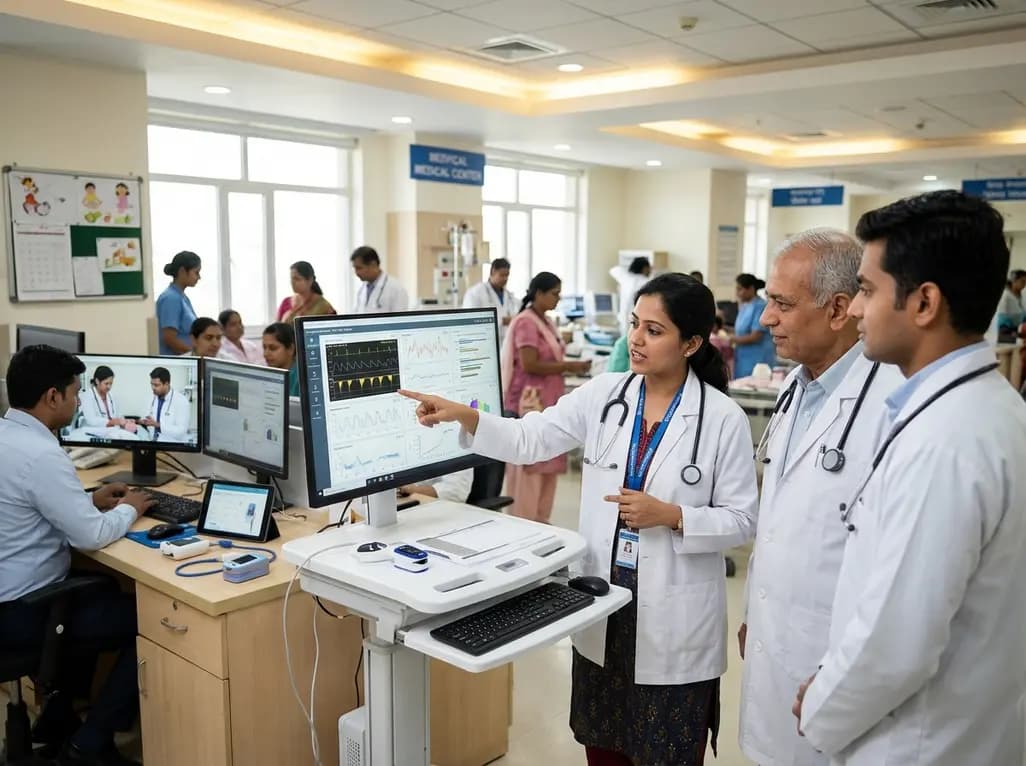
A landmark study details how an enterprise pediatric remote patient management model expanded from a single cardiology pilot to 16 diverse specialty programs by combining centralized digital operations with specialty clinical leadership.
Yesterday

A comparative review of tension band wiring and intramedullary screw fixation in thumb metacarpophalangeal arthrodesis, evaluating union rates, hardware complications, and clinical outcomes.
Yesterday

A breakthrough ultrathin multimodal sensor decouples physical hemodynamic monitoring from disposable electrochemical calibration, achieving long-term wearable glucose prediction with 81.36% accuracy and a 9.12% MARD. This offers a robust, drift-free solution for outpatient metabolic surveillance.
Yesterday
