

Loading, please wait...
Loading, please wait...

Rigorous biomedical research depends heavily on systematic reviews to distill thousands of clinical publications into actionable medical guidelines. However, manual bibliographic triage creates an overwhelming cognitive burden for clinicians and researchers. Recent advances in artificial intelligence offer promising automated alternatives to accelerate this laborious process. Modern open-source models now provide strong reasoning capabilities that streamline literature prioritization. Consequently, researchers evaluated whether a lightweight reasoning model could optimize evidence synthesis screening without sacrificing methodological precision.
Systematic reviews and clinical meta-analyses represent the cornerstone of evidence-based medicine. Nevertheless, synthesizing massive scientific databases demands hundreds of dedicated hours from subject-matter experts. Reviewers must manually inspect thousands of titles and abstracts to isolate relevant clinical trials. This labor-intensive screening process often leads to severe investigator fatigue, elevated operational costs, and prolonged project delays. Furthermore, human reviewers spend excessive energy rejecting clearly irrelevant publications because only a tiny fraction of citations meets true inclusion criteria. In resource-constrained environments, such as academic medical colleges across India, clinicians face demanding patient schedules alongside research responsibilities. Therefore, conventional dual-screening creates major logistical barriers to completing timely guideline reviews. Modern reasoning architectures interpret complex natural language instructions with remarkable precision. By grasping clinical context, these models identify nuanced population characteristics and intervention designs directly from abstract summaries. Consequently, implementing lightweight automated reasoning tools provides an attractive strategy to relieve manual workloads while safeguarding academic rigor.
To address screening bottlenecks, an innovative study published in JAMIA Open evaluated an open-source reasoning large language model called gpt-oss-20b. The investigators benchmarked the computational model against an expert-derived reference standard across three specialized clinical screening stages. Specifically, the evaluation examined base eligibility criteria across 200 records. It also assessed an obesity-focused subset of 200 records and 150 records focused on reproductive-age women. In addition, the model autonomously screened an overall dataset exceeding 20,000 bibliographic citations. Two expert reviewers established the reference standard by performing independent dual reviews on all test sets. The interreader agreement between these human reviewers reached near-perfect concordance, with kappa values between 0.99 and 1.00. This rigorous baseline provided an uncompromised gold standard for testing the artificial intelligence system. Importantly, unlike closed commercial platforms with expensive programming interfaces, this lightweight model operates open-source. As a result, research institutions can deploy the software locally on standard computing infrastructure without paying recurring vendor fees.
The computational evaluation demonstrated extraordinary fidelity between the lightweight reasoning model and the human expert standard. Overall, the model achieved an impressive F1-score ranging between 0.83 and 0.94 across the screening stages. Moreover, sensitivity—representing the critical recall metric necessary to prevent missing vital studies—reached 90% to 95%. In evidence synthesis, missing eligible clinical trials introduces fatal publication bias. Therefore, achieving high sensitivity is the most vital benchmark for any automated screening tool. Simultaneously, the model displayed robust specificity, ranging from 86% to 99%, alongside overall diagnostic accuracy between 89% and 94%. Precision spanned from 77% to 99%, while the negative predictive value remained exceptionally stable between 89% and 96%. These figures confirm that the model reliably eliminated non-relevant records without discarding crucial clinical investigations. Furthermore, the model handled specialized clinical sub-domains with commendable nuance. It correctly distinguished complex inclusion criteria involving metabolic parameters, obesity phenotypes, and reproductive healthcare demographics. Thus, the reasoning engine proved that parameter-efficient open-source architectures navigate intricate biomedical language successfully.
Beyond diagnostic accuracy, the study revealed transformative gains in operational throughput. Human reviewers maintained an average screening speed of approximately 1.0 record per minute during detailed bibliographic evaluations. In sharp contrast, the open-source reasoning model achieved an average screening rate of 19.4 records per minute. Consequently, the computational system processed literature nearly twenty times faster than experienced human investigators. This dramatic velocity shift holds profound implications for clinical research workflows. A standard comprehensive search often yields over twenty thousand database records. Screening that massive volume manually requires hundreds of person-hours, exhausting valuable clinical faculty who could otherwise focus on patient care. By contrast, the lightweight artificial intelligence model reviewed the entire database of 20,118 records within a fraction of that time. Furthermore, the model avoided cognitive fatigue, which frequently degrades human performance during prolonged repetitive screening. Therefore, adopting automated reasoning dramatically accelerates the timeline required to publish clinical evidence syntheses.
Integrating automated reasoning tools into healthcare research does not mean eliminating human clinical oversight. Instead, healthcare organizations should position the artificial intelligence model as a reliable first-line screening assistant. In a practical semi-automated workflow, the model rapidly discards unambiguous exclusions while flagging potentially eligible articles for second-tier human verification. This collaborative paradigm ensures that senior investigators concentrate their expertise where it matters most, resolving borderline inclusion decisions and synthesizing qualitative clinical findings. Furthermore, deploying open-source models locally addresses strict data governance and institutional privacy requirements. Proprietary cloud-based language models transmit institutional queries through third-party servers, raising potential ethical concerns. In contrast, running an open-weight reasoning model on local institutional hardware keeps all project data strictly on-premises. Indian research institutions, public health agencies, and clinical trial groups can harness these lightweight tools to synthesize localized evidence efficiently. For instance, teams assessing regional disease burdens can accelerate policy briefs without substantial computational overhead. Ultimately, incorporating open-source reasoning models bridges the gap between burgeoning biomedical literature and timely clinical decision-making.
An open-source reasoning model assists evidence synthesis by rapidly screening thousands of publication abstracts against predefined clinical eligibility criteria. Rather than relying on simple keyword matches, the model interprets complex medical concepts, patient demographics, and therapeutic interventions. This capability enables automated filtering that eliminates irrelevant citations with high precision. Consequently, clinical researchers save hundreds of manual hours, enabling faster publication of systematic reviews and updated clinical guidelines.
No, language models should serve as assistive screening tools rather than complete replacements for expert human reviewers. Although the model demonstrated sensitivity up to 95%, the remaining false negatives could inadvertently exclude critical clinical trials. Methodological standards for rigorous systematic reviews still demand expert human oversight to verify ambiguous citations, appraise study quality, and resolve subtle clinical discrepancies. Therefore, a hybrid workflow combining artificial intelligence speed with clinician expertise provides the safest approach.
Open-source models offer substantial advantages in data privacy, cost predictability, and customization. Unlike commercial proprietary software that charges recurring API fees, open-source architectures can run entirely on local institutional servers. This local deployment guarantees that proprietary research data and patient-sensitive bibliographies remain confidential. Additionally, academic institutions can fine-tune open-source models on specialized regional medical literature, enhancing screening accuracy for local epidemiological challenges without requiring expensive cloud subscriptions.
Disclaimer: This content is for informational and educational purposes only and does not substitute professional medical judgment or institutional research protocols. Refer to the latest local and national guidelines for clinical practice.
References
Dávila-García DM et al. Lightweight open-source reasoning large language model for evidence synthesis screening. JAMIA Open. 2026 Oct undefined. doi: 10.1093/jamiaopen/ooag210. PMID: 42920447.
Scherbakov D, Hubig N, Jansari V, Bakumenko A, Lenert LA. The emergence of large language models as tools in literature reviews. JAMIA Open. 2025;8(2):ocaf063. doi: 10.1093/jamia/ocaf063.
van de Schoot R, de Bruin J, Schram R, et al. An open source machine learning framework for efficient and transparent systematic reviews. Nat Mach Intell. 2021;3(2):125-133. doi: 10.1038/s42256-020-00287-7.

Read summarized clinical updates, watch expert medical content, and earn CME certifications right from your smartphone.
Open your smartphone camera to scan and install.





A study in JAMIA Open shows lightweight open-source reasoning LLMs achieve up to 95% sensitivity and accelerate evidence synthesis screening by nearly twentyfold, presenting a cost-effective, scalable AI solution for biomedical research and systematic reviews.
Today

The TREM-AB open-label pilot study evaluated a wearable passive nonlinear vibration absorber for essential tremor. The Nonlinear Energy Sink bracelet reduced clinical Fahn-Tolosa-Marin tremor scores by 32.1% and electrophysiological tremor power by 49.2% with no adverse effects reported.
Today
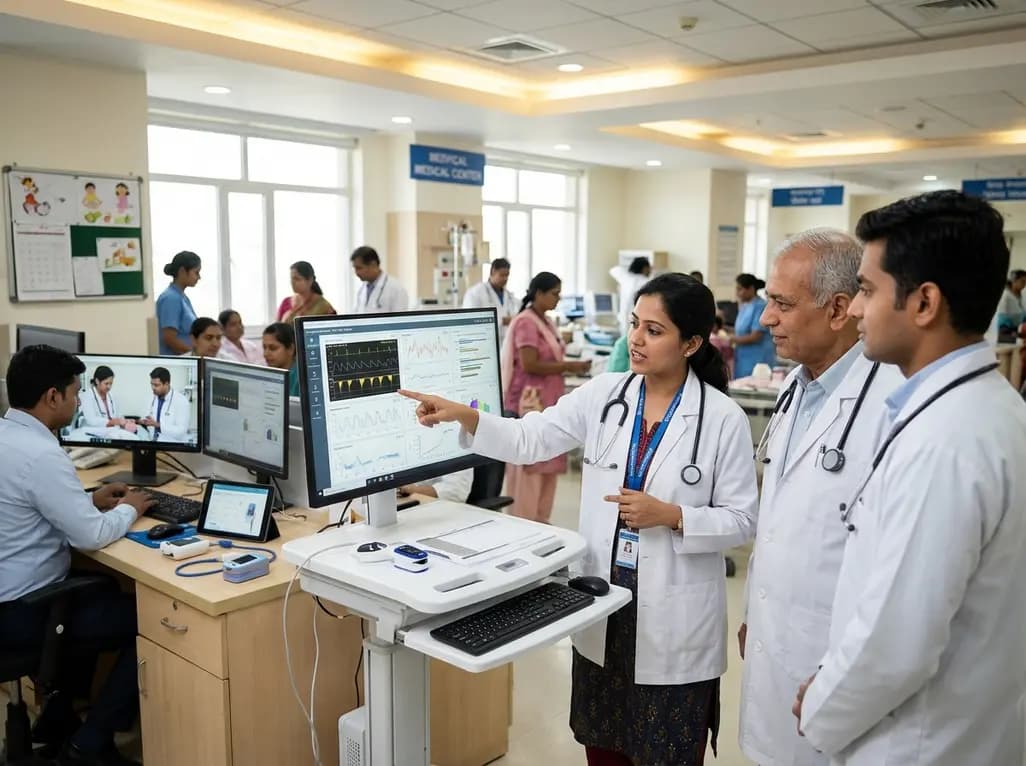
A landmark study details how an enterprise pediatric remote patient management model expanded from a single cardiology pilot to 16 diverse specialty programs by combining centralized digital operations with specialty clinical leadership.
Today

A comparative review of tension band wiring and intramedullary screw fixation in thumb metacarpophalangeal arthrodesis, evaluating union rates, hardware complications, and clinical outcomes.
Today
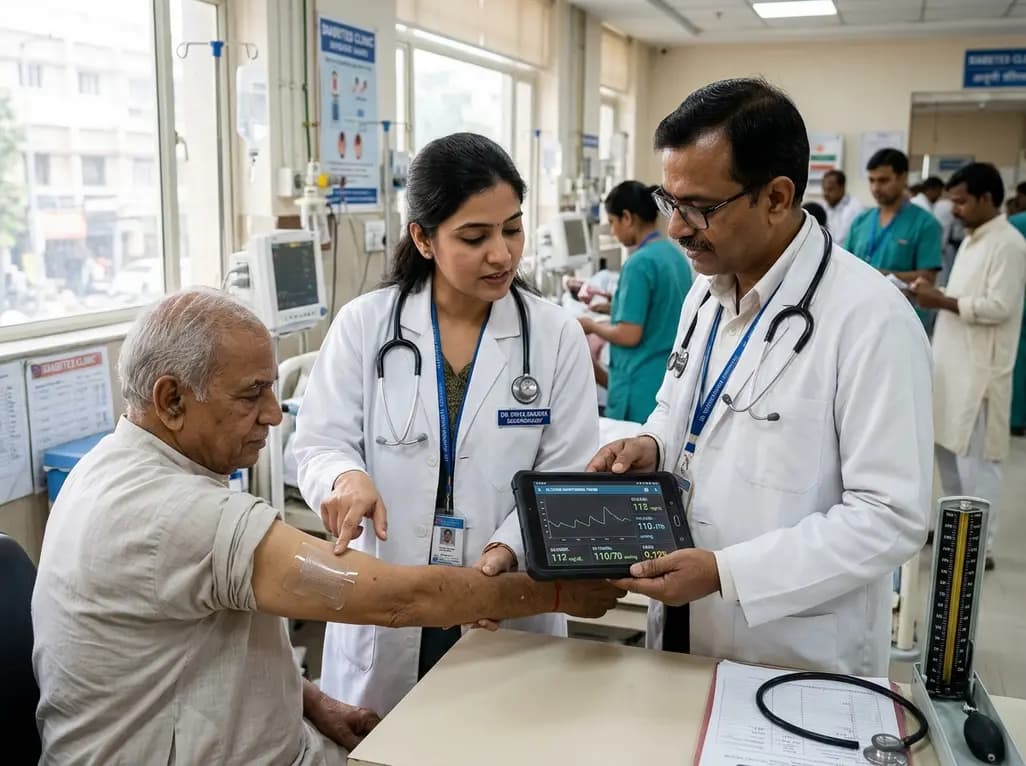
A breakthrough ultrathin multimodal sensor decouples physical hemodynamic monitoring from disposable electrochemical calibration, achieving long-term wearable glucose prediction with 81.36% accuracy and a 9.12% MARD. This offers a robust, drift-free solution for outpatient metabolic surveillance.
Today
