.webp&w=384&q=75)

Loading, please wait...
Loading, please wait...

Underutilised edible plants offer a promising way to enhance nutritional diversity in modern diets. Specifically, Stenochlaena palustris, a wild edible fern from Southeast Asia, demonstrates significant potential as a functional food ingredient. This study explores how Stenochlaena palustris nutrition integrates into contemporary food matrices, such as dates-based energy bars. Researchers aim to provide baseline data to support the use of this plant in plant-based food systems.
The research evaluated energy bars formulated with 2.5% and 5.0% fern powder. Notably, higher inclusion levels significantly boosted the nutrient density of the final product. Consequently, the fortified bars contained more dietary fibre, ash, and protein compared to the control formulation. Furthermore, the inclusion of the fern increased levels of vital minerals. These minerals include calcium, magnesium, iron, and zinc, which are crucial for maintaining metabolic health.
Physicochemical testing revealed that all formulations maintained water activity levels below 0.48. Low water activity ensures product stability and prevents microbial growth. Interestingly, total flavonoid content rose with higher fern inclusion. However, the control formulation exhibited the highest DPPH antioxidant activity in this specific composite sample analysis. Nevertheless, the study successfully validates the fern's role in improving the micronutrient profile of energy-dense snacks.
This edible fern contains significant amounts of calcium, magnesium, iron, and zinc. These minerals support bone health and various metabolic functions.
According to recent research, incorporating the fern powder at 2.5% or 5% inclusion levels does not significantly alter the total energy values of the food matrix.
Disclaimer: This content is for informational and educational purposes only. It does not constitute professional medical advice, diagnosis, or treatment. Always seek the advice of your physician or other qualified health provider with any questions you may have regarding a medical condition. Refer to the latest local and national guidelines for clinical practice.
References
Aliah N et al. Physicochemical and nutritional characteristics of an underutilised edible fern (Stenochlaena palustris) incorporated into a dates-based food matrix. BMC Res Notes. 2026 Jun 06. doi: 10.1186/s13104-026-07895-3. PMID: 42251452.
Pandiangan FI et al. A Review on the Health Benefits of Kalakai (Stenochlaena Palustris). J Funct Food Nutr. 2022;4(1):12-25. doi: 10.33555/jffn.v4i1.98.
Ndanusa AH et al. Analysis of the phytochemical contents and anti-oxidative properties of Stenochlaena palustris. Int Food Res J. 2020;27(5):811-818.

Read summarized clinical updates, watch expert medical content, and earn CME certifications right from your smartphone.
Open your smartphone camera to scan and install.





A study on the nutritional characteristics of Stenochlaena palustris (edible fern) when incorporated into dates-based food matrices for enhanced nutrition....
3 months ago

A 2026 meta-analysis evaluates PDE5 inhibitors in advanced ILD with severe gas exchange impairment. While overall mortality was not significantly reduced, a targeted subgroup with pulmonary hypertension showed a 49% risk reduction, underscoring the necessity of precise hemodynamic phenotyping.
Today

A multicentre RCT in China shows that the PAICS AI system significantly boosts sonographer sensitivity in detecting fetal intracranial malformations by 8.7% without compromising specificity, offering promising diagnostic support for prenatal neurosonography.
Today

The Supreme Court questioned FSSAI's phased warning approach, urging single-phase implementation for foods exceeding limits in any nutrient of concern. Backed by ICMR-NIN recommendations, the proposed red hexagonal warnings target added sugar, salt, and fat to combat India's escalating chronic disease epidemic.
Today

A premature neonate developed upper limb compartment syndrome after uterine rupture extruded the arm through a scar defect. Conservative management with continuous monitoring yielded complete functional recovery and normal limb growth at 10-year follow-up, highlighting non-operative safety in selected cases.
Today
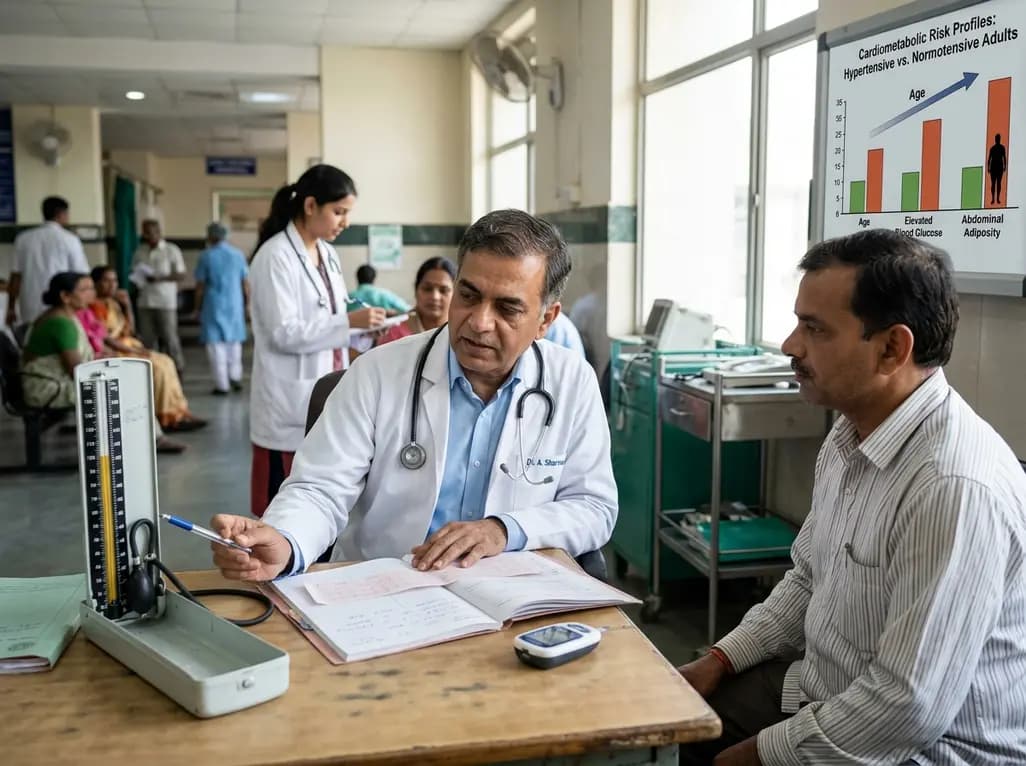
A comparative analysis shows that older age, elevated blood glucose, and abdominal adiposity are primary drivers of hypertension. Comprehensive evaluation of cardiometabolic risk profiles enables clinicians to detect overlapping metabolic dysfunctions early and optimize targeted prevention strategies.
Today
