.webp&w=384&q=75)

Loading, please wait...
Loading, please wait...

Unilateral cerebral palsy represents one of the most common physical disabilities emerging during early infancy. Clinicians frequently encounter diagnostic challenges when identifying subtle motor asymmetries during routine pediatric visits. Consequently, establishing timely diagnostic pathways remains a top priority. Early brain plasticity offers a unique developmental window where targeted motor therapy optimizes upper-limb function. However, standard diagnostic evaluations often occur after twelve months of age, delaying vital neurorehabilitative care. Conventional clinical assessments frequently demand extensive specialized training and hospital visits. For many families, geographical barriers and scheduling delays obstruct prompt clinical evaluations. In addition, infants often display uncooperative behavior in unfamiliar hospital settings, which distorts motor evaluations. To overcome these obstacles, researchers created the Screening Hand Assessment for Infants. This remote developmental tool empowers families to capture spontaneous manual behaviors within comfortable home surroundings. Therefore, clinicians can observe natural movement patterns without placing logistical burdens on healthcare centers. Early identification through such accessible methods enables practitioners to intervene before atypical motor patterns become entrenched. By addressing these diagnostic barriers, pediatricians can safeguard neurodevelopmental trajectories and initiate supportive care promptly.
The Screening Hand Assessment for Infants represents an innovative adaptation of the validated Hand Assessment for Infants. While the comprehensive clinical instrument evaluates twenty-two separate items, the screening version condenses the evaluation into six highly predictive unimanual items. Specifically, developers selected these core items using receiver operating characteristic analyses to detect subtle asymmetries. The streamlined test requires a brief five-minute video recording of semi-structured play using specific toys. During this session, the child interacts with engaging play objects that elicit unimanual reaching, grasping, and manipulating behaviors. Consequently, the scoring system assesses each hand independently across key movement parameters. Trained clinicians rate grasp ability, release quality, and finger dexterity using standardized ordinal scoring criteria. Moreover, the tool generates an Each Hand Sum score to identify functional discrepancies between limbs. This condensed format minimizes administrative duration while maintaining high diagnostic accuracy. Furthermore, digital application platforms provide structured guidance, enabling parents to prepare the play environment without clinical supervision. Thus, the screening tool provides an objective, standardized metric that integrates seamlessly into routine developmental surveillance pipelines.
A recent observational investigation conducted by Kembe and colleagues evaluated the practical feasibility and diagnostic validity of remote home evaluations. The investigators enrolled thirty infants aged 3.5 to 12 months who presented with established clinical risks for unilateral cerebral palsy. In this study, parents downloaded a dedicated smartphone application to record standardized play sessions in their domestic living spaces. In addition, the application provided comprehensive video tutorials and structured instructions regarding toy placement and infant positioning. Parents successfully conducted the five-minute interactive play protocol using standard toy kits mailed to their homes. Subsequently, families uploaded these video recordings directly to a secure medical server for professional analysis. In parallel, certified occupational therapists conducted formal in-person examinations using the full Hand Assessment for Infants within specialized hospital clinics. The research team evaluated the technical quality of parental recordings based on visual clarity, camera angles, and infant engagement. Furthermore, caregivers completed qualitative questionnaires detailing their personal experience and satisfaction with the remote recording protocol. By comparing home video ratings with clinical benchmarks, the researchers established an objective evidentiary foundation for decentralized infant screening.
The investigation yielded compelling empirical evidence supporting decentralized pediatric screening. Remarkably, parents recorded high-quality videos that satisfied professional diagnostic standards in nearly all instances. Furthermore, caregiver survey responses demonstrated outstanding acceptability, indicating that parents found the app intuitive and manageable. From an analytic perspective, the remote screening tool demonstrated exceptional concurrent validity when compared directly with clinic-based assessments. Specifically, the Each Hand Sum score achieved a strong correlation of r = 0.86 (p < 0.001) against the six-item reference standard. In addition, interrater reliability across independent blinded scorers proved outstanding. The intraclass correlation coefficient reached 0.96 for the affected hand and 0.95 for the non-affected hand. Individual items also displayed robust reliability ratings, ranging consistently from moderate to excellent agreement across examiners. Consequently, these metrics demonstrate that video recordings generated by caregivers provide dependable, reproducible clinical data. Moreover, the findings confirm that domestic environments do not compromise the diagnostic fidelity of hand function assessments. Therefore, clinicians can utilize remote video submissions with high diagnostic confidence. These results affirm that remote assessment platforms can replicate the measurement integrity of direct institutional examinations.
These findings offer significant practical value for pediatricians, neonatologists, and pediatric neurologists managing high-risk infants. In clinical practice, early detection protocols often falter due to limited access to certified therapists. However, remote screening empowers general practitioners to monitor vulnerable neonates across vast geographic territories. For example, infants with perinatal arterial ischemic stroke, intraventricular hemorrhage, or asymmetric neurological signs can undergo regular home surveillance. Therefore, clinicians can track asymmetrical motor development without requiring frequent family hospital travel. In addition, identifying asymmetrical hand function between 3.5 and 12 months enables timely initiation of modified constraint-induced movement therapy. Early goal-directed occupational therapy leverages peak neuroplasticity to preserve bilateral motor representations in the developing motor cortex. Furthermore, involving parents directly in screening strengthens family engagement and improves compliance with long-term therapeutic regimens. Consequently, caregivers transition from passive observers into active partners in developmental monitoring. In summary, utilizing remote assessments can alleviate diagnostic backlogs in tertiary hospitals while accelerating specialist referrals for children requiring comprehensive evaluations. Thus, decentralized screening models hold tremendous promise for modernizing pediatric rehabilitation pathways worldwide.
The screening Hand Assessment for Infants is specifically validated for infants between 3.5 and 12 months of age corrected for prematurity. This developmental timeframe represents a critical window of neuroplasticity. During this period, subtle unilateral hand asymmetries begin to manifest, allowing clinicians to identify cerebral palsy risk and initiate restorative therapy promptly.
While the full Hand Assessment for Infants evaluates twenty-two separate bilateral and unimanual motor items during clinical play, the s-HAI utilizes six selected unimanual items. This condensed format focuses explicitly on unimanual reaching and grasping performance, enabling rapid five-minute remote recordings by parents while preserving strong diagnostic validity and high reliability.
Yes, clinical research confirms that parents can record high-quality, scorable videos using a guided smartphone application. Standardized tutorials guide camera angles and toy presentation during a structured five-minute play session. Blown-up technical errors remain rare, and certified therapists achieve excellent interrater agreement when scoring these home-recorded parental video submissions.
Disclaimer: This content is for informational and educational purposes only and does not constitute medical advice, diagnosis, or treatment. Healthcare professionals should exercise their independent clinical judgment. The information is not exhaustive and should not substitute clinical consultation. Refer to the latest local and national guidelines for clinical practice.
References

Read summarized clinical updates, watch expert medical content, and earn CME certifications right from your smartphone.
Open your smartphone camera to scan and install.





A recent study evaluates the screening Hand Assessment for Infants (s-HAI) via parent smartphone recordings, demonstrating high feasibility, concurrent validity, and interrater reliability for early detection of unilateral cerebral palsy.
Today

Left bundle branch pacing is an emerging physiological resynchronization strategy for heart failure. While observational data and some trials show benefits over biventricular pacing, divergent trial outcomes highlight the importance of confirmed conduction capture and specialized operator technique.
Today

A retrospective study of 86,012 pregnancies demonstrates that size-selective cfDNA enrichment boosts mean fetal fraction to 18.88% and achieves a 59.20% PPV for fetal copy number variants. However, 85.83% of CNVs showed size discrepancies, underscoring the mandatory role of confirmatory microarray testing.
Today
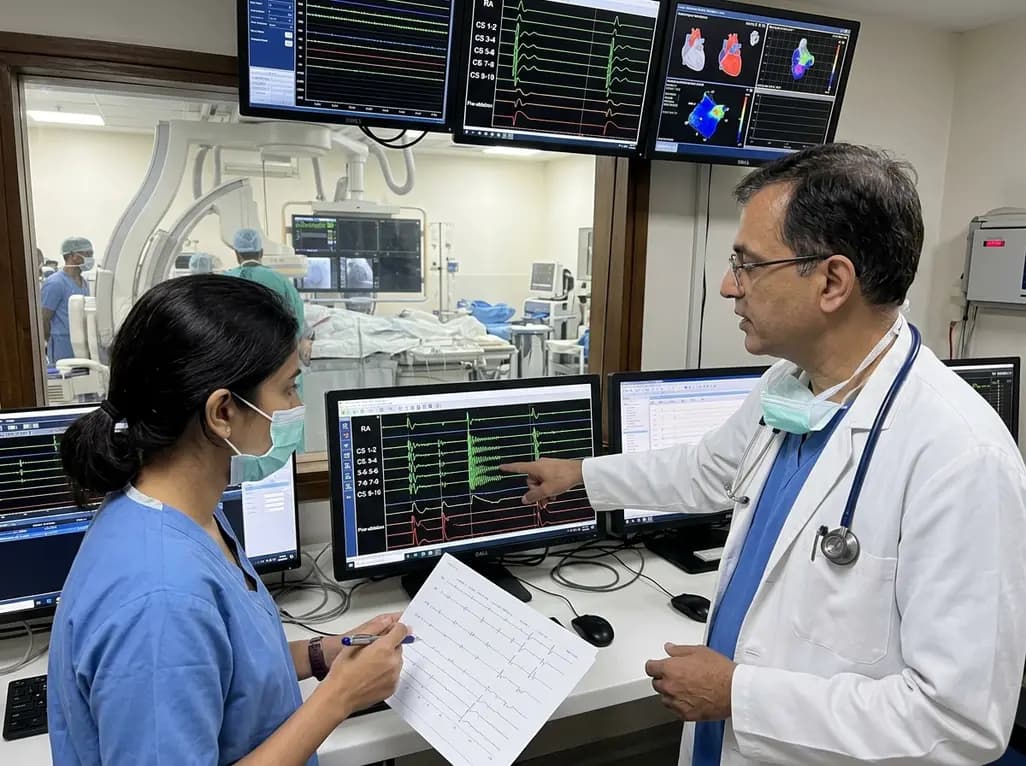
Radiofrequency catheter ablation of the cavotricuspid isthmus successfully terminates typical atrial flutter. This article reviews the mechanisms driving coronary sinus electrogram changes, wavefront activation pathways, and clinical criteria to verify bidirectional block during electrophysiology studies.
Today

A recent investigation examined load-dependent kinetic and kinematic profiles during two-way ballistic exercise across 30% to 80% 1-RM. Findings highlight load effects on velocity, impulse, and power, offering sports physicians objective guidance for neuromuscular conditioning and rehabilitation.
Today

A cross-sectional study demonstrates that increased BMI in adolescents significantly enhances mandibular length and alters salivary adipokines like adiponectin and resistin, providing novel insights into craniofacial growth and orthodontic planning.
Today
