.webp&w=384&q=75)

Loading, please wait...
Loading, please wait...

Modern sports medicine increasingly relies on biomechanical data to fine-tune athletic rehabilitation and performance. Neuromuscular conditioning often utilizes two-way ballistic exercise to enhance explosive power and kinetic chain coordination. Unlike traditional resistance exercises that enforce a terminal deceleration phase, ballistic movements allow athletes to accelerate continuously throughout the concentric action. Furthermore, two-way ballistic variations integrate rapid transitions between eccentric deceleration and concentric acceleration. Consequently, these movements challenge the stretch-shortening cycle under dynamic constraints.
Sports physicians and conditioning specialists frequently encounter challenges when prescribing precise external resistance. Because traditional percentage-based loading fails to account for velocity decay, practitioners often miscalculate neuromuscular strain. Therefore, understanding the interplay between external load and movement velocity remains paramount. Recent investigations have sought to establish clear kinematic baselines across varying intensities. In doing so, clinicians can better bridge the gap between high-velocity motor unit recruitment and safe orthopedic loading. Ultimately, these insights help practitioners tailor rehabilitation programs that safely restore explosive capacity while minimizing reinjury risks.
To characterize these biomechanical dynamics, investigators recruited twenty-four highly trained male athletes classified as Tier 3 competitors. Each participant completed standardized testing sessions using a specialized ballistic apparatus. Specifically, the researchers evaluated one-repetition maximum percentages ranging systematically from 30% to 80% 1-RM in a randomized sequence. This structured randomization effectively minimized neuromuscular fatigue and order effects during testing.
During the upward propulsive phase of each repetition, the research team recorded multiple kinetic and kinematic variables. These primary outcomes included mean propulsive velocity, peak force, mechanical power output, and the initial 100-millisecond impulse. Additionally, linear regression models helped the team evaluate load-velocity, load-impulse, and load-power relationships across all intensity conditions. The investigators utilized one-way analysis of variance to determine the statistical significance of load alterations. Consequently, this comprehensive methodological framework provided robust data regarding mechanical shifts across light, moderate, and heavy loading spectrums. These rigorous protocols established an objective biomechanical foundation for sports clinicians.
The experimental results revealed pronounced load-dependent alterations across several key kinetic measures. Notably, the researchers observed significant main effects of load on mean propulsive velocity, mechanical power output, and early propulsive impulse. As external load increased from 30% to 80% 1-RM, propulsive velocity declined in a predictable linear manner. However, early force generation demonstrated contrasting behavior. Specifically, the 100-millisecond impulse showed marked increases under heavier loading parameters, reflecting greater initial muscle activation requirements.
Furthermore, mechanical power output exhibited a parabolic distribution across the tested intensities. Moderate loads elicited optimal power outputs, balancing force production and movement velocity effectively. In contrast, lighter loads prioritized movement speed at the expense of absolute force production. Heavy loads maximized mechanical strain while substantially reducing contraction velocities. Thus, the impulse-velocity equilibrium analysis clarifies how neuromuscular systems trade velocity for force when resisting external loads. These findings provide sports physicians with precise mathematical benchmarks to evaluate athlete performance and monitor mechanical output during recovery.
These biomechanical findings carry substantial implications for clinical sports medicine and injury prevention strategies. Because athletic injuries frequently occur during rapid eccentric-to-concentric transitions, training the stretch-shortening cycle requires precise load prescription. For instance, prescribing excessively heavy loads during early rehabilitation may impair velocity recovery and increase articular shear stress. Conversely, training exclusively with light loads may fail to stimulate necessary structural adaptations in tendons and myofibrils.
Therefore, sports clinicians must balance force generation and movement speed across different phases of return-to-sport programs. By referencing objective load-velocity profiles, practitioners can systematically progress athletes through targeted physiological adaptations. Moreover, early impulse metrics offer clinicians a sensitive tool to assess explosive force readiness following lower-limb musculoskeletal injuries. When athletes achieve targeted impulse-velocity thresholds without pain or movement compensation, clinicians can confidently advance them to sport-specific activities. Consequently, this objective monitoring reduces the risk of premature athletic clearance and secondary tissue failure.
Integrating velocity-based ballistic training into clinical practice requires thoughtful implementation and appropriate monitoring technology. Practitioners should utilize linear position transducers or wearable accelerometers to capture real-time kinematic data during rehabilitation sessions. Furthermore, clinicians can adjust daily resistance based on velocity loss cutoffs rather than static weight assignments. This autoregulatory approach ensures that athletes train within the desired physiological zone regardless of daily neuromuscular fatigue.
Additionally, rehabilitation teams should individualize loading parameters according to the athlete's specific sport demands. For example, athletes in sprinting and jumping sports require high-velocity ballistic movements under lighter loads to regain neuromuscular firing rates. In contrast, collision-sport athletes may require greater focus on the high-impulse qualities developed under moderate to heavy loads. Importantly, clinicians should continuously re-evaluate these kinetic profiles to track neuromuscular recovery over time. By incorporating evidence-based impulse-velocity profiles, sports medicine practitioners in India and worldwide can optimize functional outcomes and accelerate safe athletic reintegration.
Although current research provides clear insights into male athletes, future investigations should expand across broader clinical populations. Specifically, sports medicine researchers must evaluate how female athletes, adolescent competitors, and older master athletes respond to two-way ballistic protocols. Because hormonal variations and connective tissue properties influence tendon stiffness, load-velocity profiles may differ significantly across diverse demographic groups. Moreover, studying patient cohorts recovering from specific orthopedic surgeries, such as anterior cruciate ligament reconstruction, remains essential.
In addition, combining kinetic profiling with surface electromyography could elucidate underlying neural mechanisms during ballistic contractions. Understanding motor unit synchronization and rate coding will allow clinicians to refine therapeutic interventions further. As velocity-tracking devices become more accessible and affordable in clinical settings, routine biomechanical screening will likely become standard practice in Indian sports medicine centers. Consequently, multidisciplinary rehabilitation teams will possess better diagnostic tools to guide therapeutic decision-making. Through continued research, sports physicians can establish universal guidelines that harmonize athletic performance enhancement with musculoskeletal preservation.
Two-way ballistic exercise differs fundamentally from traditional resistance training by eliminating the involuntary deceleration phase at the end of the concentric movement. During traditional lifting, muscles decelerate to protect joint integrity. In contrast, ballistic movements encourage continuous acceleration throughout the entire range of motion. Furthermore, two-way variations incorporate rapid eccentric deceleration immediately followed by explosive concentric action, challenging the neuromuscular system dynamically.
Kinematic research demonstrates that propulsive velocity decreases in a linear fashion as external load increases from light to heavy intensities. Conversely, the initial 100-millisecond impulse increases markedly with heavier loads because the muscular system must recruit high-threshold motor units rapidly to overcome external resistance. Therefore, practitioners use light loads to target movement velocity and heavier loads to stimulate early force development.
Impulse-velocity profiling provides objective, quantifiable metrics to evaluate an athlete's neuromuscular readiness during rehabilitation. Traditional clinical assessments often rely on subjective visual analysis or static strength measures, which fail to capture dynamic power deficits. By monitoring velocity loss and early impulse across varying loads, sports physicians can identify lingering neuromuscular asymmetries, guide safe loading progression, and successfully prevent premature return to competitive sport.
Disclaimer: This content is for informational and educational purposes only... Refer to the latest local and national guidelines for clinical practice.
References

Read summarized clinical updates, watch expert medical content, and earn CME certifications right from your smartphone.
Open your smartphone camera to scan and install.





A recent investigation examined load-dependent kinetic and kinematic profiles during two-way ballistic exercise across 30% to 80% 1-RM. Findings highlight load effects on velocity, impulse, and power, offering sports physicians objective guidance for neuromuscular conditioning and rehabilitation.
Today

Left bundle branch pacing is an emerging physiological resynchronization strategy for heart failure. While observational data and some trials show benefits over biventricular pacing, divergent trial outcomes highlight the importance of confirmed conduction capture and specialized operator technique.
Today

A retrospective study of 86,012 pregnancies demonstrates that size-selective cfDNA enrichment boosts mean fetal fraction to 18.88% and achieves a 59.20% PPV for fetal copy number variants. However, 85.83% of CNVs showed size discrepancies, underscoring the mandatory role of confirmatory microarray testing.
Today
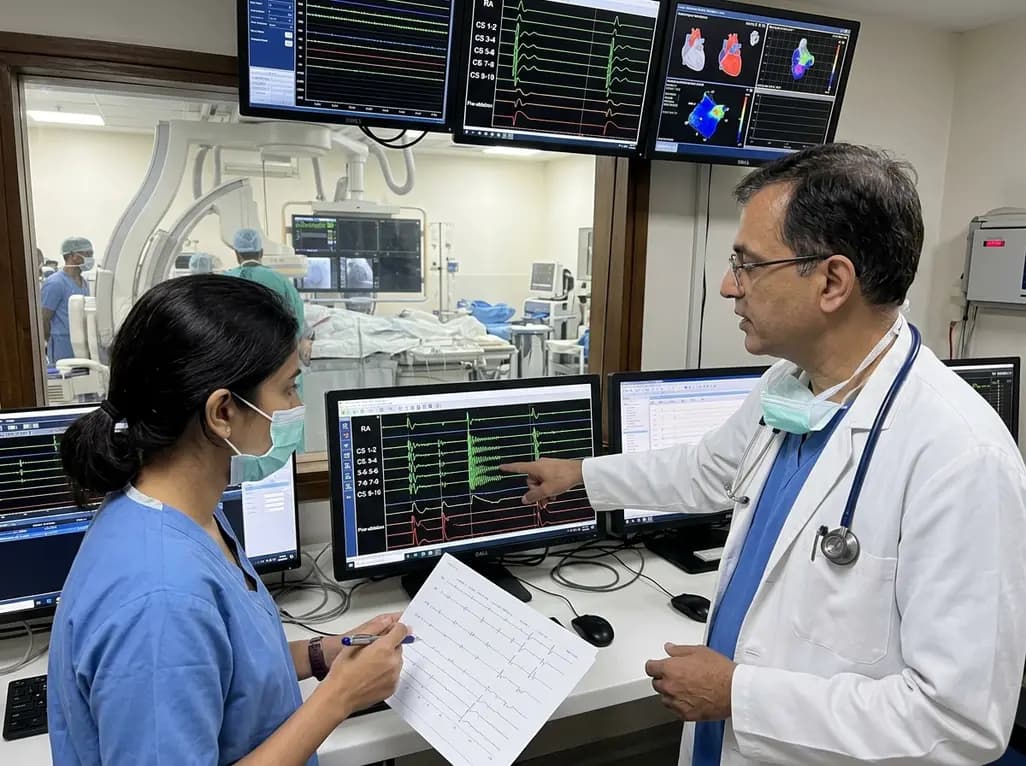
Radiofrequency catheter ablation of the cavotricuspid isthmus successfully terminates typical atrial flutter. This article reviews the mechanisms driving coronary sinus electrogram changes, wavefront activation pathways, and clinical criteria to verify bidirectional block during electrophysiology studies.
Today

A cross-sectional study demonstrates that increased BMI in adolescents significantly enhances mandibular length and alters salivary adipokines like adiponectin and resistin, providing novel insights into craniofacial growth and orthodontic planning.
Today
