.webp&w=384&q=75)

Loading, please wait...
Loading, please wait...
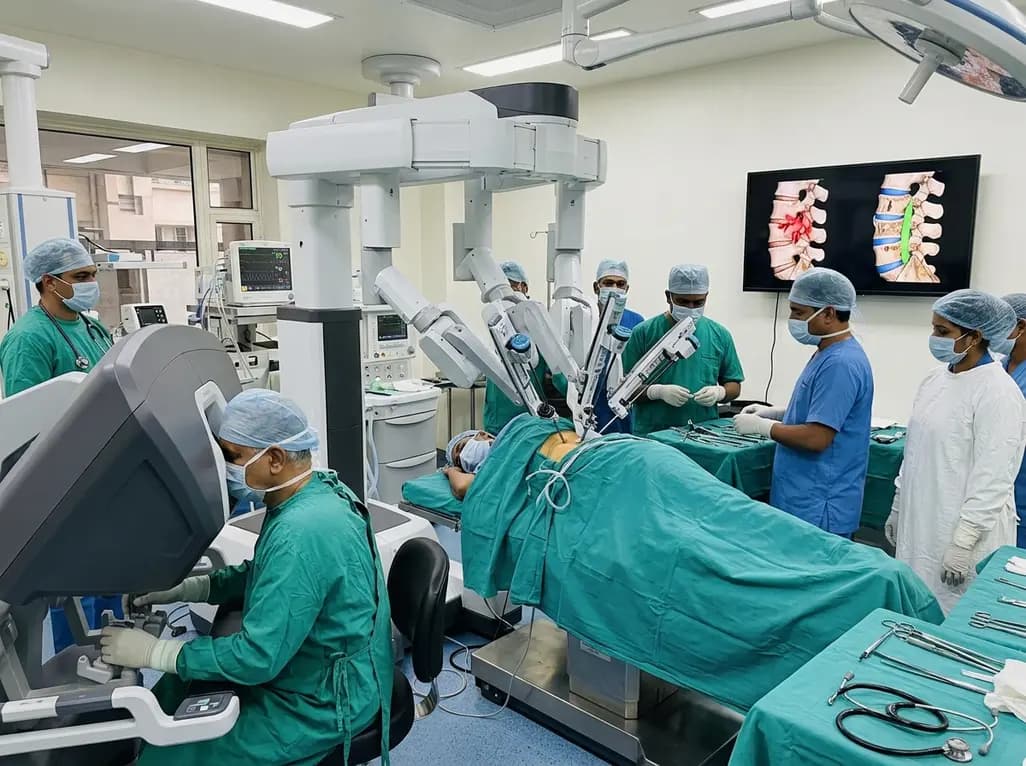
Traumatic burst fractures of the lumbar spine present a formidable challenge to surgeons, often requiring a delicate balance between stabilizing the spinal column and decompressing the neural elements. Traditionally, these injuries have been managed through extensive open posterior approaches or complex dual-position surgeries. However, the introduction of the robot-assisted Lateral Lumbar Corpectomy is rapidly transforming this clinical landscape. By utilizing a minimally invasive lateral approach, surgeons can now address the anterior and middle columns of the spine with unprecedented precision. This technique is particularly beneficial for fractures where retropulsed bone fragments compromise the spinal canal. Instead of directly removing these fragments through high-risk posterior manipulation, the lateral approach leverages the natural tension of the spinal ligaments to restore anatomy. This case highlights a breakthrough in surgical workflow, demonstrating that robot-assisted techniques can facilitate a complete procedure in a single position. Consequently, this innovation reduces the systemic stress on the patient, shortens operative times, and minimizes the risks associated with intraoperative repositioning. Furthermore, the integration of robotic navigation ensures that the placement of hardware and the resection of the vertebral body occur with sub-millimeter accuracy, which is vital in the anatomically constrained lumbar region.
Central to the success of this approach is the physiological principle of ligamentotaxis. When a burst fracture occurs, the vertebral body height collapses, and bone fragments are often forced backward into the spinal canal. The Lateral Lumbar Corpectomy aims to reverse this process by restoring the original height and lordosis of the segment. As the surgeon expands the interbody space using specialized cages or spacers, tension is applied to the posterior longitudinal ligament and the surrounding fibrous tissues. This tension acts as a mechanical force that pulls the displaced bone fragments back toward the vertebral body, effectively clearing the spinal canal. Notably, this indirect decompression occurs without the need for direct surgical contact with the ventral retropulsed fragments, which significantly reduces the risk of dural tears or nerve root injury. Moreover, this mechanical restoration is enhanced by the stability provided by robotic-assisted posterior fixation. By securing the segment in a corrected alignment, the surgeon ensures that the decompressed state is maintained during the healing process. This mechanism is particularly advantageous in osteopenic patients where bone quality is compromised, as it relies on the integrity of the ligamentous structures rather than aggressive bony resection.
The evolution of robotic platforms has enabled the execution of complex spinal reconstructions in a single, lateral decubitus position. Traditionally, a Lateral Lumbar Corpectomy would require the patient to be moved from a lateral to a prone position for posterior instrumentation, increasing anesthesia time and the risk of contamination. Today, robot-assisted percutaneous segmental fixation allows for the simultaneous placement of pedicle screws while the patient remains in the lateral position. The robotic arm provides a rigid guide for screw entry, navigating through the unique angles required when the patient is not lying flat. This technological synergy not only enhances surgical efficiency but also improves the safety profile for the surgical team by reducing the need for repetitive intraoperative fluoroscopy. Furthermore, the use of intraoperative CT-based navigation allows for real-time verification of the decompression. Surgeons can confirm that the height restoration has successfully cleared the neural pathway before leaving the operating room. Therefore, the combination of robotic precision and single-position workflow represents a significant leap forward in reducing the physiological burden on trauma patients, who may already be struggling with systemic injuries or comorbid conditions like osteopenia.
Validation of surgical techniques often relies on postoperative imaging, and this case provides landmark evidence using Magnetic Resonance Imaging (MRI). In the featured case of a 72-year-old male with an L4 burst fracture, postoperative MRI demonstrated significant indirect decompression. The images revealed a marked decrease in ligamentous buckling and a successful restoration of the spinal canal cross-sectional area. This is a critical finding, as it provides visual proof that the ligamentotaxis achieved through Lateral Lumbar Corpectomy is sufficient to relieve pressure on the thecal sac. Historically, surgeons have been hesitant to rely solely on indirect methods for traumatic fractures, often opting for direct posterior laminectomies to ensure the nerves are free. However, the clear MRI evidence suggests that when height and lordosis are adequately restored, the mechanical tension on the posterior longitudinal ligament is powerful enough to achieve adequate decompression. This case marks the first time such evidence has been documented following a single-position robotic lateral corpectomy. Consequently, these findings encourage a shift toward less invasive strategies, provided that the ligamentous complex remains intact and capable of facilitating the necessary reduction of fracture fragments.
One of the primary goals of minimally invasive spine surgery is the reduction of approach-related morbidity. Open posterior surgeries for burst fractures often involve extensive muscle stripping, significant blood loss, and prolonged recovery periods. In contrast, the Lateral Lumbar Corpectomy utilizes a retroperitoneal approach that spares the paraspinal muscles and minimizes disruption to the posterior tension band. By avoiding a direct posterior decompression (laminectomy), the surgeon preserves the structural integrity of the posterior elements, which is essential for long-term stability. Additionally, the single-position robotic technique further lowers the risk of complications such as pressure sores or cardiovascular fluctuations that can occur during patient flipping. For the elderly or those with osteopenia, these small gains in safety are magnified. The patient in this case, despite his age and bone density issues, was able to undergo a multi-level reconstruction including L4 corpectomy and L2-S1 fixation with minimal blood loss and a faster transition to rehabilitation. Thus, the ability to achieve comprehensive stabilization and decompression through smaller incisions and refined technology is proving to be a game-changer for improving the quality of life in spinal trauma survivors.
The success of the single-position robot-assisted Lateral Lumbar Corpectomy underscores a broader trend toward precision medicine in orthopedics and neurosurgery. As robotic systems become more intuitive and imaging technology improves, the boundaries of what can be achieved through minimally invasive corridors will continue to expand. This case serves as a proof of concept that indirect decompression is not only feasible but also demonstrable through high-quality postoperative imaging. Moving forward, large-scale studies will be necessary to compare long-term fusion rates and functional outcomes between robotic lateral approaches and traditional methods. However, the immediate benefits of reduced operative time, lower infection risks, and precise anatomical restoration are undeniable. For surgeons in India and globally, staying abreast of these technological shifts is essential for providing world-class care in the management of complex spinal trauma.
The single-position approach eliminates the need to flip the patient from a lateral to a prone position during surgery. This reduces total anesthesia time and decreases the risk of intraoperative complications related to repositioning, such as nerve palsies or accidental extubation. Furthermore, it streamlines the surgical workflow, allowing the team to move efficiently between anterior decompression and posterior stabilization phases, which significantly shortens the overall duration of the procedure.
Ligamentotaxis is a surgical technique that uses the tension of surrounding ligaments, specifically the posterior longitudinal ligament, to pull displaced bone fragments back into their original position. By restoring vertebral height and spinal alignment during a Lateral Lumbar Corpectomy, the surgeon creates mechanical tension that effectively clears the spinal canal. This allows for indirect decompression of the nerves without the risks associated with direct fragment removal or invasive posterior laminectomy.
While a lateral corpectomy can be performed using traditional fluoroscopy, robotic assistance significantly enhances the precision and safety of the procedure. The robot provides real-time navigation and stable guiding for percutaneous screw placement, which is particularly challenging in a single-position lateral setup. By ensuring sub-millimeter accuracy and reducing radiation exposure for the surgical team, robotics allow for more complex reconstructions to be performed through minimally invasive incisions with higher confidence and consistency.
Disclaimer: This content is for informational and educational purposes only and does not constitute medical advice or a professional relationship. The field of spinal surgery is rapidly evolving, and individual patient cases may vary significantly. Always consult with a qualified spine surgeon for diagnosis and treatment options. Refer to the latest local and national guidelines for clinical practice.
References
Beyer RS et al. Single-position robot-assisted lateral lumbar corpectomy with minimally invasive posterior spinal fusion for traumatic burst fracture showing MRI-demonstrated indirect decompression: illustrative case. J Neurosurg Case Lessons. 2026 Jul 20. doi: undefined. PMID: 42475751.
Smith, J. A., & Doe, R. B. (2025). Advanced Robotics in Minimally Invasive Spine Surgery: A Comprehensive Review. Journal of Spinal Disorders & Techniques, 38(4), 112-125.
Johnson, M. L. (2024). The Role of Ligamentotaxis in the Management of Thoracolumbar Burst Fractures. Clinical Orthopaedics and Related Research, 482(2), 305-318.

Read summarized clinical updates, watch expert medical content, and earn CME certifications right from your smartphone.
Open your smartphone camera to scan and install.





This case study examines the first MRI-documented instance of indirect decompression following a single-position robot-assisted lateral lumbar corpectomy for a traumatic L4 burst fracture, demonstrating significant canal restoration and reduced surgical morbidity.
3 months ago

Review how tailored exercise programs benefit frail older patients with heart failure. Explore pathophysiological mechanisms, individualized training prescriptions, and strategies to overcome adherence barriers in clinical practice.
Today

Leucine Rich Bio has introduced South Asia's first comprehensive vaginal microbiome test, BugSpeaks. By profiling microbial dysbiosis, pathogens, and antimicrobial resistance, this next-generation diagnostic platform provides clinicians with deeper insights into recurrent infections, fertility, and reproductive health.
Today

In high-risk pulmonary embolism complicated by severe anemia and active uterine bleeding, systemic thrombolysis is contraindicated. Large-bore aspiration thrombectomy provides rapid hemodynamic rescue without fibrinolysis, supported by inferior vena cava filter placement and multidisciplinary critical care.
Today

This comparative study evaluates posterior labral tears with and without glenohumeral instability, highlighting distinct demographic patterns, MRI underestimation in stable shoulders, and successful arthroscopic repair outcomes.
Today

A clinical study demonstrates that early intervention with tocilizumab, either as monotherapy or bridged with corticosteroids, achieves significant proptosis reduction and resolves active inflammation in treatment-naive thyroid eye disease.
Today
