.webp&w=384&q=75)

Loading, please wait...
Loading, please wait...

Managing congenital cervical conditions like Klippel-Feil syndrome (KFS) and os odontoideum requires meticulous surgical planning. These disorders often involve fused vertebral segments and significant instability at the craniovertebral junction. Furthermore, patients frequently present with hidden vascular variations. Recently, surgeons utilized robot-assisted cervical fusion to successfully navigate these anatomical challenges in a complex case. This technology provides a level of precision that traditional methods may struggle to achieve.
Vertebral artery (VA) anomalies are well-documented in patients with atlantoaxial dislocations. However, some cases present with unique courses that deviate from standard clinical expectations. For instance, a 65-year-old female patient with progressive cervical myelopathy exhibited bilateral ectatic VAs. Notably, these vessels coursed beneath the posterior arch of C1 despite the absence of atlas occipitalization. Consequently, such variations increase the risk of catastrophic vascular injury during standard fixation procedures. Therefore, clinicians must prioritize detailed preoperative imaging to identify these ectatic vessels early.
The integration of robotics and neuronavigation marks a significant shift in spinal surgery. In this illustrative case, the surgical team performed a C1-4 fixation and foramen magnum decompression. By using robot-assisted cervical fusion, the surgeons ensured highly accurate screw placement away from the anomalous vertebral arteries. Additionally, intraoperative neurophysiological monitoring provided real-time feedback on spinal cord function. This combined approach significantly mitigates risks. It allows for a safer decompression in patients whose anatomy is severely altered by fused segments and congenital malformations.
Vigilance is paramount when treating KFS and os odontoideum. Because fused segments can obscure landmarks, standard entry points for screws may be unsafe. Robot-assisted systems allow for a customized surgical plan based on three-dimensional reconstructions of the patient\'s unique anatomy. Ultimately, this technology ensures optimal patient outcomes in high-stakes neurosurgical environments.
KFS leads to congenital fusion of cervical vertebrae, which alters standard landmarks and often hides vertebral artery anomalies, significantly increasing the risk of intraoperative vascular injury.
The primary benefit is enhanced precision. It uses robotic guidance and real-time navigation to place hardware safely, even when a patient has highly atypical or ectatic blood vessel paths.
Disclaimer: This content is for informational and educational purposes only and does not constitute medical advice or a professional relationship. Always seek the advice of a qualified healthcare provider for any questions regarding a medical condition. Refer to the latest local and national guidelines for clinical practice.
References
Baig Mirza A et al. Robot- and navigation-assisted cervical fusion and decompression for complex vertebral artery anomalies in os odontoideum with Klippel-Feil syndrome: illustrative case. J Neurosurg Case Lessons. 2026 May 11. doi: undefined. PMID: 42114166.
Naz S, et al. Surgical Management Of Irreducible Atlanto-Axial Dislocation With OS Odontoideum And Klippel-Feil Syndrome. J Ayub Med Coll Abbottabad. 2022;34(3):573-577.
Kim KH, et al. Two Cases of Klippel-Feil Syndrome with Cervical Myelopathy Successfully Treated by Simple Decompression without Fixation. Neurospine. 2015;12(3):135-140.
"
Read summarized clinical updates, watch expert medical content, and earn CME certifications right from your smartphone.
Open your smartphone camera to scan and install.





A case study on robot-assisted surgery for a patient with Klippel-Feil syndrome, os odontoideum, and unique vertebral artery anomalies....
5 months ago

Following regulatory scrutiny from FSSAI regarding promotional representations and lean muscle preservation claims, Dr. Reddy's Laboratories and Nestlé Health Science are currently reviewing the branding and marketing strategy for their joint nutritional supplement Celevida GLP+.
Today
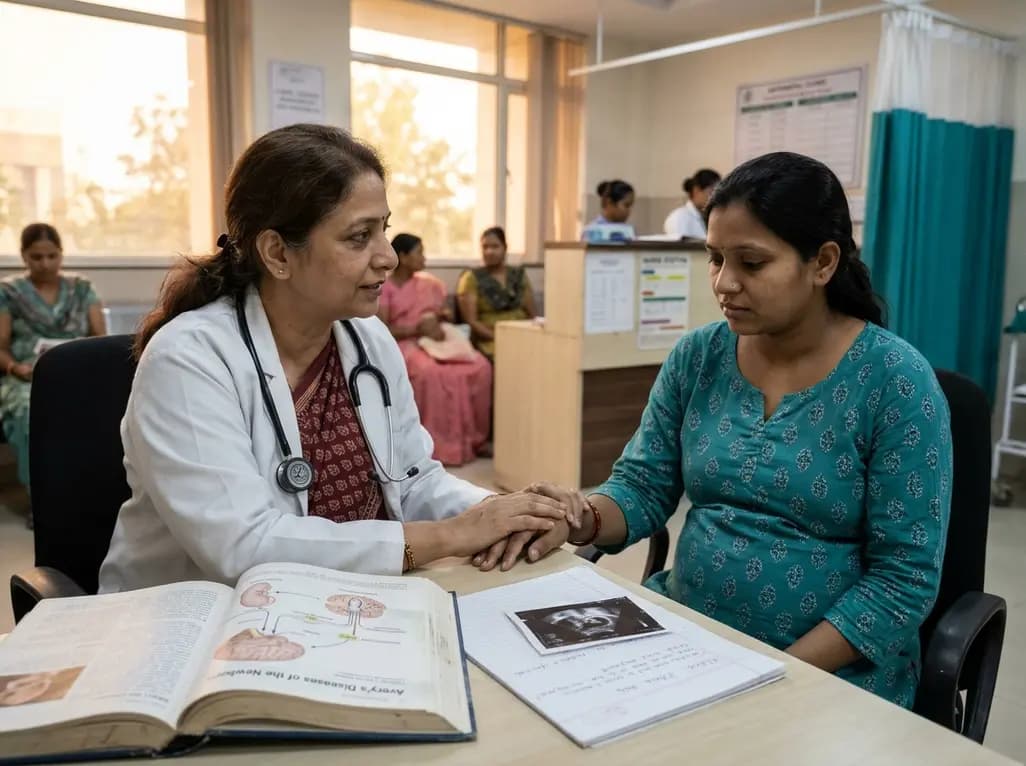
A comprehensive scoping review synthesises evidence linking prenatal maternal mental health to long-term offspring neurodevelopment, evaluating neuroendocrine, inflammatory, and epigenetic pathways while highlighting clinical screening and future research priorities.
Today

The Directorate General of Health Services directs Indian states to halt the hazardous reuse and reprocessing of single-use medical devices. Discover regulatory implications under the Drugs and Cosmetics Act, critical infection risks, legal liabilities, and operational changes required across clinical specialties.
Today

A 25-year multi-institutional cohort reveals high recurrence rates in pediatric giant cell tumor of bone, particularly in patients with open physes and bone marrow edema on preoperative MRI. Early surveillance and careful balance between growth plate preservation and tumor clearance are essential.
Today

India is advancing preventive healthcare by integrating genomics, artificial intelligence, and quantum technologies. With the SANGAM programme sequencing one million Indian genomes, clinicians can unlock personalized therapies, detect cardiometabolic risks early, and curb the burden of diabetes and heart disease.
Today
