.webp&w=384&q=75)

Loading, please wait...
Loading, please wait...

Modern oncology care increasingly relies on oral anticancer therapies to treat solid malignancies. Oral capecitabine adherence represents a paramount clinical concern for oncologists managing patients with early-stage and advanced breast cancer. Capecitabine offers undeniable convenience by shifting cancer therapy from the infusion chair to the home. However, this self-administered regimen introduces major behavioral challenges that can compromise treatment success.
Patients receive capecitabine on a cyclical schedule requiring twice-daily dosing for fourteen days, followed by a seven-day pause. Therefore, individuals must manage complex schedules, track changing pill counts, and remember rest intervals without direct oversight. Furthermore, patients often struggle to differentiate expected adverse reactions from severe toxicities such as hand-foot syndrome, diarrhea, or myelosuppression. Consequently, treatment fatigue and unmonitored side effects frequently trigger premature discontinuations or missed doses. In addition, when medication tracking relies solely on retrospective self-reporting, clinicians cannot detect lapses in real time. Suboptimal adherence can silently cause therapeutic failure, accelerate disease recurrence, and compromise long-term survival.
Health literacy encompasses an individual's ability to obtain, process, and understand basic medical instructions needed to make appropriate health decisions. In outpatient cancer chemotherapy, adequate health literacy enables patients to follow complex dosing regimens, manage adverse symptoms, and contact care teams promptly. Conversely, patients with limited health literacy encounter substantial barriers during unsupervised oral therapy.
Research demonstrates that patients facing literacy challenges frequently misunderstand written prescription labels and cyclical timelines. For example, instructions demanding varying pill quantities twice daily with meals can confuse individuals with low health numeracy. Furthermore, these patients often misinterpret early toxicity signs, leading them to stop treatment abruptly without consulting their physicians. Socioeconomic disadvantages, including poverty and limited education, compound these communication gaps. In addition, healthcare providers often overestimate comprehension during rushed clinic visits, leaving critical misconceptions unaddressed. Consequently, disparities in health literacy widen clinical inequalities, directly translating into poorer disease control. Closing these health literacy gaps therefore requires proactive clinical systems that provide structured, accessible, and continuous guidance.
To overcome health literacy hurdles and support home-based medication routines, investigators developed digital health solutions incorporating remote patient monitoring. In a two-arm pilot randomized trial, researchers evaluated an innovative digital platform among women receiving oral capecitabine for breast cancer. The investigators compared remote patient monitoring against enhanced usual care to evaluate daily medication fidelity.
The trial utilized an electronic smart pill container, Nomi by SMRxT, which tracked exact dose timing and pill quantities objectively. When a patient opened the bottle, onboard sensors transmitted real-time data to a secure clinical interface. In the remote patient monitoring group, missed or incorrect doses automatically generated personalized text reminders. Furthermore, the platform delivered weekly text-based symptom assessments to capture emerging toxicities proactively. If a participant missed doses or reported severe symptoms, the platform immediately alerted the treating oncologist. Conversely, participants in the enhanced usual care arm used the smart container without receiving automated reminders or symptom alerts. This remote monitoring framework established continuous behavioral support and timely clinical safety nets.
The post hoc exploratory analysis evaluated twenty-eight breast cancer patients, including fifteen in enhanced usual care and thirteen receiving remote patient monitoring. Notably, nine participants had lower baseline health literacy, sixteen identified as Black, and fifteen had incomes below two hundred percent of the federal poverty level. The researchers employed linear regression models with interaction terms to assess whether health literacy moderated the intervention's impact on adherence.
Although the interaction between health literacy and randomized group did not reach statistical significance, the observed clinical differences proved substantial. Among participants with lower health literacy, predicted capecitabine adherence reached 87.5 percent with remote monitoring compared to only 65.5 percent with enhanced usual care. This established a statistically significant difference of 22.1 percentage points favoring the digital intervention. Conversely, among participants with higher health literacy, adherence reached 89.9 percent with remote monitoring and 84.1 percent with usual care, showing no significant difference. In addition, within usual care, lower literacy produced an 18.6 percentage point drop in adherence. However, remote monitoring virtually eliminated this disparity, reducing the difference to a negligible 2.3 percentage points.
These pilot trial findings provide valuable lessons for clinical oncology teams managing outpatient oral chemotherapy. While conventional care relies on periodic clinic appointments, medication errors and distressing side effects happen unpredictably between visits. Therefore, oncologists must implement proactive communication systems to safeguard patients during home therapy. Connected sensors and automated reminders provide a reliable method to identify adherence lapses before treatment efficacy declines.
Importantly, digital health solutions can actively mitigate disparities for historically underserved and vulnerable patient populations. Individuals with lower health literacy do not lack motivation; rather, they lack continuous, actionable support when managing complex dosing protocols. By automating reminders and establishing timely safety escalations, remote platforms empower patients to complete prescribed therapy safely. Furthermore, in high-volume oncology centers, digital systems streamline workflow by triaging patients who need urgent clinical intervention. Future trials must prospectively examine larger cohorts to confirm whether enhanced adherence translates into better survival outcomes. Nevertheless, these promising results highlight the vital role of digital tools in bridging health literacy divides.
Capecitabine requires a complex dosing schedule that involves twice-daily oral administration for fourteen consecutive days, followed by a seven-day rest interval. Consequently, patients must manage fluctuating timetables, calculate accurate pill quantities, and recognize early toxicities independently at home. Therefore, even minor confusion or lapses in routine can cause unintended missed doses or dangerous overdosing. In addition, treatment-related toxicities like hand-foot syndrome often prompt unguided discontinuations.
Health literacy influences how effectively individuals comprehend medical prescriptions, understand cyclical schedules, and communicate adverse symptoms to their clinical teams. Patients with lower health literacy frequently experience difficulty deciphering pill labels and anticipating side effects. Consequently, these individuals encounter higher rates of nonadherence and unplanned hospital visits. Conversely, targeted educational reinforcement and structured digital navigation can mitigate these disparities, allowing patients to maintain optimal therapeutic drug levels throughout their planned cycles.
Successful remote patient monitoring platforms incorporate passive objective tracking, such as electronic smart pill containers that log ingestion times automatically. Furthermore, automated bidirectional alerts notify patients immediately after a missed dose, while prompt toxicity surveys detect emerging side effects. When severe symptoms or repeated nonadherence occur, the system immediately alerts oncology nurses or physicians. As a result, care teams can intervene proactively, adjust supportive therapies, and preserve patient safety without requiring frequent physical clinic visits.
Disclaimer: This content is for informational and educational purposes only. It is not intended to provide medical advice or to be a substitute for professional clinical judgment, diagnosis, or treatment. Medical knowledge is constantly evolving; therefore, readers should corroborate all data independently and confirm the procedures, drug dosages, and diagnostic criteria with current professional guidelines and manufacturer inserts. The authors, editors, and publishers accept no liability for any injury or loss arising from reliance on the information contained herein. Refer to the latest local and national guidelines for clinical practice.
References

Read summarized clinical updates, watch expert medical content, and earn CME certifications right from your smartphone.
Open your smartphone camera to scan and install.





A post hoc exploratory analysis reveals that remote patient monitoring significantly improves capecitabine adherence among breast cancer patients with lower health literacy, narrowing treatment disparities caused by complex oral chemotherapy regimens.
Today

Agitation complicates neurorehabilitation and challenges clinical staff. A structured quality improvement initiative demonstrates that validated scales, clinical decision trees, and multidisciplinary education significantly enhance provider confidence and optimize patient safety during inpatient recovery.
Today

A new scoping review protocol systematically maps global evidence on how climatic shifts, ambient heat, and pollution impact human fertility. Discover key physiological mechanisms, clinical preconception strategies, and critical public health alignments under Sustainable Development Goals 3 and 13.
Today

Emerging evidence shows that even dim night-time light exposure alters cardiac geometry and weakens contractility. In a landmark cohort study, nocturnal light above 3 lux triggered concentric left ventricular hypertrophy and subclinical dysfunction, highlighting nocturnal illumination as a modifiable cardiac risk factor.
Today
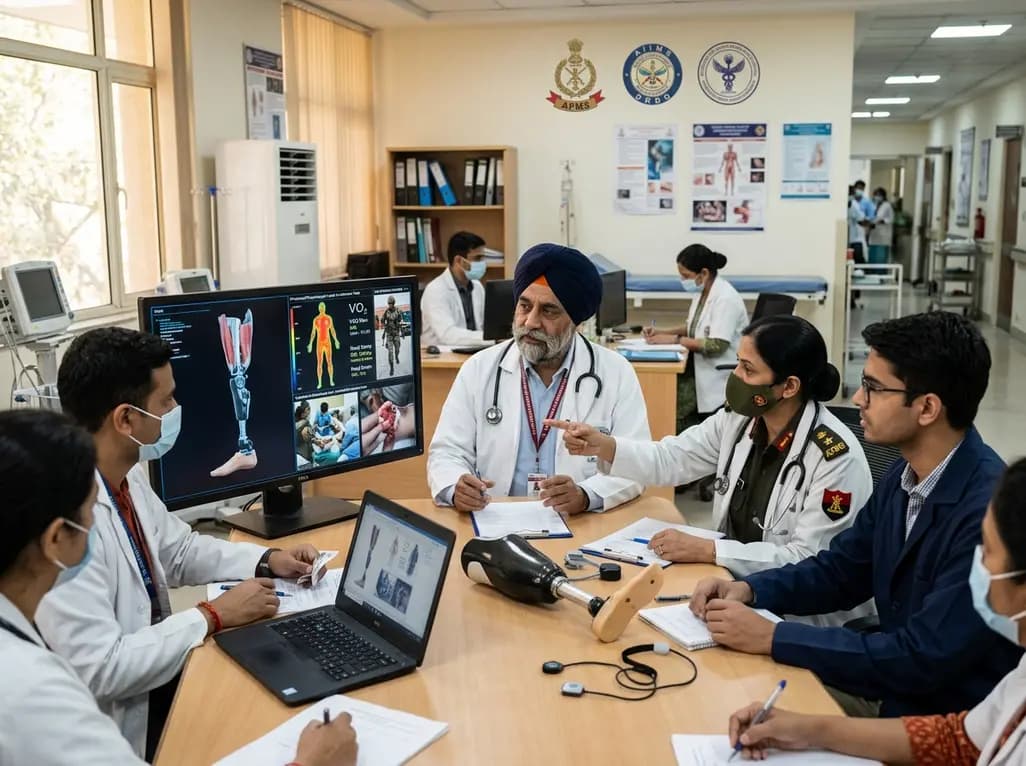
India's premier scientific bodies have joined the Armed Forces Medical Services to solve unique physiological and operational challenges faced by soldiers. The national collaboration covers combat casualty care, artificial intelligence diagnostics, bionic prosthetics, and extreme-environment physiological resilience.
Today

A retrospective cohort study evaluates the short- and long-term impacts of SARS-CoV-2 infection on patients with Graves' disease receiving antithyroid drug therapy, highlighting thyroid status destabilization, clinical symptom exacerbations, and post-viral sequelae.
Today
