.webp&w=384&q=75)

Loading, please wait...
Loading, please wait...
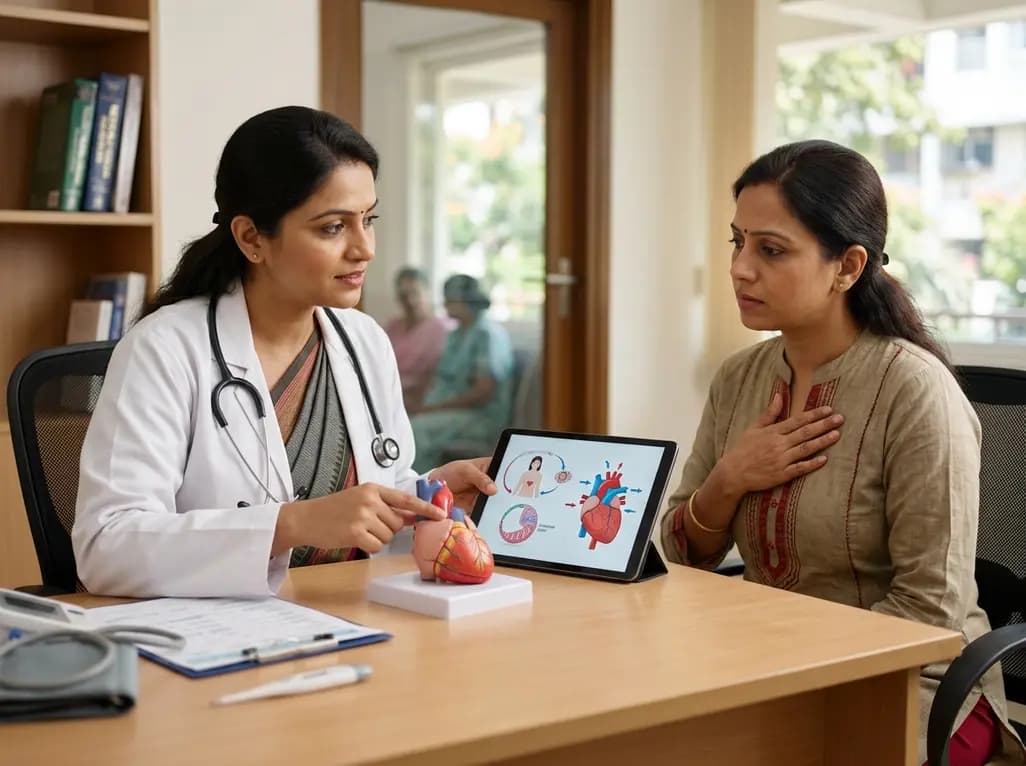
South Asian women face a significantly higher risk of experiencing premature menopause.
This critical finding comes from a multi-country analysis published in The Lancet journal.
Consequently, clinicians must recognize how this early transition impacts future female health.
Specifically, early hormonal decline closely correlates with a higher risk of cardiovascular events.
Indeed, reaching menopause before the age of 40 is clinically defined as premature menopause.
In addition, menopause occurring between ages 40 and 44 is categorized as early menopause.
According to the PURE study, younger menopause ages elevate the risk of stroke or heart attacks.
Furthermore, premature menopause increases cardiovascular risk by 27 percent.
Similarly, early menopause is associated with a 14 percent risk elevation.
Therefore, these age thresholds serve as crucial clinical indicators for cardiovascular risk assessment in female patients.
Notably, the study evaluated over 111,000 women across 26 countries.
The data revealed that women in lower-income countries experience premature menopause at a much higher rate.
For instance, their median menopausal age is 47.5 years compared to 50.6 years in wealthier countries.
Moreover, South Asian women experience menopause at a median age of 47.4 years.
This represents a 34 percent increased risk of premature menopause compared to European women.
However, traditional risk factors like obesity and hypertension do not fully explain this elevated risk.
Thus, clinicians must look beyond traditional metrics when assessing South Asian patients.
Q1: What defines premature menopause and early menopause?
Premature menopause is defined as reaching menopause before the age of 40. In contrast, early menopause occurs when a woman experiences menopause between the ages of 40 and 44.
Q2: Why does premature menopause increase cardiovascular risk?
Earlier menopause reduces the duration of natural estrogen exposure. Consequently, this hormonal decline can lead to early vascular aging, increasing the risk of stroke and heart attack.
Disclaimer: This content is for informational and educational purposes only. It does not constitute medical advice or replace professional judgment. Refer to the latest local and national guidelines for clinical practice.
References

Read summarized clinical updates, watch expert medical content, and earn CME certifications right from your smartphone.
Open your smartphone camera to scan and install.





A landmark global study reveals that South Asian women experience premature menopause at a significantly higher rate compared to European women. This earlier hormonal transition acts as an independent marker for heightened cardiovascular risks, including stroke and myocardial infarction.
4 months ago

As monsoon seasons elevate arboviral disease threats, Tamil Nadu has initiated an ICMR-monitored evaluation of the tetravalent dengue vaccine in Tenkasi district. Clinicians emphasize clinical monitoring, public prevention, and high-quality early pediatric care to reduce disease morbidity across endemic regions.
Today

A comparative cohort study evaluates vNOTES vs TLH hysterectomy for benign conditions, demonstrating shorter operative duration, faster return to daily activities, and equivalent female sexual function scores without increased dyspareunia.
Today

Review how tailored exercise programs benefit frail older patients with heart failure. Explore pathophysiological mechanisms, individualized training prescriptions, and strategies to overcome adherence barriers in clinical practice.
Today

This comparative study evaluates posterior labral tears with and without glenohumeral instability, highlighting distinct demographic patterns, MRI underestimation in stable shoulders, and successful arthroscopic repair outcomes.
Today

A clinical study demonstrates that early intervention with tocilizumab, either as monotherapy or bridged with corticosteroids, achieves significant proptosis reduction and resolves active inflammation in treatment-naive thyroid eye disease.
Today
