.webp&w=384&q=75)

Loading, please wait...
Loading, please wait...
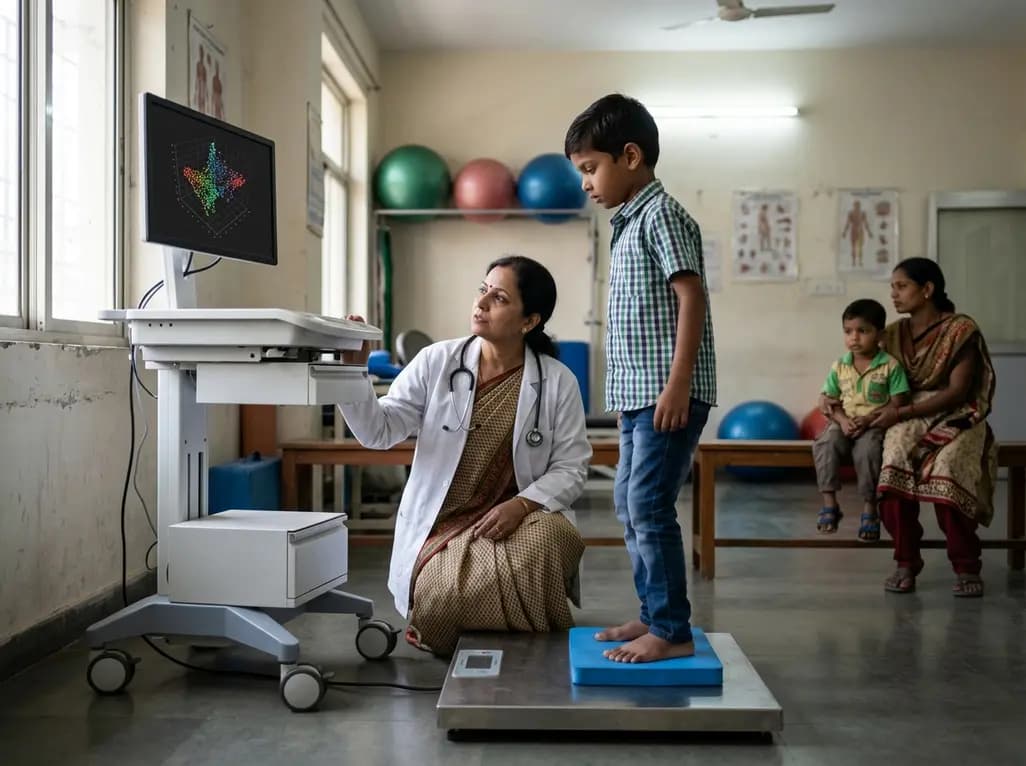
The development of postural control is a cornerstone of pediatric motor maturation, representing the intricate integration of sensory inputs and musculoskeletal responses. Traditionally, clinicians have relied on linear measurements of the Center of Pressure (CoP) to assess balance. However, these standard metrics often fail to capture the underlying geometric structure and postural sway dynamics that characterize the transition from childhood to adulthood. A recent study has introduced Topological Data Analysis (TDA) as a sophisticated method to quantify the persistence and complexity of these dynamics, offering a deeper understanding of how balance control matures across different age groups and task constraints.
As children grow, their ability to maintain stability improves through a gradual refinement of sway organization rather than a simple reduction in movement. Research indicates that younger children exhibit significantly higher variability and less structured sway patterns compared to young adults. This transition is not merely a matter of physical growth but involves the sophisticated tuning of the central nervous system. By utilizing TDA metrics, researchers have identified that the structural complexity of sway—often referred to as "loops" in the data—changes predictably with age. Specifically, children aged 7 to 12 years demonstrate more chaotic and less efficient postural strategies than adults. Consequently, these findings suggest that the maturation of balance is a non-linear process characterized by the emergence of more stable and less exploratory movement patterns. Furthermore, the ability to maintain equilibrium under challenging conditions, such as standing on a narrow base of support, becomes a critical differentiator between developmental stages. Therefore, understanding these age-related shifts in sway topology provides essential benchmarks for identifying atypical motor development in pediatric populations.
Topological Data Analysis (TDA) offers a revolutionary lens through which to view biomechanical data by focusing on the "shape" of the data points. Unlike traditional statistics that calculate averages or standard deviations, TDA identifies persistent homological features, such as holes or loops, within the postural sway dynamics. These features represent the recurring cycles of movement that an individual uses to maintain their center of mass over their base of support. For instance, the H1 Wasserstein distance and Persistent Entropy are specific TDA metrics that quantify how long these topological features persist across various scales. In childhood development, high entropy and diverse loop structures indicate a system that is still exploring its environmental limits. As the motor system matures, these loops become more consistent and less varied. This shift indicates a move from exploratory, high-variability control to a more optimized and efficient postural state. Moreover, TDA can detect subtle differences in sway that are invisible to linear analyses, making it a powerful tool for early diagnosis. By characterizing the geometric persistence of CoP trajectories, clinicians can gain a much clearer picture of a child\'s neuro-motor health and functional stability.
Postural stability is highly dependent on the availability and reliability of sensory information, including visual, vestibular, and proprioceptive inputs. When these inputs are manipulated, such as by closing the eyes or standing on an unstable surface, the demand on the postural control system increases dramatically. The study of childhood balance reveals that children are significantly more affected by the removal of visual input than adults, showing a marked increase in sway complexity. Additionally, the introduction of a cognitive dual-task, such as performing a mental calculation while balancing, further taxes the system. Interestingly, while cognitive load impacts balance, the TDA metrics highlight that the physical difficulty of the task—such as narrowing the base of support—is often a stronger driver of topological changes in sway. This suggests that while children possess the cognitive resources to multitask, their primary limiting factor remains the physiological maturation of their motor control loops. Furthermore, the interaction between sensory deprivation and task difficulty creates unique "topological signatures" that can distinguish between healthy development and potential balance disorders. Consequently, evaluating children under varied task constraints is vital for a comprehensive assessment of their functional balance capabilities.
For pediatricians and neurologists, the ability to objectively measure the quality of balance control is paramount for diagnosing conditions like developmental coordination disorder or mild neurological impairments. Current clinical scales are often subjective and lack the sensitivity required to catch early-stage deviations. Integrating TDA-based assessments of postural sway dynamics into clinical practice could bridge this gap by providing quantitative biomarkers of motor maturity. These metrics are particularly useful because they remain robust even in the presence of the "noise" typically found in pediatric data. Moreover, as children with motor delays often exhibit different sway topologies, TDA can serve as a targeted screening tool to initiate early intervention. By monitoring changes in Persistent Entropy or the number of long loops over time, therapists can also objectively track the efficacy of rehabilitation programs. Furthermore, the portability of modern force plate technology combined with automated TDA algorithms makes this approach increasingly feasible for outpatient clinics. Ultimately, shifting toward non-linear, structural analyses allows for a more personalized approach to pediatric care, ensuring that children receive the support they need during critical windows of motor development.
The integration of advanced mathematical frameworks like TDA into biomechanics marks a significant shift toward more holistic and precise movement analysis. Future research should focus on establishing larger normative databases that include children with various neurological and orthopedic conditions to further validate these topological markers. Additionally, the application of TDA could extend beyond static balance to include dynamic tasks like gait and transition movements. Such advancements would allow for a comprehensive mapping of the "topological landscape" of human movement throughout the lifespan. Furthermore, as wearable sensor technology improves, we may soon be able to collect high-fidelity sway data in naturalistic settings, allowing for continuous monitoring of balance health. This transition from laboratory-based assessment to real-world monitoring will likely revolutionize how we understand and treat balance disorders. In conclusion, TDA provides a mathematically rigorous and clinically relevant method for characterizing the evolution of postural control, promising a new era of data-driven diagnostics in pediatric medicine and beyond.
Traditional CoP measurements primarily focus on linear variables like sway area or velocity, which describe the amount of movement but ignore the underlying structure. In contrast, Topological Data Analysis (TDA) examines the geometric shape and connectivity of the data points. By identifying persistent features like loops in the sway trajectory, TDA captures the qualitative nature of balance control, providing a more sensitive assessment of neuro-motor maturation.
Children have a less automated postural control system compared to adults, meaning they must devote more conscious attentional resources to maintaining balance. When a cognitive dual-task is introduced, it competes for these limited neural resources. Consequently, children often show increased sway variability and altered topological patterns because their nervous system struggles to simultaneously manage both the cognitive challenge and the complex requirements of postural stability.
The H1 Wasserstein distance is a TDA metric that quantifies the difference between the persistence diagrams of two different sway trials. In a clinical context, a high Wasserstein distance between a child\'s sway pattern and age-matched norms can indicate a significant deviation in motor control strategy. This metric serves as a robust, non-linear biomarker that helps clinicians identify subtle instabilities that traditional linear metrics might overlook during standard screenings.
Disclaimer: This content is for informational and educational purposes only. It does not constitute medical advice or establish a doctor-patient relationship. Clinicians should use their professional judgment and refer to the latest local and national guidelines for clinical practice.
References
Azadian E et al. Topological data analysis of postural sway: characterizing balance control during childhood development. J Neuroeng Rehabil. 2026 Jun 30. doi: 10.1186/s12984-026-02078-4. PMID: 42374465.
Verbecque E et al. Postural sway in children: A literature review. Gait Posture. 2016;49:402-410. doi: 10.1016/j.gaitpost.2016.08.003.
Harbourne RT, Stergiou N. Nonlinear analysis of the development of sitting postural control. Dev Psychobiol. 2003;42(4):368-77. doi: 10.1002/dev.10110.

Read summarized clinical updates, watch expert medical content, and earn CME certifications right from your smartphone.
Open your smartphone camera to scan and install.





This article examines the use of Topological Data Analysis (TDA) to characterize postural sway dynamics during childhood development, highlighting how non-linear metrics differentiate age-related balance control strategies more effectively than traditional measures.
3 months ago

Following Nigeria's first recorded Ebola case linked to regional travel, the Africa CDC has convened an emergency ministerial summit. This alert underscores critical clinical priorities for healthcare professionals, including differentiating early viral infection from malaria, implementing barrier nursing, and triage.
Today

Leucine Rich Bio has introduced South Asia's first comprehensive vaginal microbiome test, BugSpeaks. By profiling microbial dysbiosis, pathogens, and antimicrobial resistance, this next-generation diagnostic platform provides clinicians with deeper insights into recurrent infections, fertility, and reproductive health.
Today

Review how tailored exercise programs benefit frail older patients with heart failure. Explore pathophysiological mechanisms, individualized training prescriptions, and strategies to overcome adherence barriers in clinical practice.
Today

This comparative study evaluates posterior labral tears with and without glenohumeral instability, highlighting distinct demographic patterns, MRI underestimation in stable shoulders, and successful arthroscopic repair outcomes.
Today

A clinical study demonstrates that early intervention with tocilizumab, either as monotherapy or bridged with corticosteroids, achieves significant proptosis reduction and resolves active inflammation in treatment-naive thyroid eye disease.
Today
