

Loading, please wait...
Loading, please wait...

Additive manufacturing has revolutionized restorative dentistry by enabling rapid, highly customized workflows. Today, clinicians frequently utilize 3D printed dental resins to produce provisional crowns, interim fixed partial dentures, and occlusal splints. These photopolymerizable materials offer high geometric accuracy alongside excellent fabrication speed. However, the intraoral longevity and biomechanical predictability of printed restorations depend heavily on proper postprocessing. While secondary light-curing polymerizes the resin matrix, initial cleaning procedures dictate how effectively technicians remove residual monomer. Furthermore, clinicians often apply surface glazing agents to smooth rough external topographies and enhance optical aesthetics. Inadequate processing frequently impairs restorative flexural strength and stain resistance. In particular, unpolymerized surface monomers pose severe clinical challenges, including tissue irritation and rapid discoloration. Consequently, dental practitioners require evidence-based postprinting guidelines. By standardizing cleaning duration and glazing techniques, clinicians ensure that printed restorations withstand physiological masticatory forces within the oral cavity. Recent findings emphasize that specific resin formulations significantly alter postprocessing requirements.
Following print completion, green-state restorations retain an uncured, sticky liquid layer that requires complete elimination. Technicians routinely submerge printed parts in high-purity isopropyl alcohol using ultrasonic baths. When laboratories clean restorations for only fifteen seconds without ultrasonic agitation, significant uncured monomer remains on the surface. This residual liquid layer interferes with subsequent post-curing and degrades superficial hardness. Conversely, extended ultrasonic cleaning between two and ten minutes effectively strips unpolymerized monomer from intricate margins. Nevertheless, prolonged solvent exposure introduces substantial physical risks. Specifically, extended alcohol immersion plasticizes the cross-linked polymer network and leaches low-molecular-weight oligomers. As a result, washing appliances for ten minutes can cause surface softening and microstructural damage. Most printed dental materials attain an optimal balance between thorough cleaning and structural integrity after two to five minutes of ultrasonic washing. During this moderate time window, cavitation bubbles lift uncured resin without causing destructive solvent uptake. Therefore, standardized washing cycles ensure optimal surface cleanliness without weakening the underlying restoration.
Surface glazing plays a vital role in refining restorative topography and biocompatibility. While mechanical polishing demands extensive chairside time, light-curing liquid glazes offer an efficient alternative. Formulations such as Palaseal, EQUIA Forte Coat, and COAT-IT fill surface irregularities, creating an ultra-smooth external shield. Atomic force microscopy confirms that glazing significantly reduces average surface roughness compared to untreated controls. Smoother surfaces directly diminish microbial attachment, lowering the incidence of plaque accumulation and soft tissue inflammation. Additionally, the glaze layer seals microscopic voids and printing striations. In doing so, the glaze acts as a protective barrier that bolsters structural resilience. However, different glazing products demonstrate varying degrees of adhesion depending on the underlying resin chemistry. For example, nanofilled resin glazes provide superior wear resistance compared to unfilled agents. Furthermore, complete light polymerisation of the glaze layer prevents unreacted monomer leaching. When practitioners apply these agents correctly, surface glazes enhance aesthetic shine, inhibit pigment uptake, and protect polymer matrices against intraoral degradation.
Standardized three-point bending tests reveal critical relationships between resin composition, cleaning duration, and surface treatment. Highly filled hybrid composite resins consistently achieve superior flexural strength compared to lower-filled provisional materials. Interestingly, inadequate cleaning leaves a sticky film that limits depth of cure during light exposure. This incomplete curing substantially lowers load-bearing capacity. In contrast, moderate ultrasonic washing for two to five minutes allows optimal resin conversion without stripping necessary structural elements. When technicians apply surface glaze over properly cleaned restorations, flexural strength values frequently show measurable improvements. Atomic force microscopy shows that glazed surfaces consistently record roughness values below the accepted threshold of zero point two micrometers. Uncoated or under-cleaned specimens exhibit rougher surfaces that accelerate bacterial accumulation and stain retention. Furthermore, excessive solvent cleaning creates microfissures that degrade fracture resistance under cyclic loading. Consequently, clinicians must integrate meticulous cleaning with surface coating to optimize mechanical performance. This synergistic approach maximizes restoration durability while preserving clinical aesthetics.
Color stability represents another crucial determinant of patient satisfaction in restorative dentistry. When prostheses absorb intraoral pigments, unsightly discoloration necessitates early replacement. Spectrophotometric analyses using the CIEDE2000 standard demonstrate that postprocessing protocols directly influence chromatic stability. Insufficient cleaning leaves unreacted photoinitiators that discolor upon exposure to light and oral fluids. Conversely, washing restorations in ultrasonic alcohol baths for two to five minutes establishes robust color baseline properties. In addition, applying protective glazing agents shields restorations against beverage-induced staining. Nanofilled glazes exhibit superior stain resistance compared to unsealed resin surfaces. Therefore, dental practitioners should adopt a structured postprocessing workflow. First, wash printed units in isopropyl alcohol using two minutes of ultrasonic agitation. Next, dry the components thoroughly with clean compressed air before completing final light-curing. Finally, coat all functional and polished surfaces with a compatible light-cured glaze. Standardizing these essential steps ensures consistent mechanical strength, low surface roughness, and durable aesthetic outcomes for all 3D printed restorations.
Ultrasonic cleaning in ninety-six percent isopropyl alcohol for approximately two to five minutes provides the best balance between monomer clearance and material integrity. Washing for less than two minutes leaves problematic uncured monomer layers on the restoration. Conversely, ultrasonic cycles exceeding ten minutes allow alcohol to penetrate deeply into the polymer network. This extensive solvent exposure plasticizes the resin matrix and softens the surface, noticeably reducing overall flexural strength.
Surface glazing agents apply a thin, highly cross-linked coating that seals microscopic fissures, printing layer lines, and surface voids. This protective layer significantly reduces surface roughness below the critical plaque-retention threshold of zero point two micrometers. Consequently, glazed restorations resist oral bacterial adhesion and chromatic staining much better than unglazed counterparts. Additionally, uniform glaze distribution reinforces surface integrity, preventing premature mechanical microcracking and extending the functional lifespan of provisional restorations.
Yes, base material formulation strongly governs how printed resins respond to solvent washing and surface glazes. Hybrid resin composites containing inorganic microfillers exhibit greater intrinsic flexural strength and resist solvent degradation better than unfilled acrylic resins. Furthermore, chemical compatibility between the resin matrix and glazing agent dictates interfacial bond strength. Different photoinitiator packages and resin chemistries also influence optical stability, meaning dental practitioners must adapt postprocessing parameters according to specific manufacturer instructions.
Disclaimer: This content is for informational and educational purposes only and should not be taken as medical advice. Always consult qualified healthcare professionals before implementing clinical protocols. Refer to the latest local and national guidelines for clinical practice.
References

Read summarized clinical updates, watch expert medical content, and earn CME certifications right from your smartphone.
Open your smartphone camera to scan and install.





This study evaluates how cleaning duration and surface glazing agents influence the flexural strength, surface roughness, and color stability of 3D printed dental resins, outlining optimal laboratory postprocessing protocols.
Today
The HELO study evaluates hearing function in virologically suppressed persons living with HIV. Learn how chronic inflammation, vascular factors, and antiretroviral therapy impact auditory decline and why regular audiological monitoring is critical for aging patients.
Today

A population-based study of 20,928 children reveals that small vulnerable newborns face sex-divergent mental capital outcomes at ages 6-7: term SGA girls show higher behavioral difficulties and lower resilience, while preterm non-SGA boys experience increased behavioral problems.
Today

A breakthrough ultrathin multimodal sensor decouples physical hemodynamic monitoring from disposable electrochemical calibration, achieving long-term wearable glucose prediction with 81.36% accuracy and a 9.12% MARD. This offers a robust, drift-free solution for outpatient metabolic surveillance.
Today

A comparative review of tension band wiring and intramedullary screw fixation in thumb metacarpophalangeal arthrodesis, evaluating union rates, hardware complications, and clinical outcomes.
Today
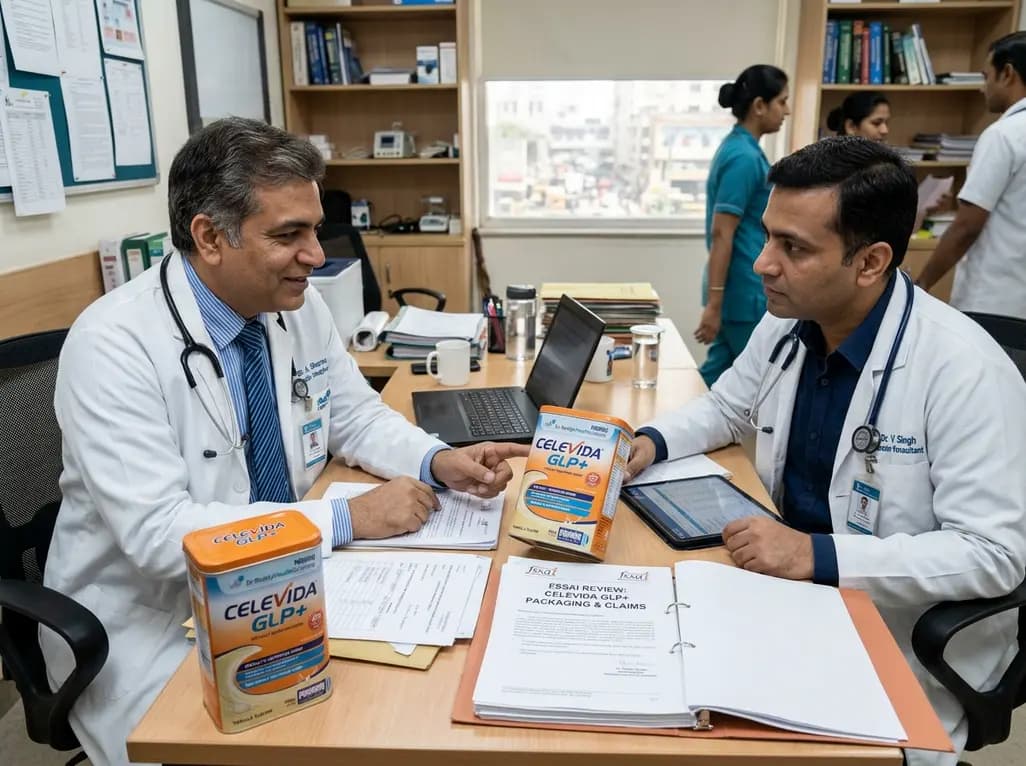
Following regulatory scrutiny from FSSAI regarding promotional representations and lean muscle preservation claims, Dr. Reddy's Laboratories and Nestlé Health Science are currently reviewing the branding and marketing strategy for their joint nutritional supplement Celevida GLP+.
Today
