.webp&w=384&q=75)

Loading, please wait...
Loading, please wait...

The postless hip distraction technique represents a major advancement for orthopedic surgeons performing hip arthroscopy. Traditionally, clinicians used a perineal post to provide counter-traction, but this often led to nerve injuries or soft tissue complications. However, this newly released consensus provides 20 evidence-based recommendations to standardize postless methods. Consequently, these guidelines aim to lower technical barriers and improve patient outcomes significantly.
The primary benefit of this technique is the total elimination of perineal complications. By using the Trendelenburg position and high-friction pads, surgeons create sufficient traction without applying physical pressure to the groin. Furthermore, this approach reduces the risk of pudendal nerve palsy and urinary retention. Studies consistently show that patients experience much higher satisfaction levels following postless procedures. Therefore, these standardized recommendations provide a clear roadmap for adopting a safer surgical method.
The expert panel identified 17 critical clinical questions through a systematic literature review. They used the GRADE system to evaluate evidence quality and the Reporting Items for Practice Guidelines in Healthcare (RIGHT) to ensure scientific rigor. Additionally, the consensus focuses on improving the scientific nature of surgical practice. These guidelines help institutions implement the postless hip distraction technique with greater precision. Moreover, the standardization promotes the global popularization of hip arthroscopy by making it more reproducible.
It is a modern traction method for hip arthroscopy that uses specific patient positioning and friction pads instead of a perineal post to distract the joint.
The Trendelenburg position utilizes gravity to provide counter-traction. This method eliminates the need for a rigid post in the groin, thereby preventing nerve damage and skin tears.
Disclaimer: This content is for informational and educational purposes only. It does not constitute medical advice or a professional relationship. Always seek the advice of a qualified healthcare provider regarding any medical condition. Refer to the latest local and national guidelines for clinical practice.
References
Wang Y et al. Expert Consensus on Trendelenburg Position Postless Hip Distraction Technique in Hip Arthroscopy. Orthop Surg. 2026 Apr 21. doi: 10.1111/os.70303. PMID: 42014935.
McCahon J et al. Is Post-less Hip Arthroscopy Here to Stay? Med Res Arch. 2022 Oct 31;10(10). doi: 10.18103/mra.v10i10.3234.
Kern MJ et al. Physician reported outcomes of hip arthroscopy without a perineal post: an international survey. J Hip Preserv Surg. 2024 Jan 15;11(1):28-34.

Read summarized clinical updates, watch expert medical content, and earn CME certifications right from your smartphone.
Open your smartphone camera to scan and install.





A comprehensive expert consensus on postless hip distraction for hip arthroscopy, highlighting perineal safety and standardized clinical recommendations....
6 months ago

The TREM-AB open-label pilot study evaluated a wearable passive nonlinear vibration absorber for essential tremor. The Nonlinear Energy Sink bracelet reduced clinical Fahn-Tolosa-Marin tremor scores by 32.1% and electrophysiological tremor power by 49.2% with no adverse effects reported.
Today

A population-based study of 20,928 children reveals that small vulnerable newborns face sex-divergent mental capital outcomes at ages 6-7: term SGA girls show higher behavioral difficulties and lower resilience, while preterm non-SGA boys experience increased behavioral problems.
Today

A breakthrough ultrathin multimodal sensor decouples physical hemodynamic monitoring from disposable electrochemical calibration, achieving long-term wearable glucose prediction with 81.36% accuracy and a 9.12% MARD. This offers a robust, drift-free solution for outpatient metabolic surveillance.
Today
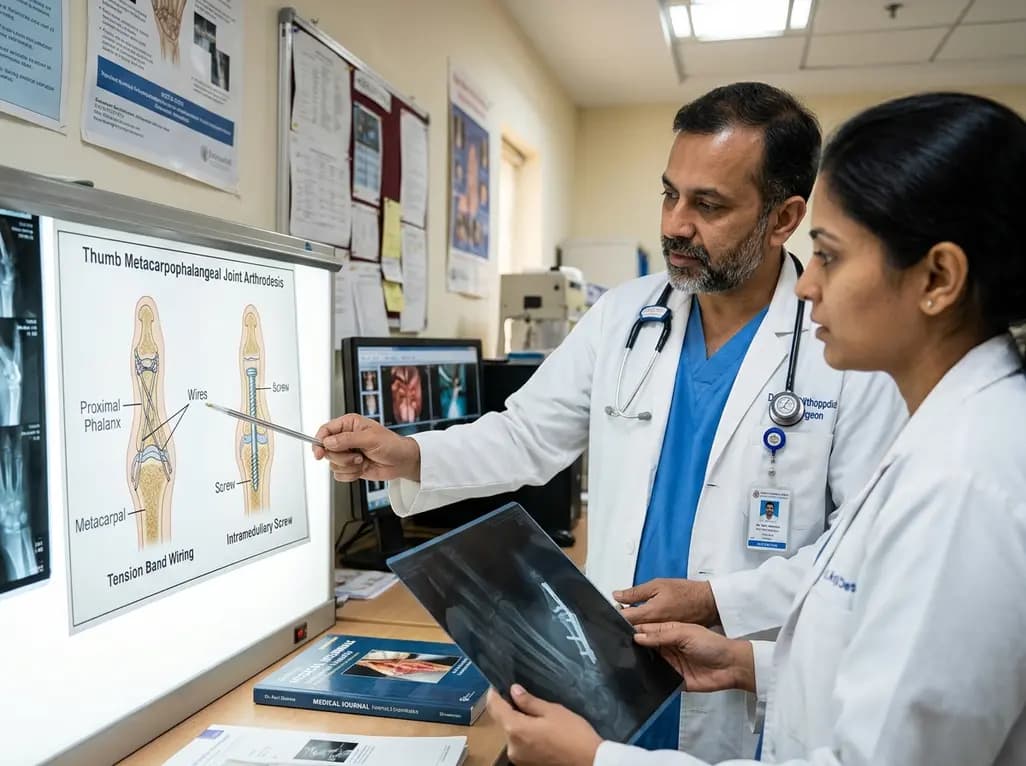
A comparative review of tension band wiring and intramedullary screw fixation in thumb metacarpophalangeal arthrodesis, evaluating union rates, hardware complications, and clinical outcomes.
Today

Following regulatory scrutiny from FSSAI regarding promotional representations and lean muscle preservation claims, Dr. Reddy's Laboratories and Nestlé Health Science are currently reviewing the branding and marketing strategy for their joint nutritional supplement Celevida GLP+.
Today
