

Loading, please wait...
Loading, please wait...

Essential tremor represents the most common movement disorder in clinical neurology practice, affecting millions of individuals globally. Although pharmacotherapy remains the standard frontline management strategy, many patients experience unsatisfactory tremor relief or debilitating medication side effects. Consequently, clinicians urgently need non-invasive alternatives that reduce involuntary oscillatory limb motion without systemic toxicity. The newly published TREM-AB open-label pilot study introduces an innovative mechanical approach utilizing a wearable essential tremor device. This wrist-worn apparatus functions as a passive nonlinear vibration absorber, specifically engineered as a Nonlinear Energy Sink to attenuate pathological tremors directly at the upper limb. Unlike active electronic stimulators or motorized orthotics, this passive device neutralizes kinetic vibrational energy without requiring external power sources. Therefore, this technology offers an intriguing non-invasive option for individuals with refractory symptoms or contraindications to neurosurgery. In this review, we examine the biomechanical principles, clinical trial outcomes, and therapeutic implications of this mechanical intervention.
Action tremors of the hands significantly disrupt activities of daily living, such as eating, drinking, and writing. Consequently, progressive physical disability frequently leads to social embarrassment, anxiety, and diminished quality of life. Currently, standard medical therapy relies on oral pharmacological agents, primarily propranolol and primidone. However, more than thirty percent of patients derive inadequate benefit from existing medications. Furthermore, older adults frequently suffer from intolerable side effects, including bradycardia, hypotension, sedation, and fatigue. As a result, long-term compliance remains remarkably low among this patient cohort. Advanced surgical options, such as deep brain stimulation, deliver impressive tremor suppression for selected patients. Nevertheless, neurosurgical procedures carry serious procedural risks and remain inaccessible to many patients due to medical comorbidities or financial expenses. Therefore, clinicians recognize an immense clinical need for non-invasive, non-pharmacological treatment modalities that provide immediate symptomatic relief.
To address the shortcomings of conventional therapies, biomedical researchers developed a passive wearable damping system called a Nonlinear Energy Sink. In mechanical engineering, passive vibration absorbers stabilize structures against chaotic dynamic forces. However, applying these concepts to the human forearm presents formidable technical hurdles because pathological tremor frequencies fluctuate across time. Traditional linear tuned mass dampers operate strictly within a narrow frequency band, rendering them ineffective for variable kinetic tremors. In contrast, this novel device incorporates targeted nonlinear cubic stiffness that responds spontaneously across a broad frequency bandwidth. Therefore, the mechanism absorbs oscillatory energy irrespective of slight physiological frequency shifts. The wrist-mounted bracelet couples mechanically with the tremulous arm, capturing the kinetic motion generated by rhythmic muscle contractions. Subsequently, the internal mechanism dissipates this energy through localized viscous damping. Because the system operates passively, it eliminates batteries, motors, and cables, providing a durable, lightweight solution for daily wear.
The prospective TREM-AB open-label pilot study evaluated the acute clinical efficacy of the passive nonlinear absorber bracelet. Investigators enrolled five adult patients with established essential tremor displaying disabling upper extremity kinetic tremors. Clinicians measured tremor severity using the validated Fahn-Tolosa-Marin rating scale and concurrent objective electrophysiological accelerometry recordings. Following short-duration device application, the study demonstrated a 32.1 percent mean reduction in clinical Fahn-Tolosa-Marin tremor scores. Furthermore, electrophysiological assessments revealed an impressive 49.2 percent decrease in tremor power compared to baseline measurements in the treated arm. Importantly, the mechanical dampening specifically quelled pathological oscillations while preserving voluntary hand movements. In addition, investigators reported zero device-related adverse events or discomfort throughout testing. Consequently, these encouraging quantitative results confirm the biomechanical viability of nonlinear energy absorption for movement disorders. While preliminary, these data justify rapid progression toward larger confirmatory clinical investigations.
The landscape of non-pharmacological tremor management has recently expanded to include active transcutaneous nerve stimulators and motorized exoskeletons. While active electrical stimulators offer benefit for some individuals, they frequently induce uncomfortable cutaneous paresthesias or muscle twitches. In contrast, passive mechanical dampening requires no electrical stimulation of peripheral nerves, entirely eliminating sensation-related discomfort. Similarly, motorized robotic braces often suffer from excessive bulk, heavy batteries, and prominent visual profiles that discourage public use. Conversely, this passive essential tremor device maintains a compact bracelet profile that minimizes patient self-consciousness. Moreover, the absence of active electronics and rechargeable batteries enhances overall mechanical reliability during routine daily activities. As a result, users do not face device shut-offs or sudden power drainage away from home. Economically, passive mechanical fabrication significantly reduces manufacturing costs. Thus, passive nonlinear absorbers offer a pragmatic, scalable, and cost-effective intervention for outpatient clinical environments.
Although the TREM-AB pilot findings demonstrate exciting proof-of-concept efficacy, physicians must maintain appropriate perspective regarding clinical application. Because this initial investigation included only five subjects, large multicenter randomized sham-controlled trials are necessary to validate these preliminary findings. Furthermore, researchers must investigate the long-term ergonomic durability, joint biomechanics, and patient compliance across months of unmonitored home use. Future clinical protocols should also evaluate patient-reported functional outcomes, such as typing efficiency, handwriting legibility, and mealtime independence. In addition, scientists should explore whether nonlinear absorbers effectively suppress tremors in Parkinson's disease and dystonia. In practical clinical management, neurologists could strategically combine passive mechanical bracelets with low-dose pharmacotherapy. Consequently, this synergistic approach may optimize functional motor control while minimizing adverse pharmacological toxicity. Ultimately, passive nonlinear vibration absorption introduces an innovative biomechanical paradigm that could redefine therapeutic options for individuals living with disabling tremors.
The nonlinear energy sink functions as a passive mechanical absorber that dynamically transfers oscillatory energy away from the tremulous limb. Because the device incorporates nonlinear cubic stiffness, it adapts instantaneously across multiple vibration frequencies rather than a single resonance point. Consequently, the mechanism captures the irregular kinetic energy generated by pathological arm oscillations and dissipates it internally as heat. This targeted absorption stabilizes the forearm without restricting normal voluntary muscle movement.
Standard oral medications like propranolol and primidone frequently trigger systemic adverse effects, including fatigue, bradycardia, dizziness, and cognitive slowing. Furthermore, nearly forty percent of patients experience refractory tremor despite maximum drug dosing. In contrast, passive vibration absorbers exert zero systemic biological effects, preventing pharmacological interactions and drug toxicity. Patients can simply wear the device on demand during motor-heavy activities, achieving rapid mechanical stabilization without experiencing sedative or cardiovascular complications.
Although initial pilot findings show significant tremor power reduction, researchers must validate the technology in randomized, double-blind, sham-controlled trials with larger patient cohorts. Clinical investigators must examine long-term wearability, device ergonomics, and potential mechanical wear over months of daily functional use. Additionally, future clinical trials should evaluate patient-reported functional independence, task completion speed, and quality-of-life scores to confirm that biomechanical attenuation translates into durable real-world improvements for everyday tasks.
Disclaimer: This content is for informational and educational purposes only and does not constitute medical advice, diagnosis, or treatment. Healthcare professionals must use their clinical judgment when interpreting clinical trial findings. Refer to the latest local and national guidelines for clinical practice.
References

Read summarized clinical updates, watch expert medical content, and earn CME certifications right from your smartphone.
Open your smartphone camera to scan and install.





The TREM-AB open-label pilot study evaluated a wearable passive nonlinear vibration absorber for essential tremor. The Nonlinear Energy Sink bracelet reduced clinical Fahn-Tolosa-Marin tremor scores by 32.1% and electrophysiological tremor power by 49.2% with no adverse effects reported.
Today

A population-based study of 20,928 children reveals that small vulnerable newborns face sex-divergent mental capital outcomes at ages 6-7: term SGA girls show higher behavioral difficulties and lower resilience, while preterm non-SGA boys experience increased behavioral problems.
Today

A breakthrough ultrathin multimodal sensor decouples physical hemodynamic monitoring from disposable electrochemical calibration, achieving long-term wearable glucose prediction with 81.36% accuracy and a 9.12% MARD. This offers a robust, drift-free solution for outpatient metabolic surveillance.
Today

A comparative review of tension band wiring and intramedullary screw fixation in thumb metacarpophalangeal arthrodesis, evaluating union rates, hardware complications, and clinical outcomes.
Today
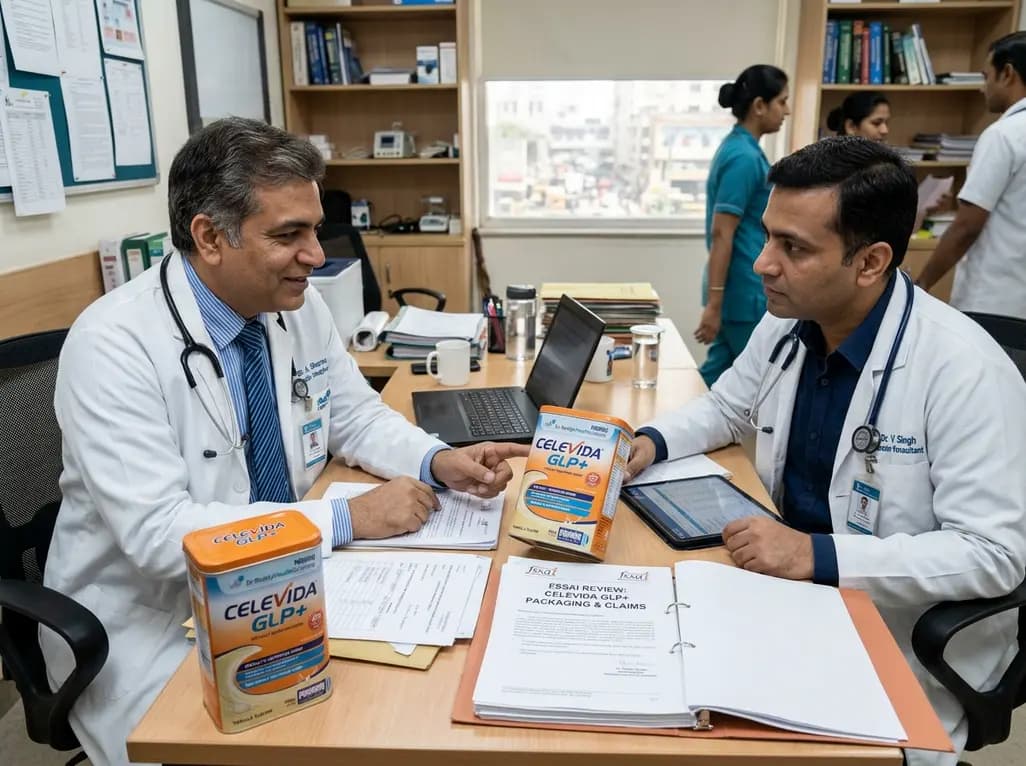
Following regulatory scrutiny from FSSAI regarding promotional representations and lean muscle preservation claims, Dr. Reddy's Laboratories and Nestlé Health Science are currently reviewing the branding and marketing strategy for their joint nutritional supplement Celevida GLP+.
Today
