.webp&w=384&q=75)

Loading, please wait...
Loading, please wait...

A recent study evaluates penile prosthesis revision outcomes following phalloplasty in assigned female-at-birth (AFAB) individuals. Specifically, the retrospective cohort analyzed 694 patients over two decades. Consequently, researchers identified significant differences in device longevity and mechanical failure rates between manufacturers. Ultimately, this data is essential for urologists managing gender-affirming surgeries.
Interestingly, the device model served as an independent predictor of mechanical failure. For example, Coloplast implants showed a significantly lower risk compared to Boston Scientific devices (SHR 0.43). However, the time to revision was shorter for Coloplast at 1.4 years versus 3 years for Boston Scientific. Therefore, surgeons must discuss these nuances during preoperative counseling.
Notably, the 15-year cumulative incidence of mechanical failure reached 30.6%. Meanwhile, the overall revision incidence was much higher at 65.1%. Furthermore, factors like phalloplasty type or staged urethroplasty did not significantly impact these rates. Thus, the mechanical integrity of the device remains the primary concern for long-term success.
According to this 15-year study, the cumulative incidence of mechanical failure is 30.6%.
Yes, Coloplast implants demonstrated a lower risk of mechanical failure compared to Boston Scientific devices, though they had a shorter time to revision.
Disclaimer: This content is for informational and educational purposes only... Refer to the latest local and national guidelines for clinical practice.
References
1. Lee WG et al. Long-term outcomes for mechanical failure and revision following primary gender-affirming penile prosthesis insertion. BJU Int. 2026 Mar 27. doi: 10.1111/bju.70258. PMID: 41896175.
2. Falcone M, et al. Outcomes of inflatable penile prosthesis insertion in 247 patients completing female to male gender reassignment surgery. BJU Int. 2018;121(1):139-144.
3. Hoebeke P, et al. Long-term results of penile prosthetic implants. J Sex Med. 2010;7(1):222-231.

Read summarized clinical updates, watch expert medical content, and earn CME certifications right from your smartphone.
Open your smartphone camera to scan and install.





A retrospective study analyzes the 15-year cumulative incidence of mechanical failure and long-term revision rates for penile prostheses in AFAB individuals...
6 months ago

An observational study from the NIH All of Us Research Program reveals that adding a multi-ancestry polygenic risk score to machine learning models provides only modest improvements in predicting adult weight gain, underscoring the enduring significance of routine clinical and lifestyle factors.
Today

A study in JAMIA Open shows lightweight open-source reasoning LLMs achieve up to 95% sensitivity and accelerate evidence synthesis screening by nearly twentyfold, presenting a cost-effective, scalable AI solution for biomedical research and systematic reviews.
Yesterday

A landmark study details how an enterprise pediatric remote patient management model expanded from a single cardiology pilot to 16 diverse specialty programs by combining centralized digital operations with specialty clinical leadership.
Yesterday
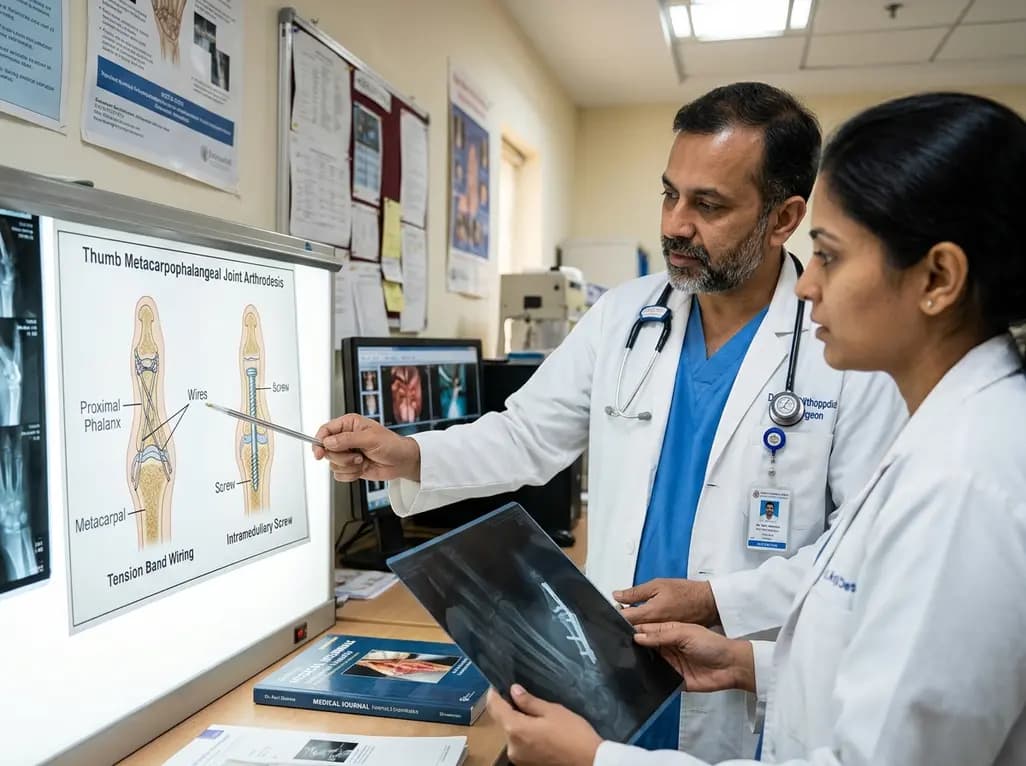
A comparative review of tension band wiring and intramedullary screw fixation in thumb metacarpophalangeal arthrodesis, evaluating union rates, hardware complications, and clinical outcomes.
Yesterday

A breakthrough ultrathin multimodal sensor decouples physical hemodynamic monitoring from disposable electrochemical calibration, achieving long-term wearable glucose prediction with 81.36% accuracy and a 9.12% MARD. This offers a robust, drift-free solution for outpatient metabolic surveillance.
Yesterday
