

Loading, please wait...
Loading, please wait...

Clinical documentation serves as the primary conduit for interprofessional communication across hospital wards, intensive care units, and outpatient clinics. However, health records do not merely chronicle clinical physiological metrics; they also transmit nuanced clinician perceptions, subjective interpretations, and emotional attitudes. Emerging evidence underscores that pain care documentation bias directly worsens disparities in pain assessment, therapeutic decision-making, and patient health outcomes. When healthcare professionals record subjective impressions rather than objective observations, they inadvertently encode systemic prejudices into the medical chart. Consequently, these biased narratives follow patients throughout their healthcare journey, distorting subsequent clinical judgments and compromising therapeutic relationships. Recognizing the profound ethical and clinical consequences of this issue, the American Society for Pain Management Nursing (ASPMN) published a comprehensive position statement. This critical guidance establishes evidence-based principles to eliminate prejudice, promote professional accountability, and ensure respectful documentation practices across all healthcare settings.
Medical documentation reflects the complex interaction between clinician observation, personal beliefs, and workplace pressures. Historically, pain evaluation relied heavily on self-reported severity scores. Nevertheless, clinicians frequently filter these subjective reports through their personal attitudes. Pain care documentation bias manifests when providers employ derogatory adjectives, judgmental descriptions, or expressions of skepticism in health records. For example, clinicians often document that a patient claims or insists they suffer from intractable pain, rather than writing that the patient reports discomfort. Furthermore, healthcare workers sometimes describe individuals as combative, demanding, noncompliant, or drug seeking without providing objective behavioural context. These linguistic markers signal skepticism regarding patient honesty. Consequently, such records influence future providers before they conduct an independent physical examination. Studies demonstrate that marginalized populations, including racial minorities and individuals with substance use disorders, experience this documentation bias at disproportionate rates. Therefore, biased medical documentation functions as a persistent vehicle for institutional health disparities.
The widespread transition to electronic health records (EHR) has amplified the propagation of biased narratives. Healthcare systems routinely utilize copy-and-paste functions and shared clinical templates to streamline workflow. However, this workflow efficiency creates an unintended transmission cascade. When one clinician writes a stigmatizing comment, subsequent providers routinely duplicate the exact phrasing in subsequent progress notes. In addition, electronic records provide immense permanency. Biased descriptors entered during an acute, stressful emergency admission remain visible indefinitely across future specialist consultations. Furthermore, subtle linguistic choices powerfully influence interpersonal empathy. Cognitive psychologists note that reading pejorative descriptors activates implicit provider biases, even among experienced practitioners who consciously strive for equity. As a result, subsequent clinicians approach the patient with heightened suspicion rather than clinical curiosity. Moreover, patients who read their open clinical notes frequently discover this disrespectful language. Consequently, patients lose confidence in healthcare providers, leading to treatment non-adherence and alienation from essential healthcare services.
Biased documentation directly impairs diagnostic vigilance and compromises acute and chronic pain therapy. When progress notes question a patient's credibility, clinicians frequently downgrade pain scores and withhold guideline-directed analgesics. Specifically, physicians order lower doses of opioids, delay analgesic administration, or substitute ineffective non-pharmacological modalities. In acute crises, such as sickle cell vaso-occlusive episodes or post-surgical recovery, this diagnostic skepticism leads to severe physical suffering. Furthermore, untreated acute pain elevates neuroendocrine stress responses, accelerates tachycardia, and increases hospital lengths of stay. Similarly, patients living with chronic non-malignant pain encounter profound undertreatment when charts describe them as difficult or opiate dependent. In response, frustrated patients may advocate assertively for symptom relief, which biased providers misinterpret as aggressive behavior. Thus, a vicious cycle develops where documentation bias drives undertreatment, which triggers patient distress, which then reinforces negative charting. Ultimately, this cycle erodes patient safety and produces avoidable clinical harm.
To resolve these persistent inequities, the American Society for Pain Management Nursing issued definitive practice recommendations. The ASPMN asserts that unbiased charting constitutes a core component of ethical, person-centered nursing and medical care. First, the society calls for comprehensive educational initiatives that train healthcare professionals to identify and correct implicit bias in writing. Clinicians must learn to recognize subtle linguistic cues that perpetuate harmful stereotypes. Second, the ASPMN recommends using standardized, neutral clinical language that records observable facts rather than moral evaluations. For instance, rather than describing a patient as aggressive, clinicians should objectively document specific observable actions, statements, and physiological signs. Third, professional healthcare institutions must integrate automated electronic alerts and natural language processing tools within EHR systems. These technologies can flag potentially pejorative terms before clinicians finalize notes. Furthermore, the position statement emphasizes that healthcare leaders must establish clear institutional policies that define respectful documentation as an essential clinical competency.
Multidisciplinary medical teams can implement practical charting techniques immediately to ensure clinical equity. Clinicians should consistently utilize direct quotations when documenting patient statements instead of applying evaluative interpretations. For example, chart 'patient states the current analgesic dose provides no pain relief' rather than 'patient claims ineffective therapy.' Additionally, practitioners must describe patient behaviors with objective, neutral context. Instead of labeling an individual as noncompliant, the clinical record should state that the patient did not take the prescribed medication due to cost or nausea. Moreover, healthcare professionals must critically examine their charting motives before finalizing progress notes. Ask whether a descriptive term provides relevant diagnostic value or simply conveys personal frustration. In addition, healthcare facilities in developing healthcare ecosystems, including busy tertiary hospitals in India, must prioritize respectful documentation training during resident and nursing orientation. Ultimately, adopting dignified and objective charting protects patient dignity, enhances therapeutic rapport, and guarantees equitable pain management for every patient.
Pain care documentation bias occurs when healthcare providers use subjective, skeptical, or judgmental terminology instead of neutral clinical descriptions. For instance, clinicians might document that a patient claims pain rather than reports pain, or label them as uncooperative and narcotics seeking. Consequently, these linguistic cues cast doubt on patient credibility. Such phrasing embeds implicit provider prejudices into the electronic health record, which distorts diagnostic accuracy and compromises person-centered analgesic interventions across subsequent clinical encounters.
Biased documentation significantly alters how subsequent clinicians evaluate and treat pain. When a doctor reads prior notes containing pejorative labels, they often develop preconceived negative impressions before meeting the individual. Therefore, practitioners may underestimate reported pain severity, delay necessary analgesic administration, or order fewer diagnostic investigations. As a result, patients experience uncontrolled suffering and medical mistrust. Furthermore, this dynamic perpetuates documented disparities in analgesic delivery across marginalized and vulnerable patient populations.
Providers should prioritize objective, factual statements and eliminate pejorative adjectives from progress notes. Specifically, replace judgmental verbs like insisted or claimed with direct patient quotes and neutral attributions like stated. Moreover, clinicians must detail observable behavioral signs, exact pain ratings, and functional limitations instead of making personal characterizations. In addition, healthcare teams must routinely review charting habits to dismantle systemic documentation inequities and uphold ethical, dignified, and patient-centered clinical standards.
Disclaimer: This content is for informational and educational purposes only. It is not intended to be a substitute for professional medical advice, diagnosis, or treatment. Always seek the advice of your physician or other qualified health provider with any questions you may have regarding a medical condition or treatment. Never disregard professional medical advice or delay in seeking it because of something you have read here. Refer to the latest local and national guidelines for clinical practice.
References

Read summarized clinical updates, watch expert medical content, and earn CME certifications right from your smartphone.
Open your smartphone camera to scan and install.





The American Society for Pain Management Nursing (ASPMN) released a position statement addressing pain care documentation bias. Biased chart notes perpetuate health disparities and compromise analgesia. Clinicians must adopt objective, respectful, and person-centered documentation practices to ensure equitable care.
Today
A prospective study introduces a clinical and biomarker-based score incorporating faecal calprotectin to predict microscopic colitis with high accuracy (AUC 0.90), outperforming older risk scores and preventing missed diagnoses during colonoscopy in chronic watery diarrhoea.
Today

Delhi is undergoing a major healthcare overhaul with enhanced Ayushman Bharat insurance up to ₹10 lakh, increased MBBS and PG medical training seats, expanded primary network mandirs, new tertiary neuro-ICUs, and public-private reproductive technology initiatives to build a resilient, preventative healthcare model.
Today
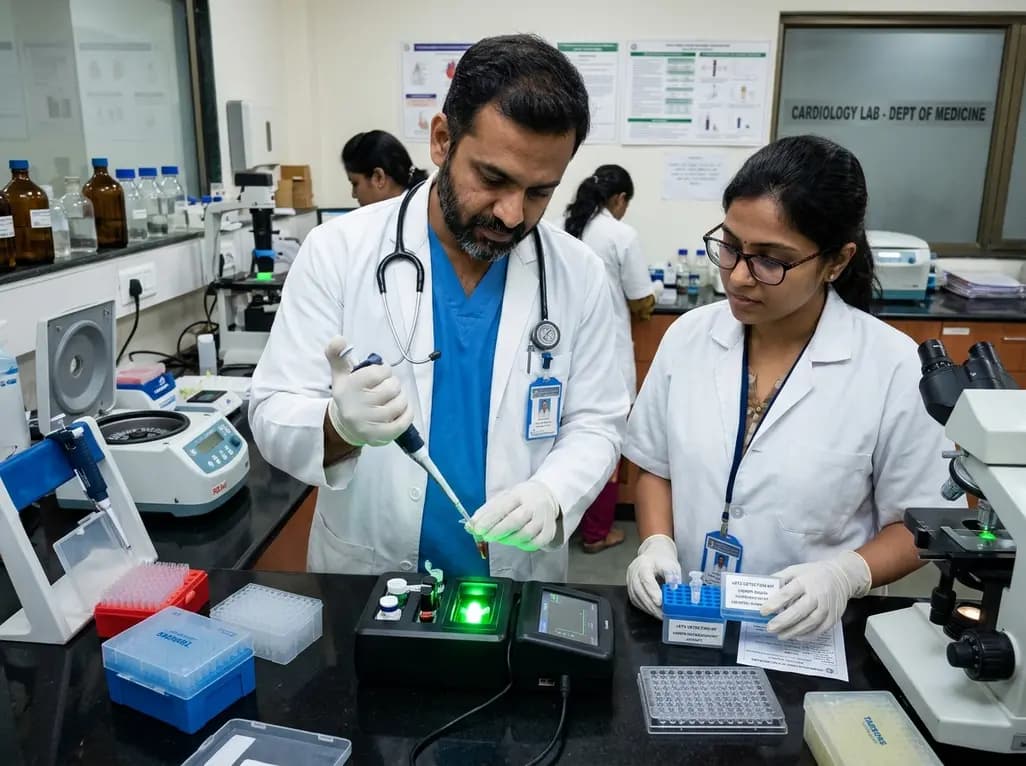
Researchers have engineered an innovative CRISPR-Cas12a fluorescent diagnostic kit for clinical sST2 detection. By combining nanotechnology with enzymatic trans-cleavage, this platform enables rapid, ultrasensitive heart failure diagnosis and risk stratification, outperforming conventional laboratory ELISA methods.
Today

Non-union fractures occur in 2-5% of cases, causing significant disability and cost. Conservative modalities such as LIPUS, PEMF, and focused ESWT offer non-surgical healing options for defects up to 5-10 mm when adequate mechanical stability exists without infection.
Today
A Brazilian birth cohort reveals significant sex-specific associations between preterm birth and adolescent adiposity, underscoring the urgent need for targeted long-term cardiometabolic surveillance and tailored clinical monitoring.
Today
