

Loading, please wait...
Loading, please wait...
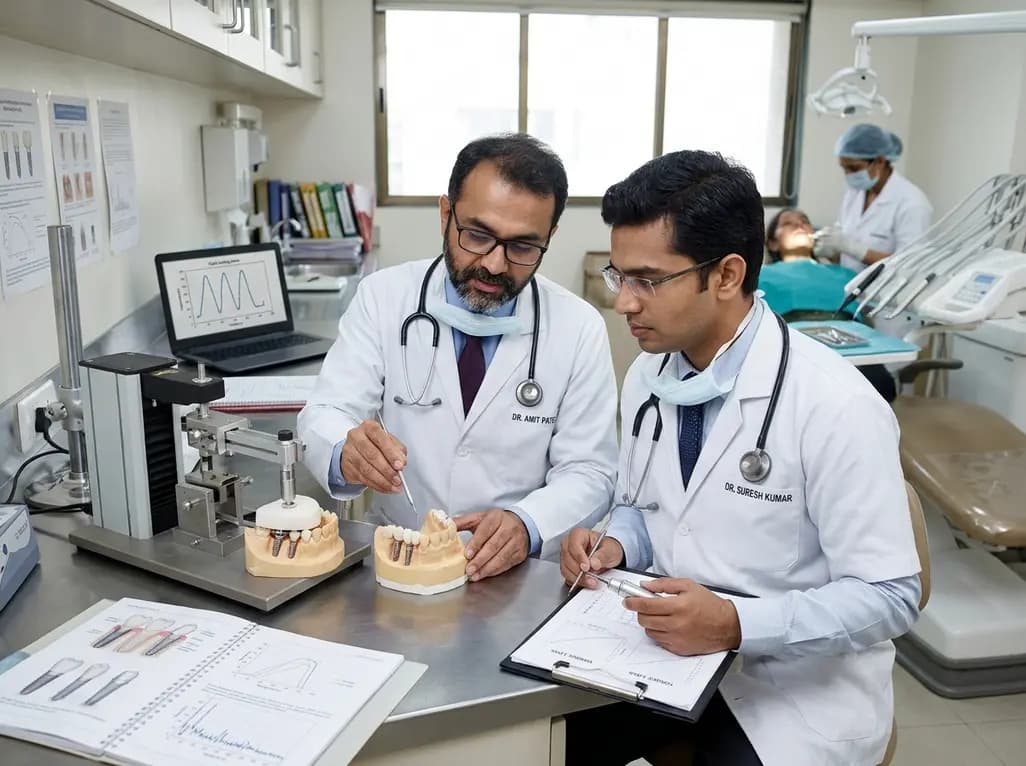
Implant dentistry often requires clinicians to navigate complex anatomical restrictions in the posterior mandible, such as the inferior alveolar nerve and localized bone resorption. Tilting distal implants allows practitioners to engage dense residual bone and avoid extensive grafting procedures. However, non-axial placement introduces severe mechanical stress that frequently precipitates abutment screw loosening during masticatory function. When masticatory forces hit inclined fixtures, bending moments and non-axial vectors challenge the mechanical stability of prosthetic connections. Consequently, clinicians must choose prosthetic components that resist dynamic micro-movements and protect preload tension. While traditional multi-unit angled abutments provide established clinical pathways for angle correction, alternative solutions like the OT Bridge system have emerged to streamline restorative protocols. Nevertheless, dynamic functional demands require thorough in vitro assessment before clinicians universally adopt newer connection designs. Therefore, understanding how repetitive stress affects screw stability remains critical for long-term clinical success in posterior implant rehabilitations.
A recent investigation evaluated the mechanical resilience of screw connections in implant-supported three-unit fixed partial dentures under dynamic fatigue testing. Specifically, researchers established a partially edentulous mandibular model reflecting a Kennedy Class II clinical situation. The experimental setup featured one axially oriented implant in the second premolar region and one distally tilted implant in the second molar position. In both experimental arms, a straight screw-in abutment secured the anterior premolar fixture. For the posterior tilted fixture, investigators utilized the OT Bridge connection in one cohort and a standard angled multi-unit abutment in the opposing cohort. Subsequently, technicians designed and precision-milled sixteen cobalt-chromium or titanium frameworks to ensure standardized fit across all specimens. The investigators systematically quantified the prosthetic screw removal torque before and after subjecting the restorations to dynamic cyclic loading of 100,000 cycles. Thus, this rigorous protocol simulated approximately five months of localized chewing function to capture early mechanical degradation.
The experimental findings demonstrated notable performance differences between the restorative systems, especially after cyclic loading. At the axially placed second premolar site, both abutment modalities performed admirably with no statistically significant variance in torque loss. Specifically, the percentage of screw loosening at the premolar position remained statistically comparable between groups both prior to fatigue testing and after dynamic loading. In sharp contrast, the tilted second molar position exhibited marked differences between the two connection types. Before loading, the OT Bridge group showed a modest screw loosening rate of 17.35 percent compared to 16.50 percent in the multi-unit group. However, following 100,000 mechanical cycles, the OT Bridge group suffered a substantial increase in loosening to 26.50 percent. Conversely, the multi-unit angled abutment cohort exhibited superior retention, recording only 18.30 percent loosening. Consequently, the retentive torque loss difference ratio was significantly higher in the OT Bridge group at the tilted molar position.
Several mechanical principles explain why angled multi-unit abutments outperformed the OT Bridge under dynamic masticatory simulations. First, angled multi-unit abutments possess a rigid, structurally reinforced collar that redistributes non-axial bending moments away from the primary prosthetic screw. Because the intermediate abutment secures directly into the implant internal geometry, the prosthetic screw primarily manages compressive seating rather than sheer lateral vectors. In contrast, low-profile ball-and-ring systems, like the OT Bridge with Seeger retaining rings, rely on localized elastomeric or mechanical snap interfaces. While this compact design permits tremendous angular divergence and facilitates passive path of insertion, it exposes the retaining screw to greater fulcrum forces. Furthermore, molar sites experience substantially higher bite loads and severe lateral excursions than anterior or premolar segments. As repetitive eccentric forces deflect the prosthetic superstructure, micro-gap formation accelerates screw detorquing. Therefore, the rigid geometric engagement of multi-unit designs provides superior defense against cyclic joint separation.
These findings provide actionable guidance for dental practitioners designing fixed restorations over non-parallel fixtures. In anterior or premolar quadrants where occlusal forces remain moderate, the OT Bridge remains a versatile and viable alternative. Moreover, its narrow profile preserves inter-occlusal space and provides predictable path correction without requiring bulky prosthetic contours. However, when restoring Kennedy Class II cases involving distal cantilevers or tilted molar fixtures, clinicians should exercise caution. Because posterior masticatory loads dramatically accelerate retentive torque loss, angled multi-unit abutments offer superior mechanical insurance against premature screw loosening. If a clinician chooses an OT Bridge protocol in high-stress posterior areas, they must establish precise occlusal schemes that minimize lateral interferences during excursion. Additionally, clinicians should consider shorter recall intervals to verify screw tightness and replace retaining components before structural fatigue leads to screw fracture or framework failure.
To mitigate mechanical complications in clinical practice, practitioners should implement standardized torque verification and maintenance protocols. Clinicians must always use calibrated digital or mechanical torque wrenches rather than hand drivers to establish manufacturer-recommended initial preload. Furthermore, retightening the retaining screw ten minutes after initial delivery helps counteract the initial embedment relaxation of metal threads. Clinicians should also verify passive framework fit using radiographic verification and the single-screw test before final torque application. When non-axial implants are unavoidable, combining splinted restorations across rigid cross-arch configurations significantly reduces stress concentration on individual screws. Moreover, treating nocturnal bruxism with custom occlusal splints protects prosthetic assemblies from destructive parasports and excessive cyclic forces. Ultimately, selecting the appropriate abutment geometry for specific anatomical zones ensures restorative longevity, minimizes chairside maintenance, and optimizes patient satisfaction.
Dynamic cyclic loading generates continuous micro-movements between the prosthetic framework, abutment, and implant interface. These repetitive micro-displacements gradually smooth the microscopic contact irregularities along the screw threads, a phenomenon known as embedment relaxation. Consequently, the initial clamping force and preload tension decline over time. Once preload drops below functional masticatory thresholds, rotational slippage occurs, causing progressive screw loosening and potential component fatigue.
Angled multi-unit abutments feature a robust intermediate design that transforms angled implant axes into parallel restorative paths. By shifting the fulcrum and locking rigidly into the implant internal connection, they disperse lateral shear stresses directly to the fixture body. Therefore, the prosthetic screw experiences primarily axial tensile forces rather than destructive lateral bending moments, which preserves thread preload across extensive masticatory cycles.
Clinicians should consider the OT Bridge system when treating cases with severely divergent implants up to eighty degrees or restricted vertical restorative space. Its low-profile equator design provides exceptional restorative clearance and facilitates passive seating without requiring extensive subgingival countersinking. However, clinicians should preferably deploy this system in low-load anterior zones rather than isolated, tilted posterior molar segments.
Disclaimer: This content is for informational and educational purposes only and should not be construed as clinical or medical advice. Dental practitioners must exercise independent clinical judgement and consider patient-specific anatomy, occlusion, and component compatibilities. Refer to the latest local and national guidelines for clinical practice.
References

Read summarized clinical updates, watch expert medical content, and earn CME certifications right from your smartphone.
Open your smartphone camera to scan and install.





A comparative study evaluated abutment screw loosening in 3-unit fixed partial dentures supported by OT bridge versus angled multi-unit abutments. While both systems performed equally at premolar sites, angled multi-unit abutments demonstrated superior screw stability and lower torque loss at tilted molar sites.
Today

Groundbreaking research from IIT Kanpur demonstrates that resident islet macrophages can shut down beta-cell insulin secretion within minutes via direct signaling. This rapid non-inflammatory communication reshapes our understanding of diabetes pathogenesis and highlights novel targets for therapeutic interventions.
Today

A review of the evolution of maternal and pediatric therapeutics over two decades, examining developmental pharmacokinetics, lactation pharmacology, pediatric formulations, and evidence-based guidance for clinicians managing pregnancy and childhood diseases.
Today
New PEX-NET registry data reveal that the right atrial pressure to cardiac output (RAP/CO) slope during exercise right heart catheterization is an independent predictor of long-term mortality in pulmonary hypertension, outperforming conventional resting measures.
Today

Chronic nonbacterial osteomyelitis (CNO) is a pediatric autoinflammatory bone disorder. This review covers the French protocol, emphasizing whole-body MRI as the diagnostic gold standard, prudent biopsy avoidance, first-line NSAID treatment, and second-line biologic or bisphosphonate therapies for spinal lesions.
Today

A comprehensive systematic review of 40 studies covering 27 million participants confirms that individuals with type 2 diabetes face a 53% higher risk of Alzheimer's disease. Clinicians must actively prioritize early cognitive screening, glycemic stability, and neuroprotective interventions in routine metabolic care.
Today
