.webp&w=384&q=75)

Loading, please wait...
Loading, please wait...

Borderline personality disorder (BPD) affects approximately one to two percent of the general population. The condition is associated with severe emotional dysregulation, unstable interpersonal relationships, identity disturbance, and high rates of healthcare utilization. Although specialized psychotherapies demonstrate proven efficacy, their resource-intensive nature creates substantial barriers to immediate access. Consequently, many newly diagnosed patients experience protracted waiting periods without structured support. Emerging clinical frameworks emphasize stepped-care models to bridge this therapeutic gap. In this context, delivering structured online psychoeducation for BPD represents an innovative, scalable strategy to engage patients immediately following diagnostic disclosure, empowering them with disease awareness and foundational coping mechanisms.
Clinical practice guidelines consistently emphasize that timely assessment, clear diagnostic disclosure, and psychoeducation should form the foundation of BPD management. When clinicians share a diagnosis transparently, patients frequently experience relief and reduced self-stigma. However, conventional treatment pathways often require lengthy delays before comprehensive psychotherapy begins. During this vulnerable interval, patients may experience symptom escalation or present to emergency departments in crisis.
Digital health solutions offer an accessible vehicle to address these limitations. By delivering structured educational modules via web-based platforms, clinicians can provide standardized, evidence-informed guidance immediately. Digital psychoeducation demystifies core symptoms, explains neurobiological and psychological underpinnings, and introduces basic emotional regulation concepts. Furthermore, digital delivery allows patients to engage with educational materials at their own pace within familiar domestic settings. This approach optimizes resource allocation across outpatient networks, ensuring that high-intensity psychotherapy is complemented by accessible preliminary interventions.
A recent randomized controlled pilot trial evaluated the safety, feasibility, and preliminary mechanisms of an online educational and assessment protocol. The study enrolled 82 newly diagnosed adults who were sequentially assigned into three study arms. Participants in the experimental conditions watched 10 brief psychoeducational videos focused specifically on BPD over a two-week period. In contrast, the active control condition received time-matched educational videos regarding general mental health principles.
To evaluate incremental clinical benefits, investigators randomized half of the BPD psychoeducation group to receive personalized feedback. This feedback detailed changes in symptom ratings and cognitive performance metrics over time. Additionally, the study incorporated 30 days of ecological momentary assessment (EMA) to capture real-time interpersonal interactions, affective fluctuations, and behavioral responses. Investigators assessed borderline symptoms, depressive severity, and overall personality functioning at baseline, immediately post-video intervention, post-feedback delivery, and at a one-month follow-up evaluation.
The pilot trial demonstrated promising feasibility metrics, with overall study retention aligning with typical digital mental health interventions. The observed dropout rate was 32.9%, which reflects standard engagement levels for self-directed digital interventions. Crucially, the protocol demonstrated a robust safety profile. The researchers observed no statistically significant differences among study arms regarding emergency department visits, psychiatric hospitalizations, or escalations in care levels. This confirms that early diagnostic education does not precipitate acute clinical crises.
Participants assigned to the BPD-specific educational arms reported significantly higher satisfaction ratings compared to active controls. Furthermore, objective assessments revealed marked improvements in disease-specific knowledge among participants receiving BPD psychoeducation. Although overall borderline symptom severity scores did not differ significantly between groups at one month, the psychoeducation plus personalized feedback arm showed significant, medium-effect-size improvements in self-impairment measures. Therefore, combining education with individualized cognitive and emotional feedback appears particularly effective for stabilizing core self-functioning.
Beyond traditional symptom rating scales, the trial explored potential mechanisms of psychological change through intensive ecological momentary data. A prominent feature of BPD is intolerance of aloneness, wherein periods of solitude frequently trigger intense dysphoria, panic, or self-harm urges. In the control cohort, mathematical modeling confirmed a strong positive correlation between time spent alone and acute borderline symptom severity.
Remarkably, participants who received both BPD psychoeducation and personalized feedback exhibited an inverted, negative correlation between solitary time and symptom intensity. This finding indicates that targeted psychoeducation helps patients reframe solitary experiences constructively. By gaining insight into emotional triggers and receiving objective feedback on their cognitive patterns, patients develop greater psychological autonomy. Consequently, improving reflective capacity allows individuals to tolerate periods of solitude without experiencing destabilizing affective surges or impulsive behavioral reactions.
These pilot findings offer practical clinical implications for general practitioners, emergency physicians, and mental health specialists. First, the data reinforce that clinicians should not delay diagnostic disclosure out of concern for patient decompensation. When accompanied by structured psychoeducation, receiving a BPD diagnosis is both safe and empowering. Digital video prescriptions provide a standardized, low-burden method for clinicians to initiate care during routine consultations.
Second, incorporating personalized objective feedback significantly amplifies the therapeutic impact of digital psychoeducation. Healthcare systems can integrate digital self-assessments into initial intake workflows, generating automated symptom summaries that foster self-reflection. While digital psychoeducation does not replace comprehensive psychotherapy, it functions as a highly valuable first step in stepped-care architecture. Implementing such scalable digital interventions can optimize patient readiness, decrease crisis presentations, and streamline subsequent specialized psychotherapy.
Digital psychoeducation provides structured, accessible explanations of symptoms, emotional dysregulation, and behavioral triggers. It demystifies the diagnosis, reduces internal self-stigma, and introduces essential coping mechanisms. Consequently, patients develop greater diagnostic insight and feel more prepared to engage actively in long-term psychotherapeutic treatments.
No, psychoeducation serves as an initial stepped-care intervention rather than a comprehensive cure. While it significantly enhances self-understanding and improves personality functioning, full symptom remission typically requires evidence-based psychotherapies such as dialectical behavior therapy, mentalization-based therapy, or good psychiatric management.
Personalized feedback provides objective insights into an individual's cognitive performance and emotional fluctuations over time. This individualized data strengthens self-reflective capacity, promotes greater self-awareness, and empowers patients to tolerate distress and periods of solitude without experiencing severe symptom escalation.
Disclaimer: This content is for informational and educational purposes only, and is not a substitute for professional medical advice, diagnosis, or treatment. Clinicians should evaluate this information in the context of individual patient presentations and verify dosages, interactions, and contraindications before prescribing any medication or starting any therapy. Healthcare practices, clinical guidelines, and pharmacological parameters are subject to continuous change. Refer to the latest local and national guidelines for clinical practice.
References
1. Choi-Kain LW et al. Online psychoeducation and assessment for borderline personality disorder as a first step of care: A pilot study assessing safety, feasibility, and mechanisms of change. PLoS One. 2026. doi: 10.1371/journal.pone.0353836. PMID: 42616804.
2. Choi-Kain LW, Finch EF, Masland SR, Jenkins JA, Unruh BT. What Works in the Treatment of Borderline Personality Disorder. Curr Behav Neurosci Rep. 2017;4(1):21-30. doi:10.1007/s40473-017-0103-z.
3. Paris J. Stepped Care: An Alternative to Routine Extended Treatment for Patients With Borderline Personality Disorder. Psychiatr Serv. 2013;64(10):1035-1037. doi:10.1176/appi.ps.201200445.

Read summarized clinical updates, watch expert medical content, and earn CME certifications right from your smartphone.
Open your smartphone camera to scan and install.





A randomized pilot trial demonstrates that online psychoeducation combined with personalized feedback is safe, feasible, and effective for newly diagnosed borderline personality disorder, improving self-impairment and reshaping how patients experience time spent alone.
last month

Following 37,899 reported cases and 9 deaths, Odisha has scaled up active case detection, rapid diagnostic testing, and vector control across high-burden districts. Here is a comprehensive clinical breakdown of the state's aggressive containment protocols, diagnostic pathways, and targeted field management.
Today

Endometriosis affects millions of women across India, yet diagnostic delays frequently exceed five years. Recent multi-centre genomic research has identified 21 novel genetic regions, notably on chromosome 13, establishing crucial population-specific insights to transform clinical screening and therapeutic strategies.
Today
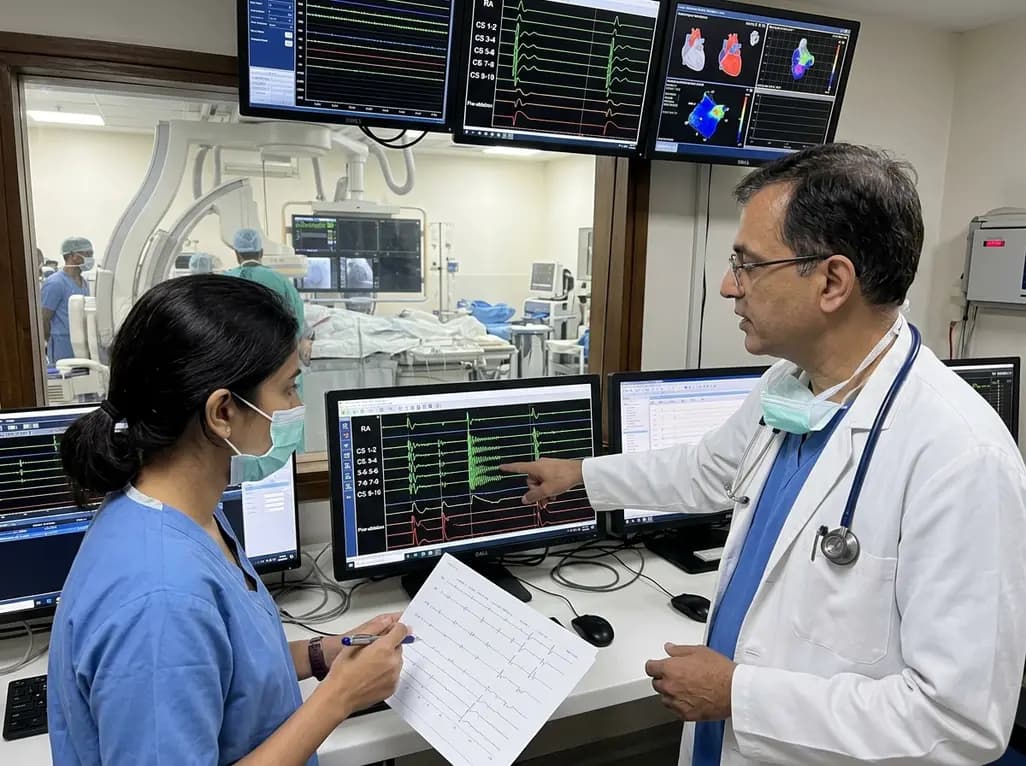
Radiofrequency catheter ablation of the cavotricuspid isthmus successfully terminates typical atrial flutter. This article reviews the mechanisms driving coronary sinus electrogram changes, wavefront activation pathways, and clinical criteria to verify bidirectional block during electrophysiology studies.
Today

A study comparing four knee flexion strength tests after ACL reconstruction using hamstring tendon autografts reveals marked variability in limb symmetry indices. Clinicians must recognize that different strength testing modalities yield divergent return-to-sport clearance rates.
Today

Discover how to identify superimposed entrapment neuropathy in diabetic patients. This review details clinical evaluation, surgical decompression evidence, and a structured algorithm for primary care referrals to prevent ulcers and preserve limb function.
Yesterday
