.webp&w=384&q=75)

Loading, please wait...
Loading, please wait...

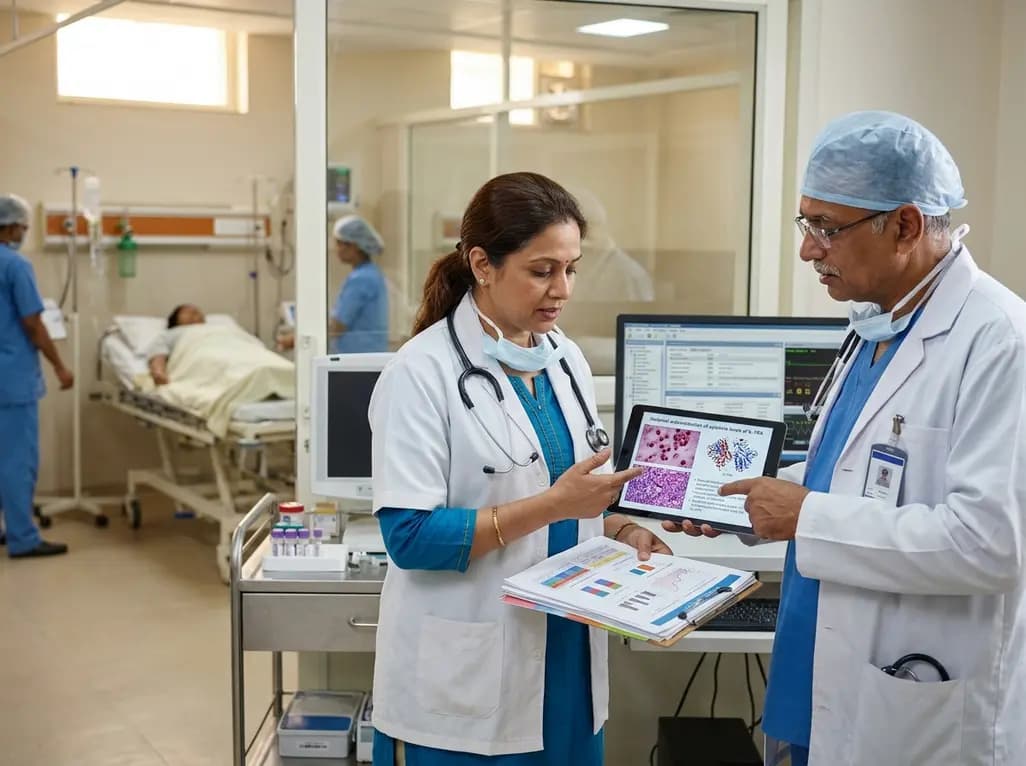
Anemia continues to be a major public health concern in India. The National Family Health Survey (NFHS-5) reports a high prevalence across various demographics, particularly among women and children. Traditional diagnosis depends on invasive blood sampling, which often deters patients. However, a recent exploratory study investigated the potential of noninvasive hemoglobin monitoring through a smartphone-based application. This technology could revolutionize point-of-care screening by eliminating the need for painful needle sticks.
The study recruited 555 adult volunteers to test the \"comestai.app,\" a tool utilizing remote photoplethysmography (rPPG). Participants faced the smartphone's front camera for approximately 90 seconds. Meanwhile, the software analyzed facial blood flow patterns to estimate hemoglobin (Hb) levels. Researchers compared these digital readings against standard laboratory results obtained from a complete blood count. Lighting conditions remained standardized throughout the testing process to ensure data consistency.
Notably, the method demonstrated an overall accuracy of 75% and an area under the curve (AUC) of 0.701. The app achieved a mean absolute error of 1.46 g/dL. Furthermore, the Bland-Altman plot showed a mean difference of only -0.70 g/dL compared to lab tests. These results suggest that rPPG technology is a feasible option for initial wellness monitoring. Consequently, this innovation may help democratize health tools in resource-limited settings. By leveraging the ubiquity of smartphones, the app contributes to proactive self-care and early detection.
In addition, the use of widespread smartphone technology allows for cost-effective health checks. Patients can monitor their status easily without visiting a clinic for every routine screen. However, the authors emphasize that further algorithmic refinement is necessary. Larger-scale validation across diverse skin tones and populations will enhance future accuracy. Therefore, while this app serves as a powerful screening aid, clinicians should still rely on gold-standard blood tests for definitive medical decisions.
The app uses the smartphone's front-facing camera to capture facial videos. It applies remote photoplethysmography (rPPG) to analyze light reflection from the skin, which correlates with blood hemoglobin concentrations.
No, the app is currently intended as a wellness and screening tool. While it offers a 75% accuracy rate, clinicians should confirm all results with a laboratory-based complete blood count before making clinical decisions.
With high anemia rates reported in NFHS-5, a non-invasive, low-cost screening tool can help identify at-risk individuals in remote areas where laboratory access is limited.
Disclaimer: This content is for informational and educational purposes only. It does not constitute medical advice or a professional recommendation. Refer to the latest local and national guidelines for clinical practice.
References
Zuccotti G et al. Feasibility of a Noncontact Photoplethysmography-Based Mobile App for Noninvasive Hemoglobin Monitoring: Exploratory Observational Study. JMIR Form Res. 2026 Feb 19. doi: 10.2196/78820. PMID: 41712961.
National Family Health Survey (NFHS-5), 2019-21. India Fact Sheet. Ministry of Health and Family Welfare.
"
Read summarized clinical updates, watch expert medical content, and earn CME certifications right from your smartphone.
Open your smartphone camera to scan and install.





A study explores using remote photoplethysmography via a smartphone app for noninvasive hemoglobin monitoring, achieving 75% accuracy in 555 volunteers....
8 months ago

Review how tailored exercise programs benefit frail older patients with heart failure. Explore pathophysiological mechanisms, individualized training prescriptions, and strategies to overcome adherence barriers in clinical practice.
Today
Recent clinical studies reveal maternal autoantibodies targeting IL-1RA as potential triggers for preterm labor, opening avenues for targeted cytokine therapies. Concurrently, new perioperative findings show inhaled cannabis increases propofol requirements during upper endoscopy compared to oral edible consumption.
Today

In high-risk pulmonary embolism complicated by severe anemia and active uterine bleeding, systemic thrombolysis is contraindicated. Large-bore aspiration thrombectomy provides rapid hemodynamic rescue without fibrinolysis, supported by inferior vena cava filter placement and multidisciplinary critical care.
Today

This comparative study evaluates posterior labral tears with and without glenohumeral instability, highlighting distinct demographic patterns, MRI underestimation in stable shoulders, and successful arthroscopic repair outcomes.
Today

A clinical study demonstrates that early intervention with tocilizumab, either as monotherapy or bridged with corticosteroids, achieves significant proptosis reduction and resolves active inflammation in treatment-naive thyroid eye disease.
Today
