.webp&w=384&q=75)

Loading, please wait...
Loading, please wait...

The National Medical Commission (NMC) launched a major initiative using NMC digital tracking to improve hospital data management. This directive requires medical institutions to link hospital systems with the national framework within 15 days. Consequently, regulators aim to create a more transparent environment for assessing medical education and healthcare delivery.
The commission recently issued a notice to all medical colleges regarding the integration of their Health Management Information Systems (HMIS). Specifically, hospitals must connect with the Ayushman Bharat Digital Mission (ABDM) portal. This linkage ensures that every registration and treatment service is recorded on a national platform. Furthermore, the National Health Authority (NHA) will maintain this digital portal to maintain data integrity. Medical colleges must submit their Health Facility Registry (HFR) IDs to the commission to facilitate this process.
One primary reason for this shift is the need to verify the actual patient load in teaching hospitals accurately. Historically, regulators faced challenges when institutions reported inflated patient numbers or created \"paper patients.\" By implementing digital tracking, the NMC can weed out fake and erroneous entries from official records. Additionally, this transparency will play a crucial role during the annual assessment and renewal process for medical colleges. Accurate data ensures that institutions maintain the minimum standard requirements for training future doctors.
Beyond oversight, the digital shift offers long-term clinical benefits for both doctors and patients. Once hospitals become digitally connected, physicians can access a patient’s comprehensive medical history seamlessly. This access allows for more informed diagnoses and coordinated treatment plans across different institutions. Moreover, patients will benefit from the creation of Ayushman Bharat Health Account (ABHA) IDs. These 14-digit IDs facilitate paperless record sharing and secure data exchange. Although nationwide integration will take time, this step represents a vital move toward a modern healthcare ecosystem.
Q1: What is the deadline for medical colleges to complete the ABDM integration?
Medical colleges and their attached hospitals must complete the integration of their digital systems with the ABDM portal within 15 days of the notice issued by the NMC.
Q2: How will digital tracking affect the assessment of medical colleges?
Digital tracking provides the NMC with objective and verifiable data on patient loads. This replaces reliance on self-reported numbers and makes the annual renewal and assessment process more transparent.
Q3: What role does the ABHA ID play in this new system?
The ABHA ID serves as a unique identifier for patients. It allows for the digital linking of prescriptions, lab reports, and treatment history across different healthcare providers nationwide.
Disclaimer: This content is for informational and educational purposes only. It does not constitute medical advice or replace professional judgment. Refer to the latest local and national guidelines for clinical practice.
References

Read summarized clinical updates, watch expert medical content, and earn CME certifications right from your smartphone.
Open your smartphone camera to scan and install.





NMC directs medical colleges to link hospital systems with ABDM within 15 days to verify patient loads and enable digital health record sharing....
7 months ago
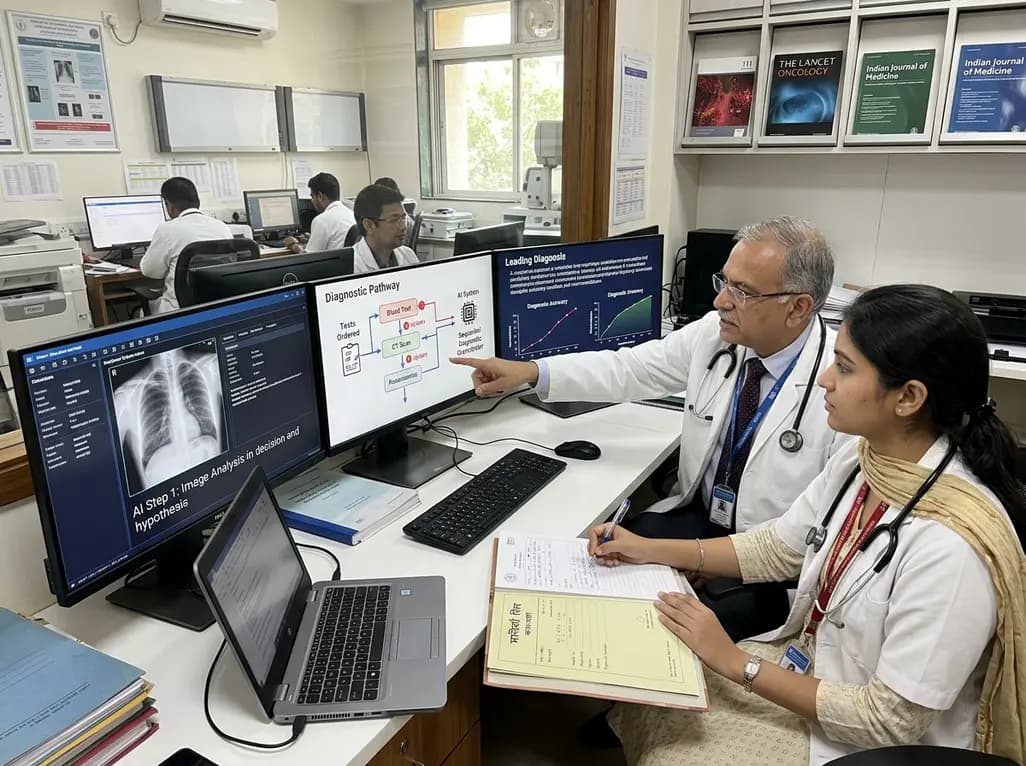
A breakthrough peer-reviewed study demonstrates that a sequential AI diagnosis system can mirror real-world clinical reasoning. By ordering stepwise tests and updating hypotheses dynamically, this multi-agent orchestrator achieved superior diagnostic accuracy while reducing investigative costs.
Today

A prenatal case highlights severe glutaric acidemia type II presenting as bilateral hyperechoic cystic kidneys at 18 weeks. Whole-exome sequencing revealed a novel homozygous ETFDH frameshift variant, demonstrating the power of rapid genetic testing in fetal renal anomalies.
Today

Review how tailored exercise programs benefit frail older patients with heart failure. Explore pathophysiological mechanisms, individualized training prescriptions, and strategies to overcome adherence barriers in clinical practice.
Yesterday

This comparative study evaluates posterior labral tears with and without glenohumeral instability, highlighting distinct demographic patterns, MRI underestimation in stable shoulders, and successful arthroscopic repair outcomes.
Yesterday

A clinical study demonstrates that early intervention with tocilizumab, either as monotherapy or bridged with corticosteroids, achieves significant proptosis reduction and resolves active inflammation in treatment-naive thyroid eye disease.
Yesterday
