.webp&w=384&q=75)

Loading, please wait...
Loading, please wait...
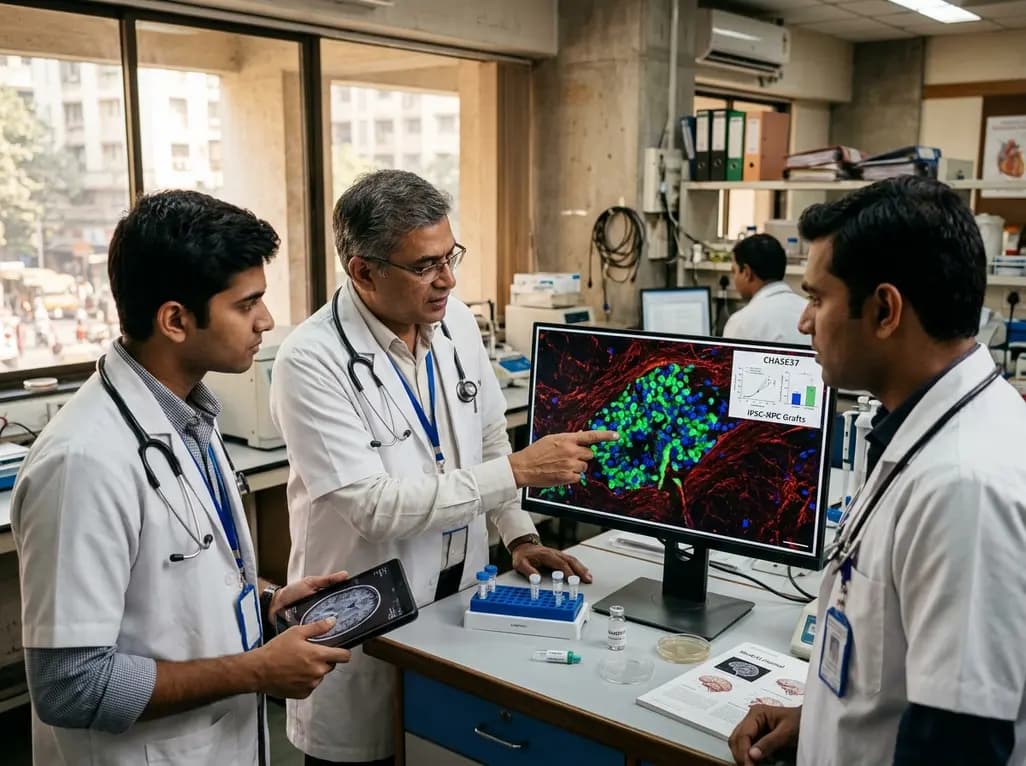
Ischemic stroke remains a leading cause of permanent disability worldwide, placing a heavy burden on modern healthcare systems. Although prompt endovascular thrombectomy and intravenous thrombolysis restore cerebral perfusion, they cannot revive necrotic brain tissue. Consequently, neural progenitor cell transplantation has emerged as a promising restorative therapy to replace lost neurons. However, hostile microenvironments within the ischemic cavity severely impede cellular engraftment. Following focal ischemia, reactive astrocytes, microglia, and extracellular matrix components form a dense glial scar. While this scar initially limits lesion expansion, it rapidly creates an impenetrable barrier against structural regeneration. Specifically, the scar deposits inhibitory chondroitin sulfate proteoglycans that repel migrating neuroblasts and arrest axonal outgrowth. Therefore, isolated stem cell grafts usually show dismal survival rates because the peri-infarct environment lacks permissive cues. To solve this clinical challenge, neuroscientists are investigating dual therapies that digest the glial barrier while delivering regenerative progenitors. Preclinical evidence indicates that enzymatically clearing inhibitory matrix proteoglycans creates a favorable niche. This bioengineered microenvironment allows implanted progenitors to engraft, mature, and extend functional axons into surviving cerebral circuits.
The bacterial enzyme chondroitinase ABC digests inhibitory chondroitin sulfate proteoglycans, rendering peri-infarct tissue permissive to neuroplasticity. Unfortunately, the wild-type enzyme exhibits extreme thermal instability at mammalian body temperature. In unengineered forms, it loses catalytic efficacy within twenty-four hours in vivo, necessitating dangerous repetitive intracerebral injections. To circumvent this hurdle, researchers computationally redesigned the enzyme by introducing thirty-seven precise point mutations. This thermostable mutant, termed ChASE37, provides remarkable thermodynamic stability and increases the catalytic half-life beyond one hundred hours. Furthermore, bioengineers coupled ChASE37 with affinity peptides to enable sustained release from biomaterial carriers. In rodent stroke models, this sustained-release formulation continuously degrades inhibitory glycosaminoglycans across multiple weeks without inducing immunogenic reactions. Crucially, the local application avoids neuroinflammatory complications and prevents toxic systemic exposure. Because the enzyme maintains long-term activity, it persistently opens regenerative corridors for migrating and extending neurites. Thus, ChASE37 overcomes the primary pharmacological roadblock that previously prevented successful translation of enzymatic matrix modification in central nervous system injury.
Delivering living cells into a fluid-filled stroke cavity requires tailored physical matrices to avoid immediate anoikis. Therefore, researchers established a complementary, bicomponent hydrogel delivery platform. First, they formulated an in situ gelling, shear-thinning hyaluronic acid hydrogel supplemented with laminin. Laminin presents vital integrin-binding peptides that anchor human induced pluripotent stem cell-derived neural progenitors, fostering survival and structural differentiation. Neurosurgeons can inject this biocompatible scaffold directly into the sub-acute cavity to fill irregular tissue defects securely. Simultaneously, investigators packaged the affinity-release ChASE37 within a methylcellulose hydrogel applied epicortically over the stroke injury. Methylcellulose provides an atraumatic reservoir that steadily diffuses active enzyme into the deeper injured cortex. Consequently, this modular design decouples the localized enzymology from cell delivery mechanics. By separating the carriers, each hydrogel delivers its payload under optimal biophysical conditions. In addition, the injectable materials minimize mechanical compression against sensitive peri-infarct tissue. This versatile hydrogel configuration provides an adaptable surgical system suitable for heterogeneous human stroke lesions.
A pivotal finding from recent preclinical investigations reveals that enzymatic digestion directly dictates stem cell fate. When researchers injected neural progenitors alone, the majority of transplanted cells succumbed within several weeks. However, co-administering sustained-release ChASE37 radically transformed this outcome. The sustained degradation of inhibitory chondroitin sulfate proteoglycans created a permissive microenvironment that supported long-term graft survival. Immunohistochemical analysis demonstrated high densities of surviving human cells displaying definitive neuronal phenotypes throughout the lesion border. Moreover, the digested peri-infarct matrix stimulated robust neurite extension, enabling transplanted progenitors to form extensive arborizations. Critically, the combined therapy shifted differentiation away from reactive glial lineages toward mature neurons and functional oligodendrocytes. This observation confirms that ChASE37 acts beyond basic matrix breakdown by modulating local signaling cascades. Consequently, the cleared environment reduces toxic inflammatory cues while enhancing beneficial trophic signaling. These cellular dynamics demonstrate that addressing hostile matrix barriers is an absolute biological requirement for successful cell therapy in stroke.
Functional improvement remains the definitive standard for assessing experimental stroke therapeutics. In animal models, animals treated with either ChASE37 or neural progenitors alone showed modest motor gains. In stark contrast, the co-delivery regimen elicited superior, long-lasting behavioral recovery as early as three weeks post-intervention. Standardized motor testing revealed marked gains in forelimb asymmetry, sensorimotor coordination, and locomotive speed. Histological tracing indicated that surviving grafted neurons established synaptically integrated pathways across damaged cortical areas. Furthermore, ChASE37 promoted extensive neuroplastic sprouting among intact host axons, compensating effectively for lost tissue function. For clinical neurologists and neurosurgeons, these synergistic results signify a major translational leap. Applying modular hydrogels loaded with human iPSC-derived progenitors and stabilized enzymes provides a viable roadmap toward clinical trials. Although clinicians must still establish standardized manufacturing and long-term tumorigenicity screening, this approach offers genuine neurorestorative potential. Ultimately, combining biomaterial delivery, enzymatic scar reduction, and stem cell transplantation may transform chronic stroke rehabilitation globally.
Wild-type chondroitinase ABC degrades rapidly at standard human body temperatures, losing nearly all enzymatic activity within twenty-four hours in vivo. Consequently, maintaining therapeutic levels requires frequent intracranial injections or continuous mechanical catheter infusions, which carry significant risks of brain infection, hemorrhaging, and parenchymal trauma. In contrast, the engineered ChASE37 variant possesses thirty-seven targeted mutations that extend its functional half-life to over one hundred hours, permitting sustained enzymatic action from a single biocompatible delivery.
Chondroitin sulfate proteoglycans are dense extracellular molecules that accumulate within the glial scar following ischemic stroke. These proteoglycans biochemically inhibit neurite outgrowth and physically block endogenous and transplanted cell migration across damaged tissue borders. By enzymatically digesting these inhibitory glycosaminoglycan chains, chondroitinase ABC dismantles both physical and biochemical barriers. This enzymatic clearance reactivates developmental plasticity, promotes compensatory axonal sprouting from spared neural circuits, and allows grafted progenitor cells to survive, integrate, and differentiate successfully.
Injecting unprotected stem cell suspensions directly into a necrotic stroke cavity results in catastrophic cell death due to anoikis and physical shear stress. Hydrogel scaffolds, such as hyaluronic acid functionalized with laminin, solve this challenge by recreating a supportive extracellular matrix. The hydrogel provides essential mechanical cushioning and adhesion ligands that promote cellular viability. Furthermore, hydrogels localize transplanted cells to the infarct core, preventing cellular leakage while supporting long-term differentiation into mature, functioning neural networks.
Disclaimer: This content is for informational and educational purposes only and should not be considered medical advice. Always consult a qualified healthcare provider for diagnosis and treatment decisions. Refer to the latest local and national guidelines for clinical practice.
References

Read summarized clinical updates, watch expert medical content, and earn CME certifications right from your smartphone.
Open your smartphone camera to scan and install.





Preclinical research shows co-delivering sustained-release ChASE37 with human iPSC-derived neural progenitor cells via hydrogels overcomes glial scar inhibition, significantly boosting graft survival, differentiation, and functional motor recovery in sub-acute stroke.
last month

Review how tailored exercise programs benefit frail older patients with heart failure. Explore pathophysiological mechanisms, individualized training prescriptions, and strategies to overcome adherence barriers in clinical practice.
Today

Leucine Rich Bio has introduced South Asia's first comprehensive vaginal microbiome test, BugSpeaks. By profiling microbial dysbiosis, pathogens, and antimicrobial resistance, this next-generation diagnostic platform provides clinicians with deeper insights into recurrent infections, fertility, and reproductive health.
Today

In high-risk pulmonary embolism complicated by severe anemia and active uterine bleeding, systemic thrombolysis is contraindicated. Large-bore aspiration thrombectomy provides rapid hemodynamic rescue without fibrinolysis, supported by inferior vena cava filter placement and multidisciplinary critical care.
Today

This comparative study evaluates posterior labral tears with and without glenohumeral instability, highlighting distinct demographic patterns, MRI underestimation in stable shoulders, and successful arthroscopic repair outcomes.
Today

A clinical study demonstrates that early intervention with tocilizumab, either as monotherapy or bridged with corticosteroids, achieves significant proptosis reduction and resolves active inflammation in treatment-naive thyroid eye disease.
Today
