.webp&w=384&q=75)

Loading, please wait...
Loading, please wait...

The intersection of quantum physics and clinical medicine often produces the most transformative technologies of our era. Recently, a significant breakthrough in nanocolumn molecular semiconductors has set a new benchmark for the field of spintronics. Published in the prestigious journal Advanced Materials, this study by Hu S and colleagues addresses the critical challenge of spin-transport efficiency at room temperature. Historically, molecular materials were limited by disorganized internal structures, which led to significant signal loss. However, by engineering vertically asymmetric nanocolumns, the researchers have increased transport efficiency from five percent to a record-breaking twenty percent. For the healthcare sector, this advancement is more than a technical curiosity. It paves the way for ultra-sensitive diagnostic biosensors and high-level hardware encryption for patient data. As clinicians in India navigate an increasingly digital environment, these hardware innovations offer the security and precision needed for future practice. Understanding how these nanocolumnar structures function is essential for appreciating the next generation of medical devices. This article explores how this physical breakthrough translates into tangible benefits for the modern medical professional and the broader healthcare ecosystem.
In traditional electronics, devices rely on the flow of electrical charge to process information. However, this process generates heat and faces physical limits as components shrink. Spintronics, or spin-based electronics, offers a more efficient alternative by utilizing the intrinsic 'spin' of electrons. Specifically, this quantum property allows for faster data processing with significantly lower power consumption. Consequently, this technology is already the backbone of modern high-density hard drives. For medical applications, the potential is even greater. High-sensitivity magnetic sensors could enhance MRI resolution or allow for the detection of ultra-low concentrations of biomarkers in the blood. Despite this promise, the efficiency of these systems at room temperature has remained low. Most molecular materials struggled with a spin-transport efficiency of only five percent. Therefore, the medical community has waited for a structural solution that could bring this technology into the clinical environment. The recent work on nanocolumn molecular semiconductors finally provides that bridge. By controlling the architecture of the semiconductor at a molecular level, researchers have unlocked the efficiency needed for the next generation of medical hardware. This transition marks a departure from bulky, power-hungry diagnostic tools toward streamlined, ultra-sensitive devices.
The primary hurdle in molecular spintronics has been the random arrangement of molecules within thin films. Specifically, unstructured films cause electron spins to lose their orientation quickly, which is a phenomenon known as decoherence. To solve this, the research team developed vertically asymmetric nanocolumn channels. These channels are created using a process called phase separation, where different components of a molecular mixture naturally organize themselves into distinct structures. Furthermore, these nanocolumns act like guided pathways for electron spins. They confine the spins within a restricted space, preventing the scattering that typically reduces efficiency. Additionally, the vertical asymmetry creates a built-in electric field. This field acts as an internal motor, pushing the spin signals through the material with minimal loss. Consequently, this structural design allows the system to reach an efficiency of twenty percent. This is a massive leap forward compared to the previous five percent limit. From a manufacturing perspective, this breakthrough is significant because it relies on self-assembly rather than expensive, complex lithography. Therefore, it opens the door for cost-effective production of spintronic components in India. For clinicians, this means that the high-tech sensors of the future could be both more capable and more affordable.
One of the most striking features of these new nanocolumn molecular semiconductors is their bias-dependent asymmetry. Specifically, the material behaves differently depending on the direction of the electrical current. At a positive voltage of 0.2 volts, the spin efficiency reaches its peak of twenty percent. In contrast, at a negative voltage, the efficiency drops to a mere one percent. This creates a record-high asymmetry factor that significantly outperforms metal oxides or traditional two-dimensional materials. Why does this matter for a doctor? In the realm of diagnostics, this asymmetry can be used to filter out background noise from biological signals. Moreover, it allows for the creation of 'rectifiers' for spin current, ensuring that delicate diagnostic data flows in only one direction. This prevents signal interference and improves the signal-to-noise ratio in biosensors. Consequently, clinicians could soon have access to bedside tests that are as accurate as laboratory-grade equipment. Specifically, detecting early-stage cancer markers or cardiac proteins requires this level of precision. Therefore, the ability to control spin transport with such high asymmetry provides a new toolkit for medical imaging and laboratory medicine. By harnessing these asymmetric properties, the next generation of diagnostics will be faster and more reliable.
Beyond diagnostics, the study highlights the potential of nanocolumn molecular semiconductors in information-secure applications. Specifically, the researchers demonstrated spin-signal encryption elements and true random number generators. In the modern Indian healthcare landscape, this is a critical development. As the Digital Personal Data Protection Act of 2023 sets strict standards for patient privacy, hospitals must adopt more robust encryption methods. Traditional software-based random number generators can often be predicted by sophisticated cyber-attacks. However, spintronic random number generators use the unpredictable nature of quantum spin to create truly random codes. Furthermore, these hardware-based security measures are much harder to hack. Consequently, integrating these molecular spintronic elements into medical tablets, servers, and wearable devices could safeguard sensitive health data. Patients in India are increasingly concerned about the privacy of their electronic health records. Therefore, providing a hardware-level solution for data security is a proactive step for the medical industry. Additionally, the low power requirements of these semiconductors make them ideal for battery-operated medical devices. Ultimately, this technology ensures that as we move toward a digital-first healthcare model, the security of our patients remains uncompromised.
The adoption of nanocolumn molecular semiconductors aligns perfectly with India's growing focus on medical device manufacturing and digital infrastructure. Specifically, the "Make in India" initiative encourages the local production of high-tech components. Because these molecular semiconductors can be fabricated using relatively simple solution-processing techniques, they are well-suited for Indian manufacturing hubs. Moreover, the integration of spintronic sensors into the national digital health ecosystem could improve rural healthcare delivery. For example, low-cost, high-sensitivity diagnostic kits could be deployed in primary health centers across the country. Furthermore, the ability to secure these devices with spin-based encryption protects the integrity of the unified health interface. As Indian doctors embrace telemedicine and remote monitoring, the reliability of the underlying hardware becomes paramount. Therefore, investments in spintronic research are not just academic; they are essential for the future of public health. Consequently, we expect to see more collaborations between physicists and medical researchers in India to tailor these materials for specific clinical needs. By bridging the gap between advanced materials science and clinical practice, we can ensure that Indian healthcare remains at the global forefront. This structural innovation provides the foundation for a more resilient and technologically advanced medical system.
Spintronics uses electron spin rather than just charge to process information. For clinicians, this translates into sensors with vastly improved sensitivity for detecting magnetic fields or chemical markers. Moreover, these devices consume far less power, making them ideal for portable diagnostic tools. Specifically, higher transport efficiency means that signals from biological molecules can be detected earlier and more reliably than with current electronic biosensors, potentially improving early disease detection rates.
Traditional encryption often relies on software algorithms that can be vulnerable to advanced cyber-attacks. However, nanocolumn molecular semiconductors enable the creation of true random number generators based on quantum physics. These generators produce encryption keys that are fundamentally unpredictable and extremely difficult to hack. Consequently, this technology provides a hardware-level security layer for electronic health records, ensuring that sensitive patient information remains protected against evolving digital threats and unauthorized access.
While these materials are currently in the research phase, their compatibility with solution-processing makes them promising for industrial scaling in India. Specifically, the "Make in India" initiative and the growth of the medical technology sector provide a perfect environment for this integration. We expect that as R&D continues, these spintronic components will move from laboratory settings to point-of-care diagnostic devices within the next decade, significantly enhancing rural healthcare accessibility and precision.
Disclaimer: This content is for informational and educational purposes only. It is not intended to provide any medical advice or be a substitute for professional medical advice, diagnosis, or treatment. Always seek the advice of your physician or other qualified health provider with any questions you may have regarding a medical condition. Refer to the latest local and national guidelines for clinical practice.
References
Hu S et al. High-Efficiency Asymmetric Spin Transport Enabled by Nanocolumn Molecular Semiconductors. Adv Mater. 2026 Jun 29. doi: 10.1002/adma.73826. PMID: 42371693.
Wang S, Hua X, Lee LJ. Electrokinetics induced asymmetric transport in polymeric nanonozzles. Lab Chip. 2008;8(4):612-619.
Li M, et al. Molecular spintronics: Challenges and prospects for future electronic devices. PMC. 2023; DOI: 10.1021/acs.jpcc.3c00071.

Read summarized clinical updates, watch expert medical content, and earn CME certifications right from your smartphone.
Open your smartphone camera to scan and install.





A breakthrough in nanocolumn molecular semiconductors has achieved record-high spin-transport efficiency. This advancement promises to transform medical diagnostics and healthcare data security by enabling more sensitive biosensors and robust encryption elements for patient record protection.
3 months ago
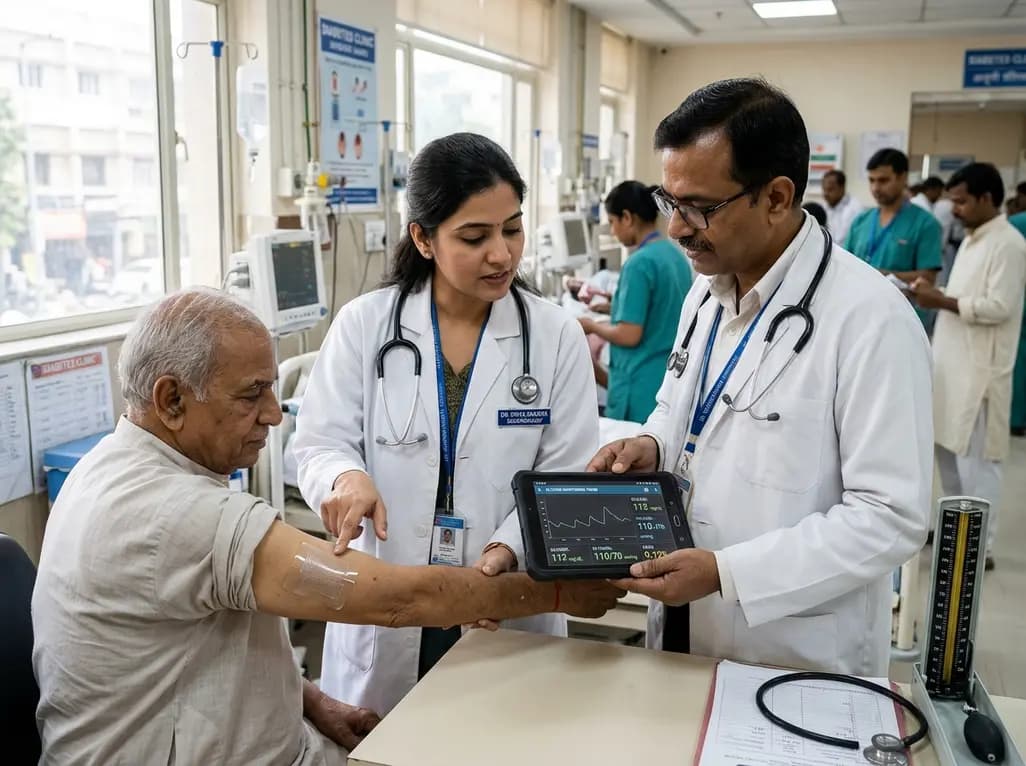
A breakthrough ultrathin multimodal sensor decouples physical hemodynamic monitoring from disposable electrochemical calibration, achieving long-term wearable glucose prediction with 81.36% accuracy and a 9.12% MARD. This offers a robust, drift-free solution for outpatient metabolic surveillance.
Today

Demanding exhaustive hormonal profiling can inadvertently discourage clinical studies involving females. Methodological standards must align with the specific scientific question to expand, not restrict, equitable evidence for women.
Today

Co-administering antiseizure medications and DOACs frequently causes pharmacokinetic interactions, subtherapeutic drug levels, and thromboembolic failures. This review highlights enzyme induction risks, unpredictable outcomes with levetiracetam, and the vital role of therapeutic drug monitoring.
Today

A comparative review of tension band wiring and intramedullary screw fixation in thumb metacarpophalangeal arthrodesis, evaluating union rates, hardware complications, and clinical outcomes.
Today

Following regulatory scrutiny from FSSAI regarding promotional representations and lean muscle preservation claims, Dr. Reddy's Laboratories and Nestlé Health Science are currently reviewing the branding and marketing strategy for their joint nutritional supplement Celevida GLP+.
Today
