.webp&w=384&q=75)

Loading, please wait...
Loading, please wait...
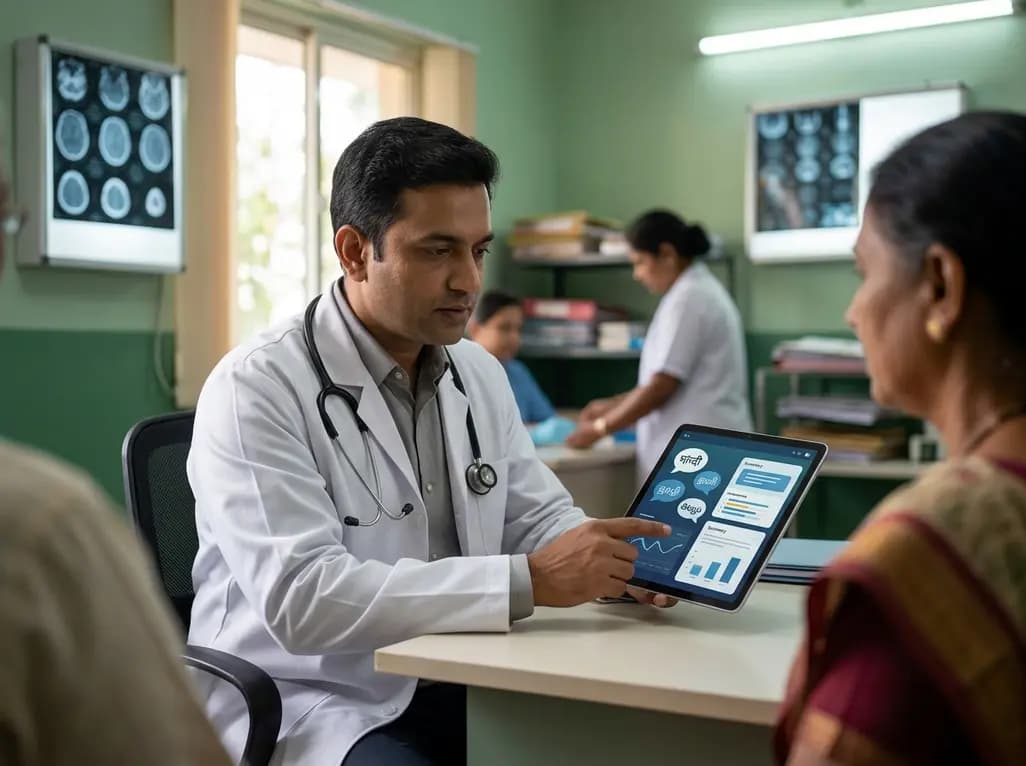
The transition from active clinical treatment to home recovery is often a highly challenging period for oncology patients in India. Christian Medical College (CMC) Vellore and IIIT Hyderabad developed BandhuCare to address this gap. This innovative multilingual AI companion acts as an essential virtual health assistant for patients between scheduled hospital visits. Crucially, the platform permits patients to interact using their native languages. This feature resolves severe communication challenges that frequently complicate modern cancer care. By establishing a continuous line of inter-consultation communication, this digital solution effectively bridges the massive post-discharge informational void. Consequently, patients receive guidance when they are most vulnerable. They do not have to wait weeks for their next hospital visit. Furthermore, healthcare providers benefit significantly from structured, clinical summaries. This collaborative Indian endeavor introduces a reliable technological bridge to improve clinical efficiency.
Managing post-treatment recovery is complex and requires continuous monitoring. Accordingly, the multilingual AI companion supports patients through natural, conversational text and voice inputs. Instead of rigid questionnaires, the platform encourages patients to describe symptoms naturally. Consequently, patients can maintain a detailed digital health journal. They can easily record swallowing difficulties, localized pain, or fatigue. Crucially, the tool currently supports eight major Indian languages. This wide linguistic support allows individuals from diverse backgrounds to communicate comfortably. The platform subsequently processes these daily journal entries. Therefore, clinicians receive accurate Patient Reported Outcome Measures before consultations. This transition from static checklists to dynamic dialogues ensures comprehensive documentation. Ultimately, the system transforms unstructured conversational data into clinical insights. This dynamic tracking saves precious time and improves documentation accuracy. By accommodating regional dialects, the system actively democratizes access to high-quality medical tracking.
A primary concern regarding the deployment of artificial intelligence in healthcare is the risk of medical misinformation. Fortunately, the development team has implemented robust security protocols to eliminate the threat of AI hallucinations. Unlike generic consumer chatbots that retrieve unverified data from the open internet, BandhuCare utilizes Retrieval-Augmented Generation (RAG). This specialized framework ensures that the generative model only extracts answers from clinician-verified, hospital-approved medical databases. Additionally, the system incorporates an independent AI safety layer. This layer double-checks every generated response before it is displayed to the patient. If a query cannot be answered using the approved local knowledge base, the tool does not attempt to guess. Instead, it systematically directs the patient to contact their clinical care team. This cautious, closed-loop methodology guarantees that the virtual assistant remains an incredibly safe clinical support mechanism. By prioritizing safety over open-ended capabilities, the platform maintains high clinical integrity.
During the anxious weeks between oncology appointments, patients frequently experience a wide range of symptoms. However, due to high cognitive stress and anxiety, they often forget to report these symptoms during brief hospital visits. Expert oncologists note that standard ten-minute consultations leave little room for exhaustive symptom recall. To resolve this issue, the virtual platform converts daily patient entries into concise, structured clinical summaries. These summaries provide oncologists with an accurate, chronological record of the patient's physical state. Furthermore, rather than relying on a fixed checklist, the system dynamically tailors follow-up questions. This intelligent approach saves valuable clinical time while significantly enhancing the overall quality of gathered patient histories. As a result, physicians can make highly informed medical decisions based on comprehensive longitudinal data. The platform thus functions as a powerful collaborative tool, augmenting clinical judgment. It converts subjective patient recollections into objective clinical data points.
Informed consent remains a cornerstone of ethical clinical practice. Yet, patients often struggle to comprehend complex, jargon-heavy medical documents. To resolve this persistent ethical challenge, the developers integrated an AI-powered consent agent into the application. This specialized module translates and simplifies complicated clinical consent documents. It provides clear, layperson language in the patient's preferred dialect. More importantly, the system does not merely present information. It actively tests the patient's comprehension using interactive questions. By verifying that the patient truly understands the implications of a procedure, the platform significantly strengthens patient autonomy. Currently, the technology has achieved Technology Readiness Level 5. It is now entering targeted clinical pilot studies. These initial pilot programs will focus on head and neck cancer patients at CMC Vellore. This clinical testing will validate the application's utility and refine its speech recognition capabilities under real clinical pressures.
The developmental journey of this clinical tool illustrates the incredible potential of collaborative public-private partnerships in India. The consortium behind this project includes CMC Vellore, IIIT Hyderabad, AIIMS Guwahati, startup Revan AI, and patient advocacy group PatientsEngage. Recently, this innovative project secured the prestigious IndiaAI-National Cancer Grid CATCH Grant for Cancer 2026. This financial and institutional backing will accelerate the tool's clinical validation. It will also facilitate its rapid scaling across diverse healthcare settings. While the immediate focus remains on head and neck oncology, the underlying architecture is designed for multi-specialty expansion. Consequently, future iterations will target other highly prevalent chronic illnesses. These include diabetes, cardiovascular diseases, and chronic kidney disease requiring dialysis. By generating vast, standardized, and high-quality digital health datasets, the platform will also support epidemiological research. Ultimately, this scalable digital infrastructure promises to democratize high-quality, personalized healthcare monitoring.
Q1: How does the multilingual AI companion verify the accuracy of its medical responses?
The companion utilizes Retrieval-Augmented Generation (RAG) coupled with a dedicated safety layer. This system completely bypasses the open internet and restricts the AI's search query parameters strictly to clinician-verified, hospital-approved medical databases. Every response generated is audited against this closed medical repository prior to patient delivery, virtually eliminating the risk of AI hallucinations and ensuring that patients receive only safe, accurate, and localized clinical advice.
Q2: Why was head and neck cancer selected for the initial clinical pilot studies?
Head and neck cancers represent a massive clinical burden in India, especially at premier referral centers like CMC Vellore. Patients undergoing treatment for these malignancies experience profound post-operative and post-radiation side effects, including severe swallowing, speech, and communication difficulties. These specific physical challenges make this patient cohort the ideal group to test and refine a natural conversational voice-and-text platform designed to bridge communication barriers.
Q3: Can this artificial intelligence platform replace traditional clinical consultations or diagnoses?
No, the platform is strictly designed to act as an interactive clinical support tool and cannot replace professional medical judgment. It is not engineered to diagnose illnesses or prescribe new treatment regimens. Instead, it captures patient symptoms, provides verified educational answers to routine recovery questions, and compiles structured clinical summaries. These summaries help clinicians make highly accurate, personalized, and informed treatment decisions during actual face-to-face medical consultations.
Disclaimer: This content is for informational and educational purposes only. It does not constitute medical advice or replace professional judgment. Refer to the latest local and national guidelines for clinical practice.
References

Read summarized clinical updates, watch expert medical content, and earn CME certifications right from your smartphone.
Open your smartphone camera to scan and install.





A joint consortium led by CMC Vellore and IIIT Hyderabad has developed BandhuCare, an innovative multilingual AI platform. It captures symptoms through natural conversations in eight Indian languages, translating post-treatment interactions into actionable clinical summaries to aid oncologists.
3 months ago
Following Nigeria's first recorded Ebola case linked to regional travel, the Africa CDC has convened an emergency ministerial summit. This alert underscores critical clinical priorities for healthcare professionals, including differentiating early viral infection from malaria, implementing barrier nursing, and triage.
Today

Leucine Rich Bio has introduced South Asia's first comprehensive vaginal microbiome test, BugSpeaks. By profiling microbial dysbiosis, pathogens, and antimicrobial resistance, this next-generation diagnostic platform provides clinicians with deeper insights into recurrent infections, fertility, and reproductive health.
Today

Review how tailored exercise programs benefit frail older patients with heart failure. Explore pathophysiological mechanisms, individualized training prescriptions, and strategies to overcome adherence barriers in clinical practice.
Today

This comparative study evaluates posterior labral tears with and without glenohumeral instability, highlighting distinct demographic patterns, MRI underestimation in stable shoulders, and successful arthroscopic repair outcomes.
Today

A clinical study demonstrates that early intervention with tocilizumab, either as monotherapy or bridged with corticosteroids, achieves significant proptosis reduction and resolves active inflammation in treatment-naive thyroid eye disease.
Today
