.webp&w=384&q=75)

Loading, please wait...
Loading, please wait...

Embodied cognition suggests that our brains simulate physical actions to understand motor-related words. Recent research reveals new insights into motor semantic processing and how it persists through the aging process. While neurodegenerative diseases often impair these functions, healthy aging presents a much more positive picture for cognitive health.
Motor semantic processing remains surprisingly robust as we age. Researchers conducted three experiments to test how older adults handle motor information. Specifically, they focused on Body-Object Interaction (BOI). This metric measures how easily a person can physically interact with the referent of a word, such as a \"cup\" versus the \"sun.\"
In the first experiment, healthy older adults provided BOI ratings similar to younger participants. This finding suggests that motor representations stay intact over time. Furthermore, subsequent lexical decision and categorization tasks showed a facilitatory BOI effect. Consequently, both age groups processed words for interactable objects more efficiently than abstract ones. This indicates that the ability to simulate motor information is relatively preserved in the elderly.
However, older adults did exhibit slower overall response times during the linguistic tests. Clinicians should note that this delay likely stems from a decline in domain-general executive control rather than a loss of motor knowledge. Therefore, the core motor simulation mechanism appears functional even when general processing speed drops. Researchers believe that the motor system continues to support semantic understanding throughout the healthy lifespan.
Understanding these distinctions helps doctors in India and abroad differentiate normal aging from pathological decline. For instance, a significant loss in motor simulation might signal early neurological issues, such as Parkinson's disease, rather than healthy aging. In contrast, healthy seniors continue to benefit from sensorimotor knowledge. Maintaining active physical engagement could therefore be a vital strategy to support long-term cognitive health.
It is the cognitive ability to simulate or mentally represent motor information when processing words related to physical actions or objects.
Current research suggests that healthy aging does not significantly degrade motor representations. Instead, slower response speeds are usually attributed to a decline in general executive control.
The BOI effect refers to the phenomenon where words associated with high physical interaction are processed faster and more accurately by the brain.
Disclaimer: This content is for informational and educational purposes only. It does not constitute medical advice or a professional relationship. Refer to the latest local and national guidelines for clinical practice.
References
1. Pan X et al. EXPRESS: Motor information might be relatively preserved in healthy aging: Investigation of body-object interaction. Q J Exp Psychol (Hove). 2026 Feb 20. doi: 10.1177/17470218261427945. PMID: 41721458.
2. Siakaluk PD, Pexman PM, Aguilera L, Owen WJ, Sears CR. Evidence for the activation of sensorimotor information during visual word recognition: the body-object interaction effect. Cogn Sci. 2008;32(2):331-344.
3. Valdez G et al. Old motor neurons don't die, scientists discover — they just slow down. Brown University. 2023.

Read summarized clinical updates, watch expert medical content, and earn CME certifications right from your smartphone.
Open your smartphone camera to scan and install.





A recent study explores how motor semantic processing and representations are preserved in healthy aging, despite declines in general executive control....
8 months ago

Following regulatory scrutiny from FSSAI regarding promotional representations and lean muscle preservation claims, Dr. Reddy's Laboratories and Nestlé Health Science are currently reviewing the branding and marketing strategy for their joint nutritional supplement Celevida GLP+.
Today

Demanding exhaustive hormonal profiling can inadvertently discourage clinical studies involving females. Methodological standards must align with the specific scientific question to expand, not restrict, equitable evidence for women.
Today

The Directorate General of Health Services directs Indian states to halt the hazardous reuse and reprocessing of single-use medical devices. Discover regulatory implications under the Drugs and Cosmetics Act, critical infection risks, legal liabilities, and operational changes required across clinical specialties.
Today
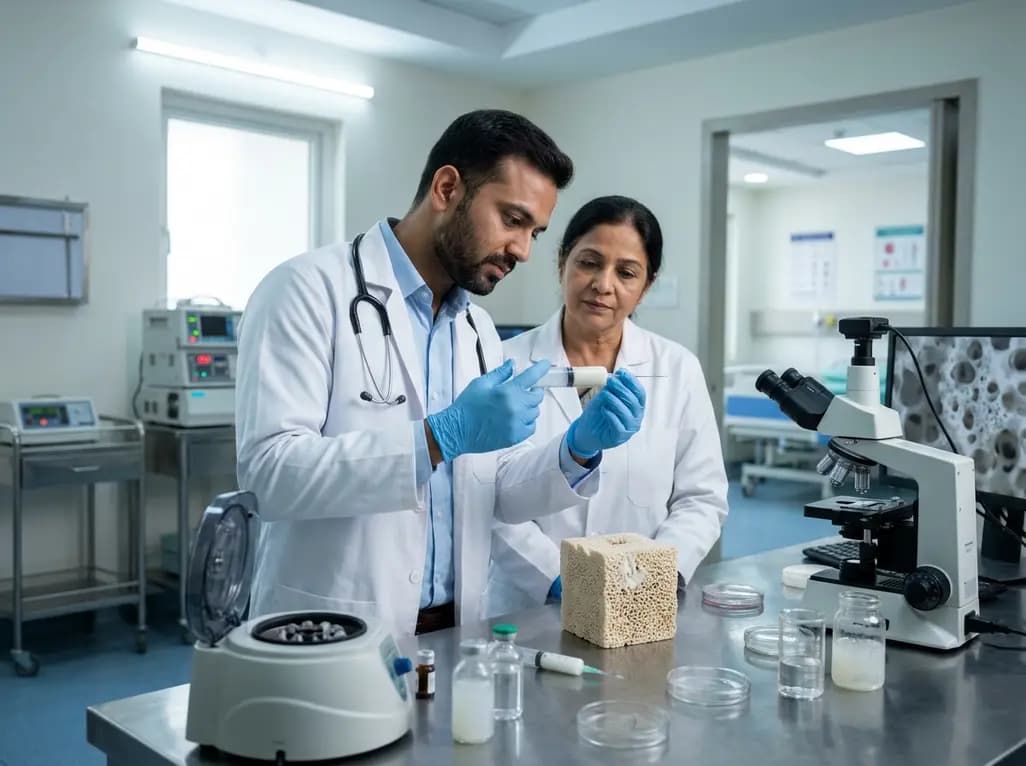
A novel calcium polyphosphate coacervate enables injectable bone implants with in situ hierarchical porosity via phase separation and gas foaming, significantly enhancing cell proliferation, energy metabolism, and osteogenic differentiation for minimally invasive bone defect repair.
Today

India is advancing preventive healthcare by integrating genomics, artificial intelligence, and quantum technologies. With the SANGAM programme sequencing one million Indian genomes, clinicians can unlock personalized therapies, detect cardiometabolic risks early, and curb the burden of diabetes and heart disease.
Today
