

Loading, please wait...
Loading, please wait...

Digital learning platforms have transformed modern healthcare training across the globe. Today, medical education apps serve as indispensable resources for medical undergraduates, resident doctors, and practicing clinicians seeking timely clinical references. A landmark longitudinal study evaluated 467 mobile applications and analyzed 232,598 user reviews across major app marketplaces in China and the United States. This extensive investigation provides critical insights into how clinical learners select, evaluate, and utilize digital educational resources throughout their training.
Over the past fifteen years, mobile learning tools experienced rapid global expansion across diverse healthcare systems. Specifically, cumulative observable app counts expanded dramatically in both the United States and China, exhibiting average annual growth rates above 41%. Joinpoint regression models revealed crucial inflection points around 2017 and between 2021 and 2022. These turning points mirrored broader structural changes in global healthcare technology, including smartphone maturation and the sudden surge in remote learning during the COVID-19 pandemic. Furthermore, user engagement deepened substantially as mobile devices evolved from simple supplementary digital textbooks into sophisticated interactive learning ecosystems. In both nations, review volumes rose sharply as clinical learners embraced smartphone technology during ward rotations and didactic studies. However, the overall rating-based satisfaction proxy rate displayed noteworthy geographic differences. American reviewers reported a 97.75% satisfaction proxy rate, whereas Chinese reviewers recorded a 91.82% rate. Consequently, while overall satisfaction remained high at 94.20%, national differences highlight how local training ecosystems influence learner expectations. Developers rapidly modernized interfaces, but maintaining software stability across varying operating environments remained a constant technical challenge.
Natural language processing and topic modeling revealed fascinating shifts in learner demands across different developmental eras. In China, early app users between 2009 and 2017 prioritized clinical practicality, which accounted for over 37% of narrative reviews. Chinese clinicians sought quick bedside drug references and diagnostic guides during initial clinical postings. However, after 2018, Chinese user attention pivoted decisively toward practice test functions, dominating more than 40% of all submitted reviews. This dramatic shift highlights the immense pressure surrounding competitive national licensing tests and postgraduate entrance examinations. In contrast, United States app store reviews told a completely different story. Between 2009 and 2017, American learners focused overwhelmingly on functional availability, which generated nearly 80% of all review comments. Users primarily cared whether applications operated smoothly across various mobile devices without crashing. By the 2018 to 2025 period, however, American user narratives shifted predominantly toward cost, representing over 40% of discussions. Rising subscription fees, locked study questions, and unexpected paywalls triggered intense user pushback. Therefore, educational app designers must recognize that user priorities change dramatically as digital markets mature.
To understand how specific features govern user sentiment, researchers applied Tobit regression and the Kano model classification system. This rigorous analytical framework revealed that app features do not influence user satisfaction in a uniform manner. Instead, factors demonstrate asymmetric effects that vary according to geographic location and developmental stage. In the Kano framework, essential attributes represent foundational expectations that users take for granted. When an app lacks these baseline features, negative ratings spike immediately. For instance, technical stability, seamless offline synchronization, and rapid content retrieval serve as mandatory prerequisites. If an app crashes during clinical ward rounds, frustrated users quickly post one-star reviews. Conversely, charm factors represent novel features that delight users and drive positive rating deviations without causing dissatisfaction when absent. Early in digital app adoption, interactive anatomical diagrams and multimedia case simulations functioned as delightful charm features. Over time, however, these innovative elements transitioned into baseline expectations. Today, learners demand reliable factual accuracy and uninterrupted service as non-negotiable fundamentals. Consequently, developers who neglect baseline stability risk catastrophic reputational damage.
The rapid adoption of mobile resources carries profound implications for clinical competency and medical curricula. Busy healthcare professionals frequently operate under intense cognitive loads and severe time constraints in modern hospital wards. Therefore, mobile tools provide accessible microlearning opportunities, allowing clinicians to review drug dosages and rare syndromes between patient encounters. Systematic meta-analyses confirm that integrating smartphone applications into medical curricula significantly enhances factual knowledge scores and practical procedural confidence. Moreover, digital test banks improve retention through spaced repetition algorithms and targeted remediation. Nevertheless, significant educational challenges persist within the digital health ecosystem. Because app marketplaces lack rigorous peer-review mandates, misinformation and outdated therapeutic guidelines occasionally infiltrate popular commercial platforms. Junior doctors who rely uncritically on unvalidated apps risk making preventable clinical errors. In addition, commercial test-prep software frequently encourages superficial pattern recognition rather than deep pathophysiological understanding. Medical schools and regulatory councils must therefore establish formal accreditation mechanisms for educational applications. Academic institutions should actively curate validated digital libraries, guiding trainees toward trustworthy evidence-based mobile resources throughout their clinical training.
The future of healthcare learning lies at the intersection of mobile software and generative artificial intelligence. Integrating large language models into revision apps enables conversational case simulations, real-time diagnostic reasoning assessments, and automated tutoring. Furthermore, artificial intelligence can tailor question difficulty dynamically to match individual learner performance, maximizing study efficiency. However, integrating machine learning into medical training requires extreme vigilance regarding factual veracity and algorithmic bias. Developers must build robust guardrails to prevent algorithmic hallucinations when trainees seek acute management protocols. Additionally, future platforms must prioritize cross-platform technical stability, equitable subscription structures, and transparent clinical references. App creators should collaborate directly with academic medical centers and professional societies to ensure continuous content verification. As digital health technologies converge, mobile applications will evolve beyond passive question banks into intelligent clinical companions. Longitudinal metadata analyses highlight a clear lesson for app developers and educators alike: technological novelty never compensates for poor factual accuracy or prohibitive financial barriers. By prioritizing reliable evidence, affordable access, and user-centered design, digital platforms can sustainably elevate global healthcare education standards.
Mobile platforms provide high-yield question banks, interactive clinical vignettes, and simulated mock examinations directly on personal smartphones. Consequently, students and resident trainees rely heavily on these digital resources to reinforce core factual knowledge and test diagnostic acumen. Furthermore, structured practice tests allow learners to identify knowledge gaps rapidly before high-stakes licensing exams. As digital curricula expand globally, accessible question modules remain an indispensable cornerstone for modern medical revision and competitive licensing examinations.
Healthcare trainees often manage significant educational debt alongside steep professional living expenses. Therefore, rising subscription fees and aggressive in-app paywalls create substantial financial friction for medical trainees. When essential updates or full question banks demand recurring premium payments, user satisfaction plummets sharply. App developers must therefore balance revenue sustainability with affordable pricing models. Transparent pricing and institutional subscriptions help alleviate this financial burden, ensuring equitable access to high-quality digital learning materials for every aspiring healthcare professional.
Artificial intelligence will transform static revision apps into dynamic, adaptive tutoring platforms. Specifically, intelligent algorithms analyze learner performance trends to generate individualized revision schedules and targeted clinical scenarios. Furthermore, natural language models can answer nuanced diagnostic queries and explain complex physiological mechanisms instantaneously. However, developers must rigorously validate algorithmic accuracy against established clinical guidelines. Ensuring high evidence quality and mitigating algorithmic hallucinations will determine whether intelligent digital assistants succeed in high-stakes medical training environments.
Disclaimer: This content is for informational and educational purposes only... Refer to the latest local and national guidelines for clinical practice.
References
Ma J et al. Mobile Medical Education Apps as Digital Health Information Resources in China and the United States: Longitudinal App Store Metadata Analysis and Topic Modeling of User Review Narratives. JMIR Med Educ. 2026 Nov 03. doi: 10.2196/107560. PMID: 42976334.
Lee H, Min H. Mobile applications in medical education: A systematic review and meta-analysis. BMC Med Educ. 2026;24:145.
Franko OI, Tirrell TF. Smartphone app use among medical providers in ACGME training programs. J Med Syst. 2012;36(5):3135-3139.

Read summarized clinical updates, watch expert medical content, and earn CME certifications right from your smartphone.
Open your smartphone camera to scan and install.





A longitudinal study of 467 medical education apps and 232,598 reviews reveals shifting user priorities from clinical tools to exam tests and cost concerns across China and the US.
Today
A retrospective study of 6,113 adults shows that combining GLP-1 receptor agonists with digital health apps nearly doubles the odds of achieving significant weight loss. Frequent progress logging serves as a primary behavioral driver of long-term metabolic success.
Today

Sexual dysfunction affects a high proportion of reproductive-age females with multiple sclerosis. This comprehensive review highlights multi-tier etiologies, proactive clinical screening tools, preconception counseling considerations, and integrated therapeutic options across multidisciplinary care pathways.
Today
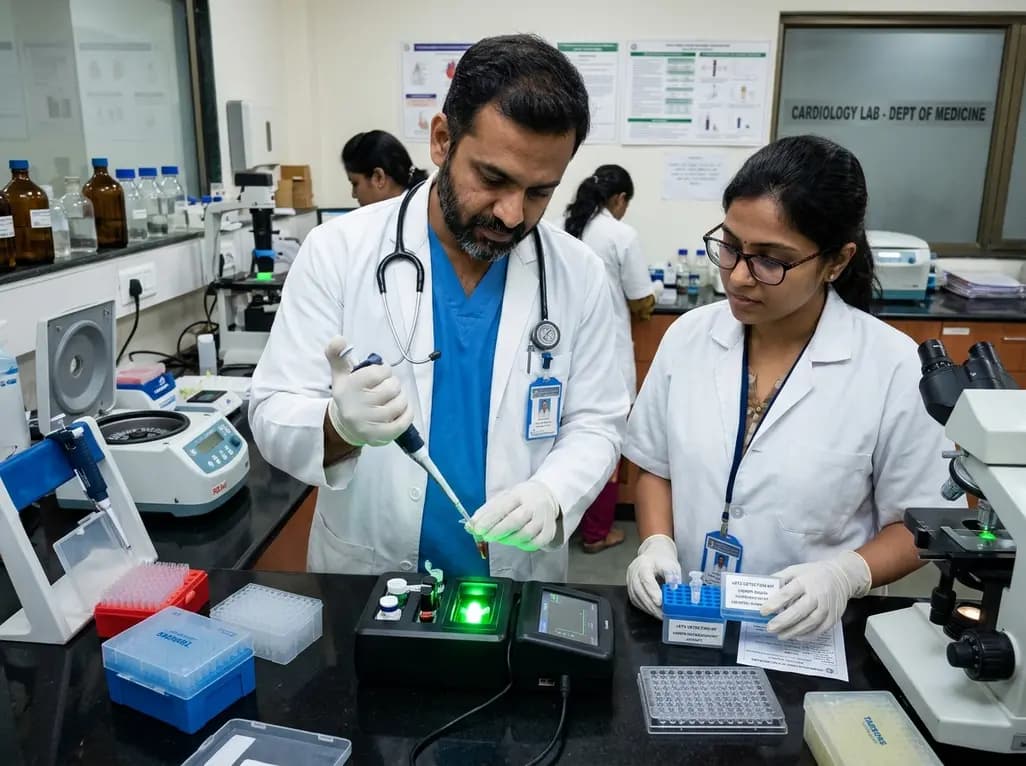
Researchers have engineered an innovative CRISPR-Cas12a fluorescent diagnostic kit for clinical sST2 detection. By combining nanotechnology with enzymatic trans-cleavage, this platform enables rapid, ultrasensitive heart failure diagnosis and risk stratification, outperforming conventional laboratory ELISA methods.
Today

Non-union fractures occur in 2-5% of cases, causing significant disability and cost. Conservative modalities such as LIPUS, PEMF, and focused ESWT offer non-surgical healing options for defects up to 5-10 mm when adequate mechanical stability exists without infection.
Today

India is poised to transform chronic disease management through wearable health technology. Discover how continuous remote monitoring and predictive algorithms empower clinicians to detect early cardiovascular signals, personalize metabolic interventions, and deliver equitable preventive care across populations.
Yesterday
