.webp&w=384&q=75)

Loading, please wait...
Loading, please wait...
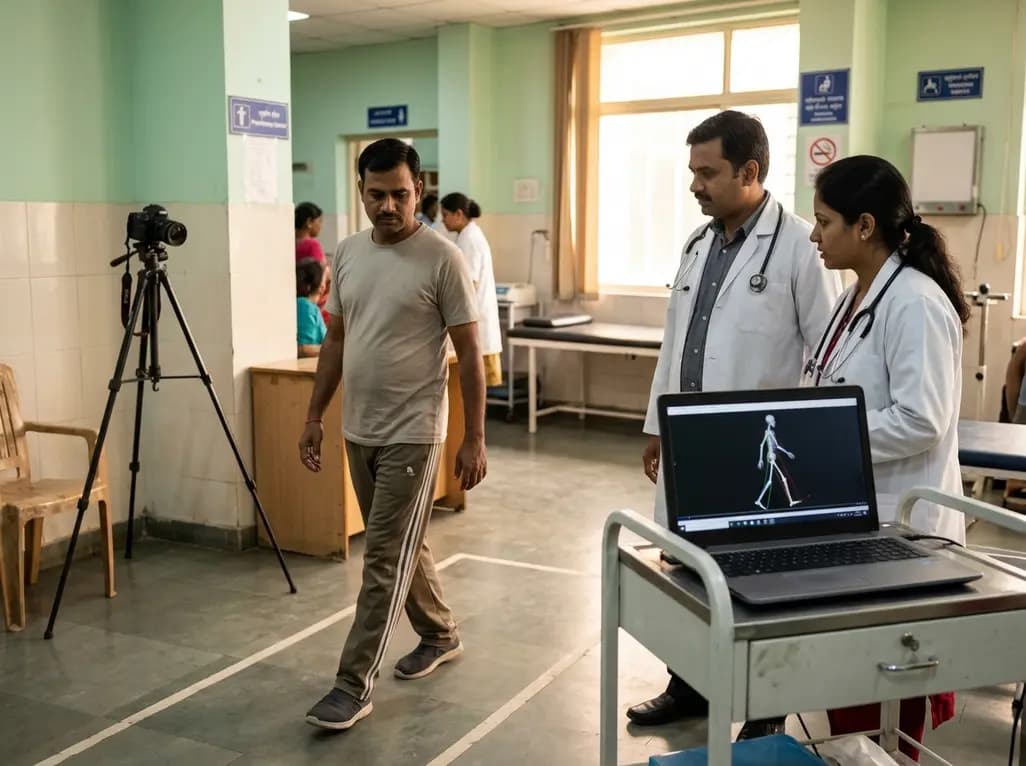
Gait analysis serves as a cornerstone in modern biomechanics, providing critical insights into human locomotion for rehabilitation and orthopedic diagnostics. Traditionally, high-fidelity gait assessments relied on sophisticated laboratories equipped with multi-camera marker-based motion capture systems and embedded force plates. However, the substantial cost and infrastructure requirements of these setups often limit their accessibility in everyday clinical practice. Recent advancements in markerless gait analysis technology are beginning to dismantle these barriers by offering portable and cost-effective alternatives. By utilizing a single RGB-D camera combined with physics-based optimization, researchers are now able to estimate three-dimensional poses and kinetic data without traditional markers. This shift toward markerless systems represents a significant evolution in how clinicians monitor movement disorders and recovery progress in real-world settings. Furthermore, this technology simplifies the patient experience by removing the need for physical attachments, thereby allowing for more natural walking patterns during assessment.
The core of markerless gait analysis technology lies in its ability to extract kinematic data from standard video or depth-sensing streams. Unlike traditional systems that require reflective markers placed on specific anatomical landmarks, markerless approaches utilize computer vision algorithms to identify body segments. The RGB-D camera plays a pivotal role here, as it captures both standard color video and depth information, allowing for a three-dimensional reconstruction of the subject's movement. This dual-stream data enables the system to track joint centers and segment orientations with increasing precision. Consequently, the reliance on a single camera significantly reduces the space needed for a gait lab, making it feasible for smaller clinics or sports facilities. Moreover, the integration of artificial intelligence and deep learning has drastically improved the robustness of these pose estimation models. These systems can now handle various lighting conditions and clothing types, which were previously major hurdles for optical tracking. Therefore, the transition to markerless solutions is not merely a cost-saving measure but a step toward more versatile clinical tools.
While tracking joint positions is a visual task, estimating the forces acting on those joints requires a deeper level of mathematical modeling. Physics-based optimization is the critical bridge that allows markerless systems to calculate kinetics without physical force plates. This process involves using the observed kinematic data—such as joint angles and limb velocities—and applying the laws of classical mechanics to solve for unknown variables. Specifically, inverse dynamics are used to derive joint moments and ground reaction forces (GRFs) by ensuring that the calculated movements align with the physical constraints of the human body. By minimizing the discrepancy between the observed motion and a biomechanical model, the optimization algorithm produces a consistent estimate of the forces at play. Additionally, this method accounts for the interaction between the feet and the ground during the stance phase of walking. Although this computational approach is complex, it provides a viable way to gain kinetic insights that were previously impossible without expensive floor sensors. This integration of physics ensures that the data remains bio-fidelic and clinically relevant.
Recent validation studies have demonstrated that markerless gait analysis technology achieves impressive accuracy in the sagittal plane. Researchers found that sagittal joint angles for the hip, knee, and ankle show high correlations when compared to gold-standard marker-based systems. For instance, Pearson correlation coefficients for these joints often exceed 0.90, indicating a strong agreement between the two methodologies. This level of accuracy is particularly beneficial for assessing common gait deviations, such as knee hyperextension or reduced hip flexion, which are primarily observed from a side profile. Furthermore, the root mean square errors for these joint angles remain within clinically acceptable ranges, often staying below 12 degrees for the hip and even lower for the knee and ankle. These results suggest that for the majority of clinical gait evaluations focusing on forward progression, a single-camera markerless system is remarkably effective. Similarly, the sagittal joint moments—representing the internal torque generated by muscles—also show high reliability. This high performance in the sagittal plane reinforces the system's utility in monitoring standard rehabilitation protocols for orthopedic patients.
Despite the successes in kinematic tracking, estimating three-dimensional ground reaction forces (GRFs) remains a complex challenge for markerless systems. Recent findings indicate that while vertical and anterior-posterior GRF components show high concordance with force plate data, the mediolateral component is less reliable. The mediolateral GRF, which represents the side-to-side forces during a stride, often shows lower correlation coefficients and higher normalized errors. This discrepancy likely stems from the perspective limitations of a single-camera setup and the subtle nature of lateral balance shifts. Additionally, physics-based optimization models sometimes struggle to accurately partition forces when the foot's interaction with the ground is not directly measured. Nevertheless, the vertical GRF, which is essential for understanding weight-bearing and impact loading, remains highly accurate in these markerless pipelines. This suggests that while the technology may not yet be ready for complex multi-directional balance studies, it is already highly capable for standard overground walking assessments. Future refinements in depth-sensing resolution and optimization algorithms are expected to address these lateral force inaccuracies over time.
The clinical feasibility of markerless gait analysis technology is particularly high in resource-limited environments or busy orthopedic practices. By eliminating the time-consuming process of marker placement and system calibration, clinicians can perform assessments much faster, increasing patient throughput. Furthermore, the portability of a single RGB-D camera allows for gait analysis to be conducted in diverse settings, including bedside evaluations or community health camps. In the context of the Indian healthcare system, where high-end gait laboratories are concentrated in major metropolitan centers, this technology offers a democratic solution for objective movement assessment. It provides practitioners with quantifiable data to support their clinical observations, leading to more personalized treatment plans. Moreover, the ability to track kinetic progress without force plates means that small-scale physiotherapy centers can now provide data-driven insights to their patients. While the mediolateral limitations exist, the overall benefits of cost, ease of use, and sagittal plane accuracy make this technology a transformative addition to the orthopedic toolkit. Consequently, its adoption is likely to grow as the software continues to mature.
Markerless gait analysis technology demonstrates high accuracy, especially in the sagittal plane, where joint angles and moments show correlation coefficients often exceeding 0.90. While it may have higher errors in mediolateral force estimation compared to gold-standard force plates, its precision for vertical forces and spatiotemporal parameters is sufficient for most clinical applications. It effectively bridges the gap between subjective visual observation and high-cost laboratory setups.
Yes, these systems utilize physics-based optimization and inverse dynamics to calculate joint moments and ground reaction forces. By analyzing the kinematics of the body segments captured by the RGB-D camera, the software applies biomechanical models to estimate the underlying forces. While not as precise as physical sensors for every force component, the method provides a reliable estimation of vertical and anterior-posterior forces during walking.
The main limitation of a single-camera setup is the potential for joint occlusion, where one limb hides the other from the camera's view. This can lead to less accurate tracking of the distant limb. Additionally, the system currently struggles with mediolateral ground reaction force estimation, making it less suitable for analyzing complex lateral movements or subtle balance disorders that occur primarily in the frontal plane.
Disclaimer: This content is for informational and educational purposes only. It does not constitute professional medical advice, diagnosis, or treatment. Always seek the advice of your physician or other qualified healthcare provider with any questions you may have regarding a medical condition. Refer to the latest local and national guidelines for clinical practice.
References
Kubota K et al. Force-plate-free estimation of ground reaction forces and lower-limb joint moments during gait using a single RGB-D camera and physics-based optimization. Gait Posture. 2026 Jul 17. doi: undefined. PMID: 42468060.
Corazza S, et al. A markerless motion capture system to study musculoskeletal biomechanics: Visual hull and simulated annealing optimization. Ann Biomed Eng. 2006;34(6):1019-1030.
Mündermann L, et al. Gait analysis using a low-cost RGB-D sensor. Proceedings of the 2012 IEEE International Conference on Robotics and Automation.

Read summarized clinical updates, watch expert medical content, and earn CME certifications right from your smartphone.
Open your smartphone camera to scan and install.





New research validates a single-camera markerless gait analysis system using physics-based optimization. While sagittal plane accuracy for joint angles and moments is high, challenges remain in mediolateral force estimation, offering a cost-effective alternative for clinical biomechanical assessments.
3 months ago

Review how tailored exercise programs benefit frail older patients with heart failure. Explore pathophysiological mechanisms, individualized training prescriptions, and strategies to overcome adherence barriers in clinical practice.
Today

Leucine Rich Bio has introduced South Asia's first comprehensive vaginal microbiome test, BugSpeaks. By profiling microbial dysbiosis, pathogens, and antimicrobial resistance, this next-generation diagnostic platform provides clinicians with deeper insights into recurrent infections, fertility, and reproductive health.
Today

In high-risk pulmonary embolism complicated by severe anemia and active uterine bleeding, systemic thrombolysis is contraindicated. Large-bore aspiration thrombectomy provides rapid hemodynamic rescue without fibrinolysis, supported by inferior vena cava filter placement and multidisciplinary critical care.
Today

This comparative study evaluates posterior labral tears with and without glenohumeral instability, highlighting distinct demographic patterns, MRI underestimation in stable shoulders, and successful arthroscopic repair outcomes.
Today

A clinical study demonstrates that early intervention with tocilizumab, either as monotherapy or bridged with corticosteroids, achieves significant proptosis reduction and resolves active inflammation in treatment-naive thyroid eye disease.
Today
