.webp&w=384&q=75)

Loading, please wait...
Loading, please wait...
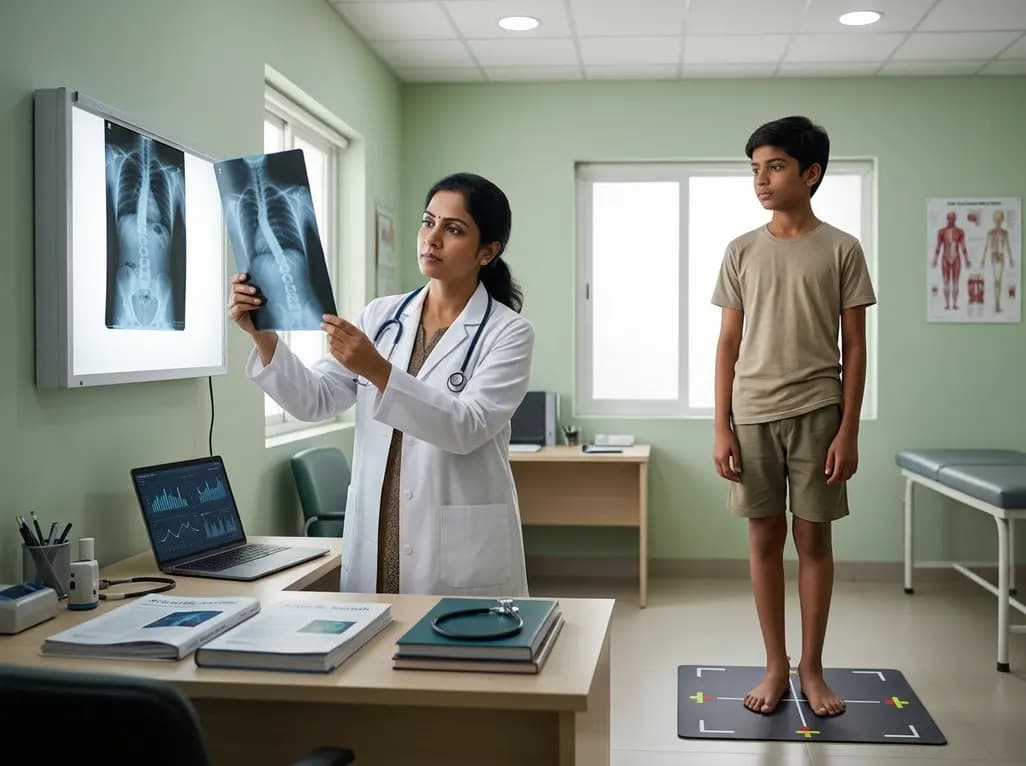
Managing adolescent idiopathic scoliosis (AIS) requires a deep understanding of various risk factors that might lead to curve progression. Clinicians often question whether a lower-limb length discrepancy AIS (LLLD) contributes to the worsening of the spinal curvature. To address this uncertainty, researchers recently conducted a systematic review of observational studies. They aimed to determine if LLD acts as a significant risk factor for Cobb angle progression in these young patients.
The research team utilized a rigorous PECO framework to identify relevant studies. This framework analyzed the population (AIS), exposure (LLLD), comparator (AIS without LLLD), and outcome (Cobb angle progression). Initially, the search identified 730 records across major databases like Medline, Embase, and Google Scholar. However, after a thorough screening of 655 unique titles and abstracts, the reviewers excluded the vast majority of papers. Only 11 full-text articles underwent eligibility assessment, and many failed to meet the strict inclusion criteria. Furthermore, the final review included only three studies that partially met the requirements.
Consequently, the small number of eligible studies prevented the researchers from performing a meta-analysis. They also could not conduct a formal assessment of publication bias due to the lack of appropriate control groups in the available data. Therefore, the researchers concluded that current evidence remains insufficient. It is currently impossible to definitively state whether LLD is a primary risk factor for curve progression in AIS. Practitioners should continue to monitor other established factors, such as skeletal maturity and initial curve magnitude, while more robust research is developed.
While limb length differences can certainly affect gait and posture, their specific impact on structural scoliosis progression remains unproven. In addition, the heterogeneous nature of existing studies makes it difficult for physicians to draw firm conclusions. Clinicians should remain vigilant and prioritize standardized radiographic assessments to track changes in the Cobb angle over time.
While a significant leg length discrepancy can cause a functional or compensatory spinal curve, it is distinct from structural adolescent idiopathic scoliosis. Functional curves often resolve when the limb length difference is corrected, whereas structural AIS involves vertebral rotation.
Doctors typically measure LLD using clinical methods like the tape measure method or radiographic techniques such as a full-length standing orthoradiogram. Radiographic imaging provides the most accurate measurement for clinical decision-making.
Shoe lifts may improve pelvic obliquity and balance in patients with functional curves. However, there is no strong evidence suggesting that shoe lifts prevent or slow the progression of structural curves in AIS.
Disclaimer: This content is for informational and educational purposes only. It does not constitute professional medical advice, diagnosis, or treatment. Always seek the advice of your physician or other qualified healthcare provider with any questions you may have regarding a medical condition. Refer to the latest local and national guidelines for clinical practice.
References
1. Romano-Farani B et al. Is lower-limb length discrepancy a risk factor for curve progression in adolescent idiopathic scoliosis? A systematic review. Rehabilitacion (Madr). 2026 Jun 05. doi: undefined. PMID: 42247719.
2. Pinto EM, Alves J, Castro AM, et al. Leg length discrepancy in adolescent idiopathic scoliosis. Coluna/Columna. 2019;18(3):192-195.
3. Scoliosis Research Society. Adolescent Idiopathic Scoliosis: Risk Factors and Natural History. [Accessed May 2025].

Read summarized clinical updates, watch expert medical content, and earn CME certifications right from your smartphone.
Open your smartphone camera to scan and install.





A systematic review finds insufficient evidence to link lower-limb length discrepancy to curve progression in adolescent idiopathic scoliosis (AIS)....
4 months ago

As monsoon seasons elevate arboviral disease threats, Tamil Nadu has initiated an ICMR-monitored evaluation of the tetravalent dengue vaccine in Tenkasi district. Clinicians emphasize clinical monitoring, public prevention, and high-quality early pediatric care to reduce disease morbidity across endemic regions.
Today

Leucine Rich Bio has introduced South Asia's first comprehensive vaginal microbiome test, BugSpeaks. By profiling microbial dysbiosis, pathogens, and antimicrobial resistance, this next-generation diagnostic platform provides clinicians with deeper insights into recurrent infections, fertility, and reproductive health.
Today

Review how tailored exercise programs benefit frail older patients with heart failure. Explore pathophysiological mechanisms, individualized training prescriptions, and strategies to overcome adherence barriers in clinical practice.
Today

This comparative study evaluates posterior labral tears with and without glenohumeral instability, highlighting distinct demographic patterns, MRI underestimation in stable shoulders, and successful arthroscopic repair outcomes.
Today

A clinical study demonstrates that early intervention with tocilizumab, either as monotherapy or bridged with corticosteroids, achieves significant proptosis reduction and resolves active inflammation in treatment-naive thyroid eye disease.
Today
