.webp&w=384&q=75)

Loading, please wait...
Loading, please wait...

Researchers have recently developed a promising solution for chronic wound care using LMWCS nanofibers wound healing technology. Traditional high molecular weight chitosan often presents solubility challenges in medical applications. In contrast, low molecular weight chitosan (LMWCS) offers superior water solubility and biological reactivity. By integrating these biopolymers into electrospun poly(vinyl alcohol) (PVA) fibers, scientists have created a material that prevents infection while actively regenerating tissue.
Furthermore, the synthesis process avoids the use of toxic crosslinkers, which maintains the biocompatibility of the dressing. Elemental analysis and NMR spectroscopy confirmed that the LMWCS samples integrate seamlessly into the PVA matrix. Consequently, the resulting nanofibers allow for a controlled release of antimicrobial agents. Specifically, the CS7 variant demonstrated remarkable efficacy against pathogens such as S. aureus and P. aeruginosa. Additionally, these fibers significantly promote the migration of keratinocytes, which accelerates the closure of the wound site.
Moreover, the study establishes molecular weight-dependent principles for future wound dressing design. Together, these findings suggest that tuning the molecular weight can optimize both antimicrobial and pro-regenerative capabilities. Therefore, this technology provides a versatile platform for treating complex surgical and chronic wounds. For instance, the superior migration rates observed in scratch assays indicate faster re-epithelialization. Notably, this innovation could revolutionize the management of infected wounds in clinical settings.
The LMWCS integrated into the nanofibers penetrates bacterial cell walls more effectively than standard chitosan. This action inhibits the growth of common wound pathogens, including E. coli and C. albicans, without requiring additional antibiotics.
LMWCS is highly water-soluble and possesses more available functional groups. These properties allow it to promote faster keratinocyte migration and provide better antibacterial protection compared to traditional high molecular weight versions.
Disclaimer: This content is for informational and educational purposes only. It does not constitute medical advice or a substitute for professional healthcare consultation. Refer to the latest local and national guidelines for clinical practice.
References

Read summarized clinical updates, watch expert medical content, and earn CME certifications right from your smartphone.
Open your smartphone camera to scan and install.





A study highlights how low molecular weight chitosan (LMWCS) nanofibers provide superior antimicrobial properties and faster skin cell migration for healing...
4 months ago

Review how tailored exercise programs benefit frail older patients with heart failure. Explore pathophysiological mechanisms, individualized training prescriptions, and strategies to overcome adherence barriers in clinical practice.
Today

Leucine Rich Bio has introduced South Asia's first comprehensive vaginal microbiome test, BugSpeaks. By profiling microbial dysbiosis, pathogens, and antimicrobial resistance, this next-generation diagnostic platform provides clinicians with deeper insights into recurrent infections, fertility, and reproductive health.
Today
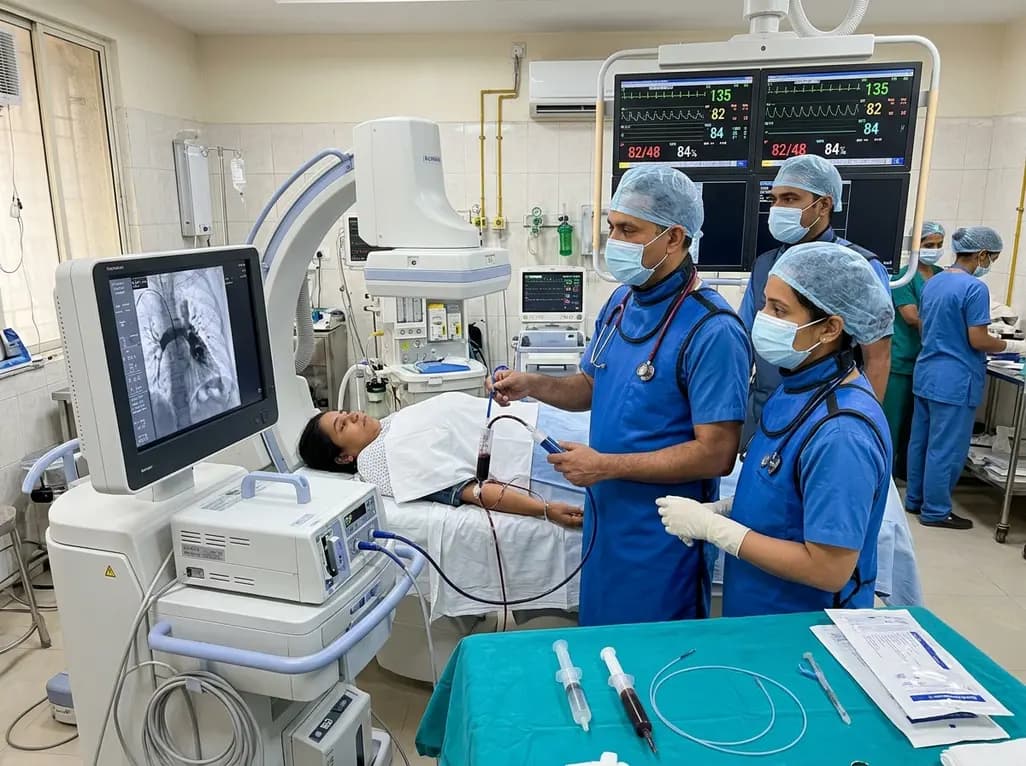
In high-risk pulmonary embolism complicated by severe anemia and active uterine bleeding, systemic thrombolysis is contraindicated. Large-bore aspiration thrombectomy provides rapid hemodynamic rescue without fibrinolysis, supported by inferior vena cava filter placement and multidisciplinary critical care.
Today

This comparative study evaluates posterior labral tears with and without glenohumeral instability, highlighting distinct demographic patterns, MRI underestimation in stable shoulders, and successful arthroscopic repair outcomes.
Today

A clinical study demonstrates that early intervention with tocilizumab, either as monotherapy or bridged with corticosteroids, achieves significant proptosis reduction and resolves active inflammation in treatment-naive thyroid eye disease.
Today
