.webp&w=384&q=75)

Loading, please wait...
Loading, please wait...

Natural language processing tools provide objective windows into psychiatric pathophysiology. Recently, investigators explored the linguistic phenotypes of schizophrenia across diverse discourse tasks to uncover robust digital biomarkers. For decades, psychiatrists recognized subtle alterations in verbal communication, formal thought disorder, and syntactic fragmentation during clinical evaluations. However, subjective rating scales often lack granular precision and reproducible measurement. In this groundbreaking study, researchers leveraged advanced computational linguistics to analyze spontaneous speech from 104 individuals with schizophrenia and 101 healthy controls. Furthermore, the team assessed three distinct elicitation contexts: unconstrained free conversation, structured storytelling, and standardized picture description. By evaluating discourse across multiple tasks, the investigators sought to distinguish task-independent core disruptions from context-dependent communication patterns. Consequently, this computational approach uncovered coherent patterns across lexical, syntactic, and semantic domains. Ultimately, natural language processing offers clinicians reproducible metrics that move beyond conventional qualitative mental status examinations.
In particular, computational psychiatry translates complex speech signals into quantifiable clinical phenotypes. As clinicians seek objective tools for monitoring illness trajectory, algorithmic language tracking provides an innovative, non-invasive diagnostic pathway.
To capture the full spectrum of linguistic production, the research team implemented a multilevel computational architecture. Specifically, the investigators utilized state-of-the-art Japanese natural language toolkits, including GiNZA, Word2Vec, TF-IDF, and SentenceBERT frameworks. The automated pipeline extracted 76 comprehensive features spanning morphosyntax, lexical diversity, semantic associations, and global discourse cohesion. Instead of relying on predefined clinical assumptions, the authors performed exploratory factor analysis to identify representative linguistic dimensions independent of clinical diagnosis. Subsequently, the researchers tested these factors using generalized estimating equations. Moreover, the investigators rigorously validated their statistical models through extensive bootstrap and permutation testing.
Additionally, the investigators examined cross-task stability across structured and unstructured settings. Free conversation captures everyday communicative competence, whereas picture description assesses constrained lexical retrieval. Therefore, comparing these elicitation modalities allows researchers to delineate universal psychotic language traits from task-specific compensatory strategies. Through this rigorous mathematical modeling, the authors established a replicable baseline for computational speech markers in psychiatric cohorts. Furthermore, automated linguistic extraction eliminates clinician-dependent subjective interpretation, creating standardized datasets suitable for longitudinal predictive modeling across diverse healthcare settings.
The quantitative results demonstrated outstanding discriminatory power, particularly within open-ended interpersonal communication. In free conversation, three core linguistic variables emerged as dominant discriminators: decreased case-particle frequency, reduced adverbial usage, and increased mean pairwise word similarity. When combined into a predictive model, these parameters distinguished individuals with schizophrenia from healthy controls with high diagnostic accuracy. Specifically, the classifier achieved an area under the receiver operating characteristic curve of 0.87, with a 95% confidence interval ranging from 0.74 to 0.97. This finding indicates exceptional discriminative potential for automated diagnostic support.
Furthermore, the authors identified that adverbial modulation, case-particle structure, and semantic network measures maintained stability across elicitation contexts. While constrained storytelling and picture description elicited subtle language changes, unstructured conversation magnified these communicative deficits. In spontaneous dialogue, cognitive load increases substantially because participants must plan, retrieve, and structure ideas simultaneously. Consequently, the demands of real-time discourse unmask latent neurocognitive deficits that structured tasks often obscure. Thus, naturalistic conversation remains the gold-standard elicitation environment for psychiatric computational linguistics. Overall, spontaneous conversational speech yields superior diagnostic value compared to artificial elicitation paradigms.
The authors proposed a cohesive tripartite linguistic phenotype to explain the multifaceted communication impairments in schizophrenia. First, patients exhibited diminished morphosyntactic explicitness. In Japanese, speakers employ case particles, known as kakujoshi, to specify grammatical relationships between nouns and predicates. Patients with schizophrenia omitted these markers frequently, leading to structurally underspecified and ambiguous sentences. Second, the investigators observed significant semantic narrowing, characterized by elevated mean pairwise word similarity. Rather than exploring diverse conceptual spaces, affected speakers repeatedly cycled through closely related lexical terms. Consequently, this semantic contraction generates impoverished discourse content, reflecting classic clinical alogia and executive dysfunction.
Third, the analysis revealed reduced modification-based contextual modulation. Patients produced significantly fewer adverbs and qualifying phrases during conversation. Adverbs serve vital pragmatic functions by shading meanings, framing temporal contexts, and establishing epistemic stance. Therefore, lacking adverbial elaboration leaves narrative speech flat, rigid, and disconnected from dynamic conversational contexts. Together, these three interlocking dimensions—reduced morphosyntactic explicitness, semantic narrowing, and diminished adverbial framing—define a core linguistic signature of schizophrenia. Importantly, this model unifies previously isolated clinical observations under a coherent computational framework.
Remarkably, these findings mirror language phenomena observed across other distinct linguistic typologies. For instance, prior natural language processing studies in English and Turkish cohorts documented comparable reductions in syntactic complexity and lexical diversity. English-speaking patients exhibit decreased clause embedding and heightened repetitive phrasing. Similarly, Turkish studies identified reduced coordinating conjunctions alongside elevated semantic redundancy. The Japanese cohort findings reinforce the hypothesis that formal thought disorder reflects universal disruptions in neurocognitive architecture rather than culture-specific linguistic habits. Specifically, frontotemporal dysconnectivity and aberrant dopamine transmission disrupt the neural machinery governing real-time syntactic hierarchy and semantic retrieval.
In India, integrating automated linguistic biomarkers into psychiatric care presents both immense opportunities and unique challenges. With overburdened outpatient clinics, clinicians require rapid, scalable screening instruments to assist routine mental status assessments. Moreover, remote telemedicine platforms across Indian states can incorporate automated speech analytics to monitor relapse risk. However, practical implementation requires addressing substantial multilingual diversity across Indo-Aryan and Dravidian language families. Therefore, researchers must validate models in Hindi, Tamil, Telugu, and Bengali. In conclusion, adapting computational psychiatry to Indian healthcare ecosystems could transform early intervention strategies and equitable mental health delivery.
Natural language processing quantifies subtle speech patterns by analyzing lexical choice, syntactic complexity, and semantic coherence. Algorithms extract features like part-of-speech frequencies and sentence vector similarities. By comparing these linguistic metrics against normative standards, machine learning models identify cognitive disorganization and formal thought disorder with high statistical precision.
Free conversation requires real-time narrative formulation, social cognition, and dynamic syntactic planning without external prompts. Consequently, this unconstrained communicative context places higher demands on frontotemporal executive networks. When cognitive resources fail, subtle impairments in argument marking, semantic diversity, and contextual modulation become markedly apparent compared to guided descriptive tasks.
Computational linguistic tools serve as objective decision-support aids rather than autonomous replacements for clinical evaluation. While natural language processing offers reproducible biomarkers of thought disorder, psychiatrists must still evaluate clinical history, affect, functional capacity, and longitudinal risk factors to formulate accurate diagnostic formulations and personalized management plans.
Disclaimer: This content is for informational and educational purposes only... Refer to the latest local and national guidelines for clinical practice.
References

Read summarized clinical updates, watch expert medical content, and earn CME certifications right from your smartphone.
Open your smartphone camera to scan and install.





Researchers utilizing natural language processing have identified distinct linguistic phenotypes of schizophrenia. In spontaneous speech, diminished morphosyntactic explicitness, semantic narrowing, and reduced adverbial framing achieved high diagnostic accuracy across multiple elicitation tasks.
Today

A North Texas pilot study reveals that combining virtual physician consultations with in-person house calls safely manages adult pneumonia. By utilizing CRB-65 severity scores, clinicians effectively triaged patients, providing home-based recovery while directing higher-risk individuals to emergency care.
Today

A quasi-experimental study demonstrates that culturally tailored educational interventions significantly boost HPV knowledge and vaccination intentions. These findings provide actionable strategies for healthcare providers in India to overcome vaccine hesitancy and advance cervical cancer prevention.
Today
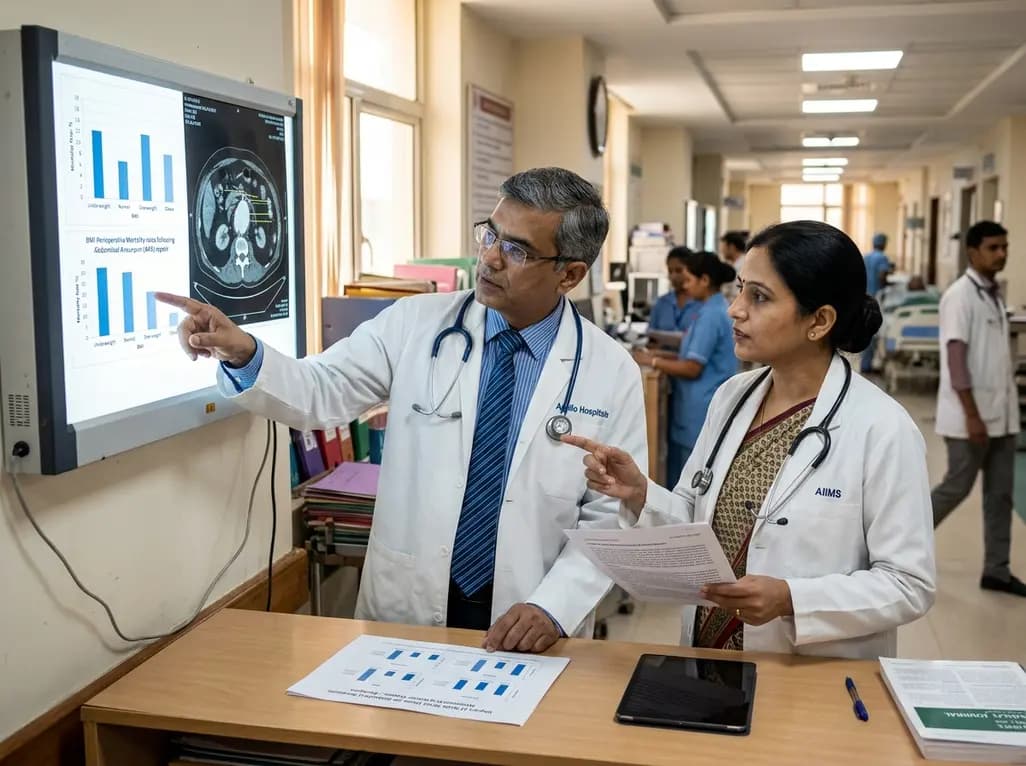
A comprehensive meta-analysis evaluates the association between Body Mass Index and outcomes following abdominal aortic aneurysm repair. Discover how overweight and obesity correlate with lower mortality while underweight status confers heightened risk, challenging conventional preoperative risk stratification.
Today

The SOLARIO trial shows that a short course (≤7 days) of systemic antibiotic therapy is noninferior to long courses (≥4 weeks) in orthopedic infections treated with local antibiotic carriers, with significantly fewer adverse events.
Today
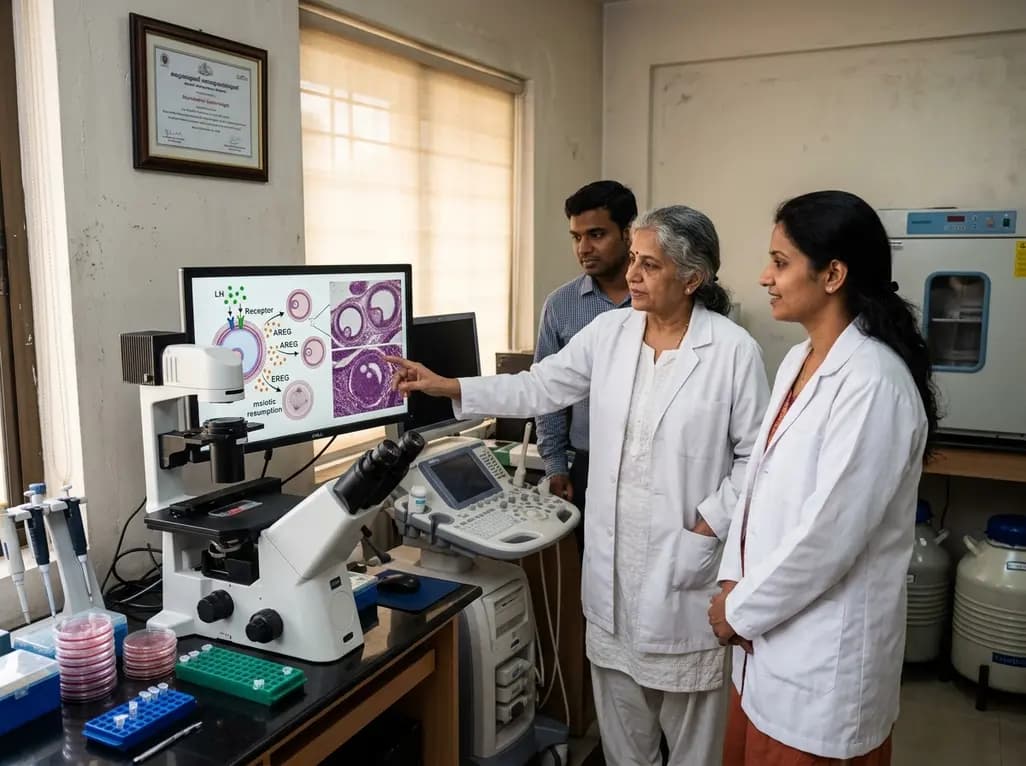
New research reveals that preovulatory follicles communicate via LH-induced paracrine signaling. Diffusible EGF ligands epiregulin and amphiregulin coordinate oocyte meiotic resumption across neighboring follicles, challenging traditional concepts of follicular autonomy.
Today
