.webp&w=384&q=75)

Loading, please wait...
Loading, please wait...
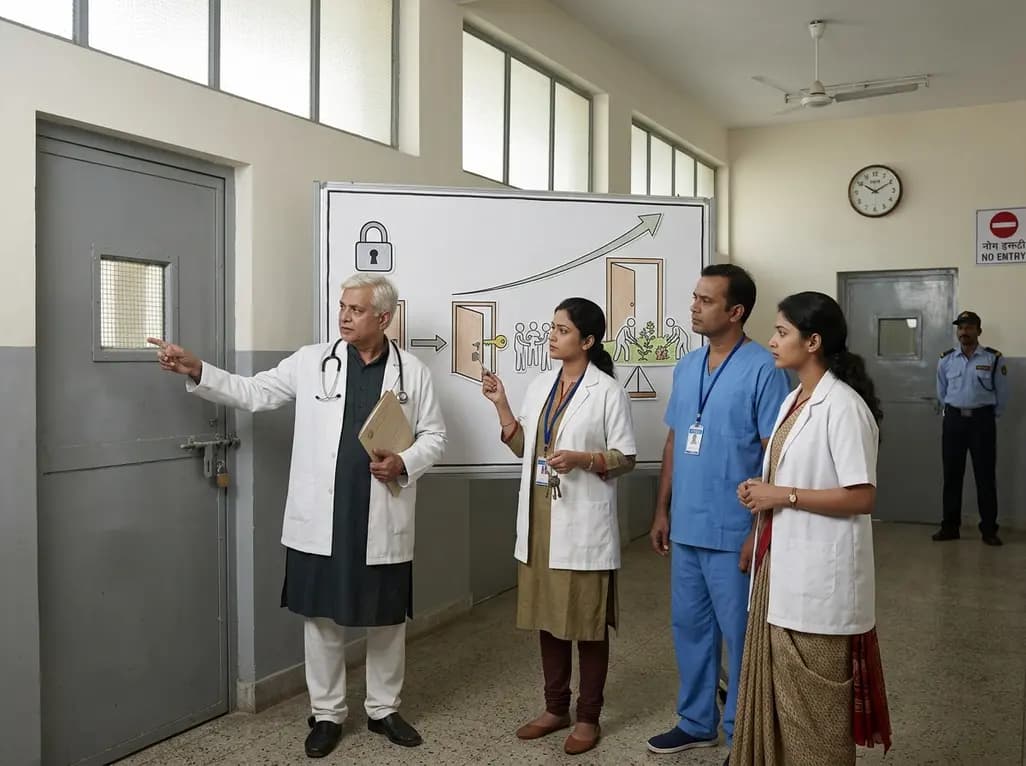
Clinicians often debate the use of restrictive interventions in mental healthcare. These practices frequently conflict with autonomy principles and fundamental human rights. To address this, the least restrictive alternative principle provides a legal framework protecting the constitutional rights of mentally ill individuals. This principle specifically guides staff to select treatments that maximize patient freedom. However, previous research shows that mental health workers often hold clashing views on which methods are truly less restrictive.
Consequently, a new study explored how Danish forensic hospital staff make these difficult clinical decisions. Researchers conducted focus groups and interviews with medical and nursing personnel to identify key themes. They found that clinical choices depend on more than just legal rules. Specifically, staff composition and situational dynamics play a major role in how teams apply the least restrictive alternative principle. Moreover, the results highlight a need for flexible frameworks in everyday practice. Furthermore, clear structural support can help staff navigate collective decision-making mechanisms. Therefore, understanding these factors is essential for improving forensic mental healthcare.
This principle requires clinicians to offer the treatment option that meets a patient's needs while imposing the fewest possible limitations on their rights and liberty.
Differences in professional background, individual risk assessment, and clinical experience often lead to varying interpretations of what constitutes a restrictive intervention.
Disclaimer: This content is for informational and educational purposes only... Refer to the latest local and national guidelines for clinical practice.
References
Lindekilde CR et al. An Exploration of Danish Forensic Hospital Staffs' Clinical Decision-Making about the Least Restrictive Alternative Principle. Issues Ment Health Nurs. 2026 Jun 01. doi: 10.1080/01612840.2026.2664965. PMID: 42224010.
The Mental Healthcare Act, 2017. Ministry of Law and Justice, Government of India.
World Health Organization. WHO QualityRights Tool Kit: Assessing and improving quality and human rights in mental health and social care facilities. Geneva: WHO; 2012.

Read summarized clinical updates, watch expert medical content, and earn CME certifications right from your smartphone.
Open your smartphone camera to scan and install.





Study examines how forensic hospital staff navigate the least restrictive alternative principle, emphasizing the impact of team dynamics and clinical contex...
4 months ago

Review how tailored exercise programs benefit frail older patients with heart failure. Explore pathophysiological mechanisms, individualized training prescriptions, and strategies to overcome adherence barriers in clinical practice.
Today

Leucine Rich Bio has introduced South Asia's first comprehensive vaginal microbiome test, BugSpeaks. By profiling microbial dysbiosis, pathogens, and antimicrobial resistance, this next-generation diagnostic platform provides clinicians with deeper insights into recurrent infections, fertility, and reproductive health.
Today

In high-risk pulmonary embolism complicated by severe anemia and active uterine bleeding, systemic thrombolysis is contraindicated. Large-bore aspiration thrombectomy provides rapid hemodynamic rescue without fibrinolysis, supported by inferior vena cava filter placement and multidisciplinary critical care.
Today

This comparative study evaluates posterior labral tears with and without glenohumeral instability, highlighting distinct demographic patterns, MRI underestimation in stable shoulders, and successful arthroscopic repair outcomes.
Today

A clinical study demonstrates that early intervention with tocilizumab, either as monotherapy or bridged with corticosteroids, achieves significant proptosis reduction and resolves active inflammation in treatment-naive thyroid eye disease.
Today
