

Loading, please wait...
Loading, please wait...

Chronic kidney disease requiring long-term hemodialysis imposes a profound physical toll on patients. Individuals regularly experience severe muscle wasting, poor exercise tolerance, and overwhelming fatigue that limit daily activities. In clinical practice, conventional exercise programs often trigger intradialytic hypotension or cardiovascular instability, leading to poor patient compliance. Consequently, nephrologists need comfortable, passive therapies that support physical resilience without compromising safety. Emerging evidence highlights intermittent pneumatic compression as an attractive supportive strategy during routine dialysis treatments. While previous clinical trials confirmed that sequential compression stabilizes blood pressure fluctuations during ultrafiltration, its effects on functional mobility remained uncertain. A pilot randomized controlled trial has demonstrated that this non-invasive approach significantly improves walking capacity and selected quality of life domains over twelve weeks.
Patients undergoing maintenance hemodialysis endure progressive musculoskeletal deterioration driven by chronic uremic toxins, systemic inflammation, metabolic acidosis, and prolonged physical inactivity. In addition, recurrent episodes of intradialytic hypotension cause transient organ ischemia, which worsens post-dialysis fatigue and accelerates lower-limb muscle loss. This debilitating decline compromises ambulatory independence and substantially increases the risk of accidental falls and hospital admissions.
Furthermore, physical impairment directly undermines patient wellbeing and emotional health. Routine daily tasks, such as climbing stairs or purchasing groceries, rapidly become exhausting chores. Unfortunately, active intradialytic cycling and resistance training frequently face low adherence due to patient exhaustion or fear of vascular access complications. Therefore, nephrologists urgently require passive, well-tolerated modalities that patients can receive while reclining in dialysis chairs. External mechanical compression offers a promising solution by supporting systemic circulation without requiring voluntary physical exertion.
To investigate functional outcomes, researchers conducted a pilot randomized controlled trial enrolling maintenance hemodialysis patients. The trial randomized thirty participants into either an intervention cohort or a standard care control group. Specifically, the control cohort received usual dialysis care alone, whereas the experimental group received usual care alongside intermittent pneumatic compression during every hemodialysis session for twelve weeks.
The intervention protocol applied sequential pneumatic cuffs to both lower extremities throughout each treatment session. Crucially, the researchers conducted objective functional assessments at baseline and following twelve weeks of therapy. The primary physical performance outcome was the 6-minute walk test, which reliably assesses functional exercise tolerance. Secondary endpoints included lower-limb functional endurance measured by the 30-second sit-to-stand test and isometric handgrip strength. Investigators analyzed the data using generalized estimating equation models, thoroughly adjusting for age, sex, and intradialytic hypotension frequency.
Among the thirty enrolled participants, twenty-six successfully completed the post-intervention assessments at twelve weeks. The trial revealed a striking improvement in ambulatory performance favoring the compression cohort. Specifically, the between-group difference in the 6-minute walk test favored the intervention group by 49.5 meters, with a 95% confidence interval ranging from 5.40 to 93.6 meters.
In chronic disease management, an improvement exceeding thirty meters represents a clinically meaningful gain, reflecting noticeable restoration of functional mobility. However, the study observed no statistically significant between-group differences in 30-second sit-to-stand repetitions or handgrip strength. Because intermittent pneumatic compression acts primarily as a passive circulatory aid rather than a muscle hypertrophy stimulus, it enhances aerobic capacity and muscular perfusion rather than maximum contractile force. Therefore, the pronounced increase in walking distance suggests that patients achieved greater endurance and reduced ambulatory fatigue during everyday activities.
Beyond objective physical performance, the investigators evaluated health-related quality of life across multiple validated dimensions. End-stage kidney disease profoundly impairs psychological wellbeing and personal relationships, yet clinicians frequently overlook these crucial patient-centered factors. Notably, the trial demonstrated marked, domain-specific quality of life enhancements among individuals receiving pneumatic compression.
Participants in the intervention arm achieved statistically significant improvements in sexual function, showing a mean difference of 17.2 points compared to controls. In addition, the intervention cohort demonstrated meaningful gains in perceived social support, with an adjusted increase of 14.6 points. Conversely, other generic quality of life domains showed no statistically significant differences. Researchers hypothesize that improved lower-extremity circulation and reduced post-dialysis exhaustion restore physical vitality. Consequently, patients feel less depleted after their dialysis sessions, enabling them to engage more actively with family members and sustain fulfilling social connections.
The physiological benefits of sequential pneumatic leg compression stem from targeted hemodynamic optimization during fluid removal. Standard hemodialysis ultrafiltration often causes venous blood pooling in the lower extremities, triggering symptomatic hypotension. In contrast, sequential pneumatic compression rhythmically propels pooled venous blood toward the central circulation, effectively augmenting venous return, cardiac stroke volume, and blood pressure stability.
Furthermore, this cyclical mechanical pumping enhances arterial inflow and microvascular shear stress. Increased vascular shear stress stimulates endothelial nitric oxide production, which diminishes peripheral vascular resistance and enhances skeletal muscle perfusion. By preventing acute blood pressure drops and tissue hypoperfusion, compression therapy mitigates the debilitating post-dialytic fatigue syndrome. Consequently, patients preserve their daily energy reserves, which facilitates sustained ambulatory activity between treatment days. Because hemodialysis staff can easily apply these lightweight compression sleeves without disrupting dialysis workflows, the therapy represents an exceptionally practical adjunctive intervention.
Intermittent pneumatic compression uses inflatable garments to apply rhythmic, sequential pressure to the calves and thighs. This action mechanically propels pooled venous blood back toward the central circulation, enhancing cardiac preload and stabilizing intradialytic blood pressure. In addition, the cyclical compression elevates vascular shear stress, which promotes endothelial nitric oxide release. Consequently, peripheral tissue perfusion and microvascular oxygen delivery improve, reducing post-dialysis fatigue and facilitating superior physical walking endurance.
Although participants achieved an impressive 49.5-meter gain in the 6-minute walk test, the trial observed no statistically significant changes in sit-to-stand endurance or handgrip strength. Because pneumatic compression functions primarily as a passive vascular therapy rather than an active resistance training modality, it does not induce skeletal muscle hypertrophy. Instead, the intervention primarily enhances circulatory efficiency and aerobic walking stamina without directly altering peak isometric force or rapid lower-limb muscular power.
Yes, intermittent pneumatic compression integrates smoothly into routine outpatient dialysis care because patients receive the therapy while comfortably seated in dialysis chairs. Clinical studies report high adherence rates above ninety percent with minimal treatment-related adverse events. Furthermore, the passive technique requires minimal active exertion from debilitated patients, avoiding the cardiovascular strain occasionally triggered by intradialytic cycling. Therefore, it serves as a practical, well-tolerated adjunctive modality for dialysis centers.
Disclaimer: This content is for informational and educational purposes only. It does not constitute formal medical advice, diagnosis, or treatment. Healthcare providers must exercise independent clinical judgment when interpreting trial findings and selecting interventions. Refer to the latest local and national guidelines for clinical practice.
References

Read summarized clinical updates, watch expert medical content, and earn CME certifications right from your smartphone.
Open your smartphone camera to scan and install.





A pilot randomized trial demonstrates that applying intermittent pneumatic compression during hemodialysis sessions significantly enhances 6-minute walking capacity and improves specific quality of life domains, offering a non-invasive supportive therapy for end-stage kidney disease patients.
Today
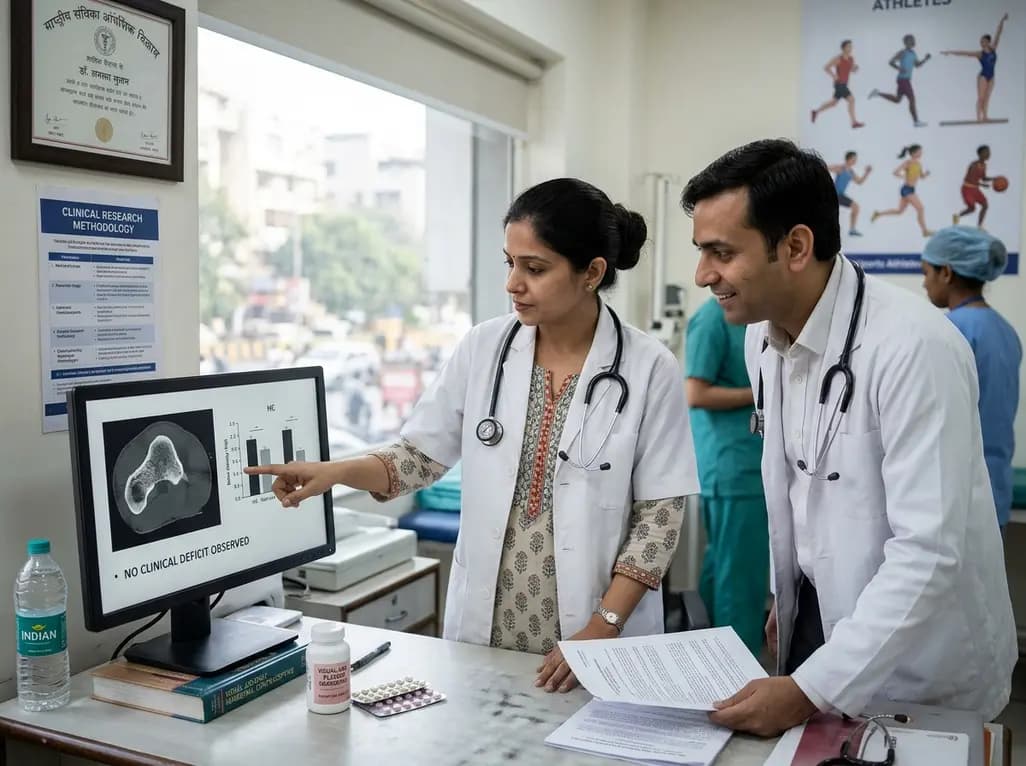
A recent Canadian study evaluates the relationship between hormonal contraceptive use, sport discipline, and volumetric bone density in elite female athletes. Using HR-pQCT, researchers found no clinically meaningful deficits, offering reassuring evidence for sports medicine and gynecology clinicians.
Today

A cross-sectional study of 948 police officers reveals an active-but-sedentary pattern. While 84.4% met WHO activity guidelines, 31.9% sat for ≥6 hours daily. Operational roles had lower sedentary odds, whereas desk assignments heightened sitting risks, emphasizing role-specific occupational health interventions.
Today

A comparative study demonstrates that simple and complex labral tears achieve comparable functional outcomes and low recurrence rates following arthroscopic stabilization for anterior shoulder instability, despite differing clinical presentations and dislocation histories.
Today

A real-world panel study reveals that an automated diet management app significantly improves BMI, blood pressure, and lipid profiles in employees. Frequent meal self-monitoring yielded distinct sex- and age-specific cardiometabolic benefits, highlighting the clinical potential of digital lifestyle interventions.
Today
