.webp&w=384&q=75)

Loading, please wait...
Loading, please wait...
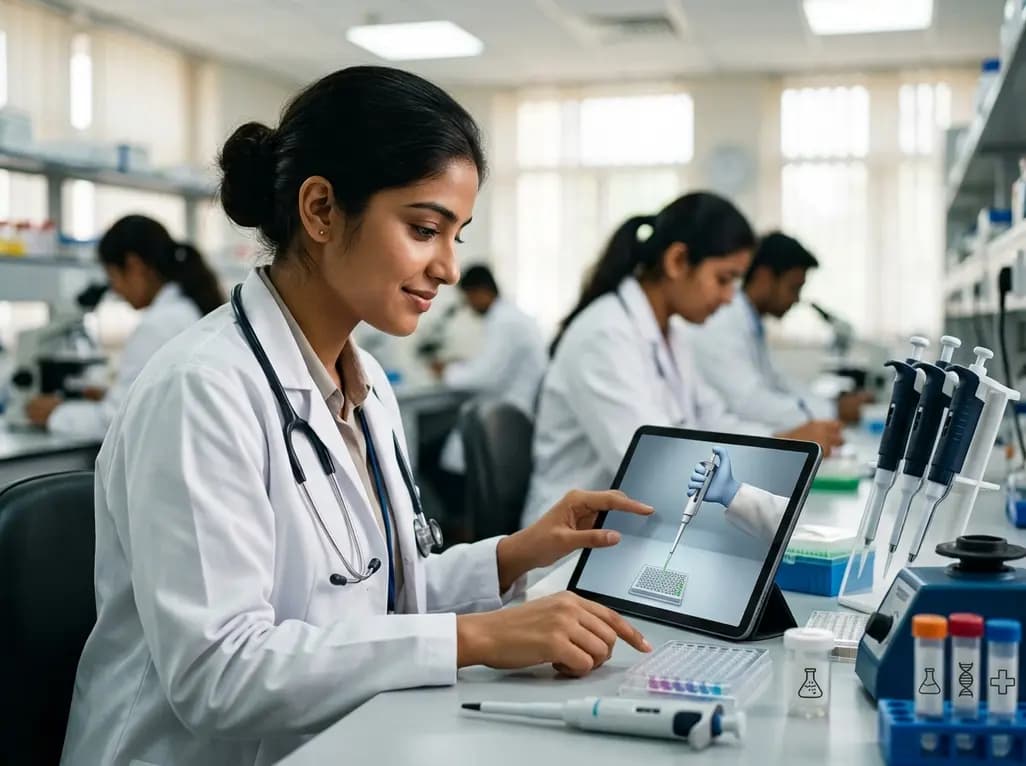
Effective training in an interactive laboratory simulation is becoming essential for medical students. Precision in laboratory diagnostics begins with the ability to use equipment correctly. Manual air displacement micropipettes are standard in most Indian medical laboratories. However, students often struggle to set and read these tools accurately. This gap can lead to errors in experimental outcomes and diagnostic interpretations.
Researchers recently developed a digital solution using Articulate Storyline. This interactive laboratory simulation isolates the mental task of reading dials from the physical movement. Traditionally, training focuses only on the hands-on action. This new digital approach allows students to master the scale before they touch a pipette. Consequently, this method offers a scalable and cost-effective way to train many students at once.
The study utilized a pre-post mixed methods design at two independent universities. Results showed that students significantly improved their self-rated confidence. More importantly, their accuracy in reading scales increased after using the simulation. Furthermore, students gave highly positive feedback. They felt the digital environment provided a safe space to fail and learn. Therefore, this tool is an ideal prerequisite for face-to-face practical sessions.
The National Medical Commission (NMC) emphasizes competency-based medical education. Integrating an interactive laboratory simulation fits perfectly within this framework. Medical colleges can use these modules in first-year biochemistry and second-year pathology. By doing so, they prepare students for real-world diagnostic precision. Additionally, digital tools reduce the wear and tear on expensive laboratory equipment during initial training.
A digital simulation allows students to focus on the cognitive task of understanding equipment settings. This reduces cognitive load during actual laboratory practice, leading to better accuracy and fewer errors.
No, it serves as a preparatory tool. It builds the necessary confidence and knowledge required for effective hands-on training in a face-to-face setting.
Disclaimer: This content is for informational and educational purposes only. It does not constitute medical advice or laboratory standards. Refer to the latest local and national guidelines for clinical practice.
References

Read summarized clinical updates, watch expert medical content, and earn CME certifications right from your smartphone.
Open your smartphone camera to scan and install.





Explore how an interactive laboratory simulation helps medical students master micropipette reading, enhancing confidence and diagnostic accuracy in the lab...
4 months ago

As monsoon seasons elevate arboviral disease threats, Tamil Nadu has initiated an ICMR-monitored evaluation of the tetravalent dengue vaccine in Tenkasi district. Clinicians emphasize clinical monitoring, public prevention, and high-quality early pediatric care to reduce disease morbidity across endemic regions.
Today

Leucine Rich Bio has introduced South Asia's first comprehensive vaginal microbiome test, BugSpeaks. By profiling microbial dysbiosis, pathogens, and antimicrobial resistance, this next-generation diagnostic platform provides clinicians with deeper insights into recurrent infections, fertility, and reproductive health.
Today

Review how tailored exercise programs benefit frail older patients with heart failure. Explore pathophysiological mechanisms, individualized training prescriptions, and strategies to overcome adherence barriers in clinical practice.
Today

This comparative study evaluates posterior labral tears with and without glenohumeral instability, highlighting distinct demographic patterns, MRI underestimation in stable shoulders, and successful arthroscopic repair outcomes.
Today

A clinical study demonstrates that early intervention with tocilizumab, either as monotherapy or bridged with corticosteroids, achieves significant proptosis reduction and resolves active inflammation in treatment-naive thyroid eye disease.
Today
