.webp&w=384&q=75)

Loading, please wait...
Loading, please wait...

Researchers have recently introduced the iGABASnFR2 GABA sensor, a second-generation genetically encoded tool designed to monitor GABAergic inhibition with unprecedented precision. While the first-generation sensor enabled initial studies, it often struggled with low signal-to-noise ratios and slow kinetics. Consequently, the team employed near-saturation mutagenesis to refine the protein structure. This breakthrough allows clinicians and researchers to observe inhibitory neurotransmission in vivo with much higher clarity.
The updated iGABASnFR2 GABA sensor offers a 4.1-fold improvement in sensitivity compared to its predecessor. Moreover, it features a 30% faster rise time, making it ideal for capturing rapid synaptic events. Specifically, the binding affinity remains within a range that accurately reflects physiological GABA fluctuations at the synapse. Furthermore, the scientists identified a negative-going variant, iGABASnFR2n, which decreases fluorescence upon GABA binding. This additional tool helps scientists corroborate findings by providing a reverse-response signal.
Initial in vivo testing has already yielded significant results in specialized neural tissues. In the retina, iGABASnFR2 enabled the first successful measurements of direction-selective GABA release. Additionally, imaging in the somatosensory cortex revealed the sensor\'s ability to report volume-transmitted GABA following whisker stimulation. Therefore, these improvements suggest that iGABASnFR2 will become a standard tool for mapping complex inhibitory circuits in real-time. This technology holds great potential for understanding disorders linked to GABAergic dysfunction, such as epilepsy and schizophrenia.
The iGABASnFR2 sensor provides 4.1 times more sensitivity and 30% faster kinetics than the original iGABASnFR. These upgrades allow for significantly better signal-to-noise ratios during live brain imaging.
iGABASnFR2n is a negative-going sensor that dims when GABA binds to it. Researchers use it alongside the positive-going sensor to confirm that observed fluorescence changes truly represent GABA dynamics rather than imaging artifacts.
While primarily a research tool, it provides critical insights for neurology, psychiatry, and ophthalmology. It specifically aids in studying how inhibitory signals govern motion sensitivity in the eye and sensory processing in the brain.
Disclaimer: This content is for informational and educational purposes only and does not constitute medical advice or a recommendation for any specific technology. Always refer to the latest local and national guidelines for clinical practice.
References

Read summarized clinical updates, watch expert medical content, and earn CME certifications right from your smartphone.
Open your smartphone camera to scan and install.





iGABASnFR2 is an improved genetically encoded sensor for GABA, offering 4.1-fold better sensitivity and faster kinetics for advanced in vivo neural imaging....
7 months ago

Researchers at IIT Bombay have engineered an automated, cost-effective point-of-care device that diagnoses anaemia and sickle cell disease from a single drop of blood. By measuring blood smear spreading length, this portable tool assesses blood viscosity to offer rapid screening in resource-limited healthcare centers.
Today

A multicenter study evaluates whether standardized simulation training reduces cup detachment during vacuum-assisted vaginal birth. Evidence-based simulation equips obstetricians to improve cup placement, reduce maternal-fetal trauma, and optimize clinical decision-making during operative deliveries.
Today
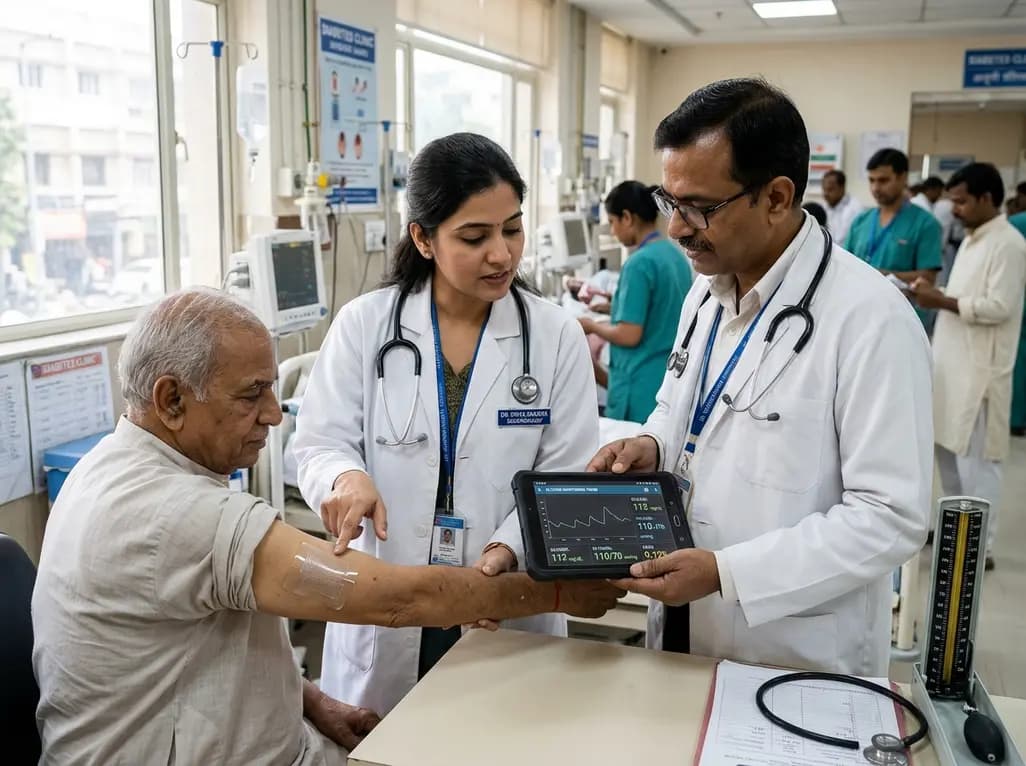
A breakthrough ultrathin multimodal sensor decouples physical hemodynamic monitoring from disposable electrochemical calibration, achieving long-term wearable glucose prediction with 81.36% accuracy and a 9.12% MARD. This offers a robust, drift-free solution for outpatient metabolic surveillance.
Today

A comparative review of tension band wiring and intramedullary screw fixation in thumb metacarpophalangeal arthrodesis, evaluating union rates, hardware complications, and clinical outcomes.
Today

Following regulatory scrutiny from FSSAI regarding promotional representations and lean muscle preservation claims, Dr. Reddy's Laboratories and Nestlé Health Science are currently reviewing the branding and marketing strategy for their joint nutritional supplement Celevida GLP+.
Today
