.webp&w=384&q=75)

Loading, please wait...
Loading, please wait...
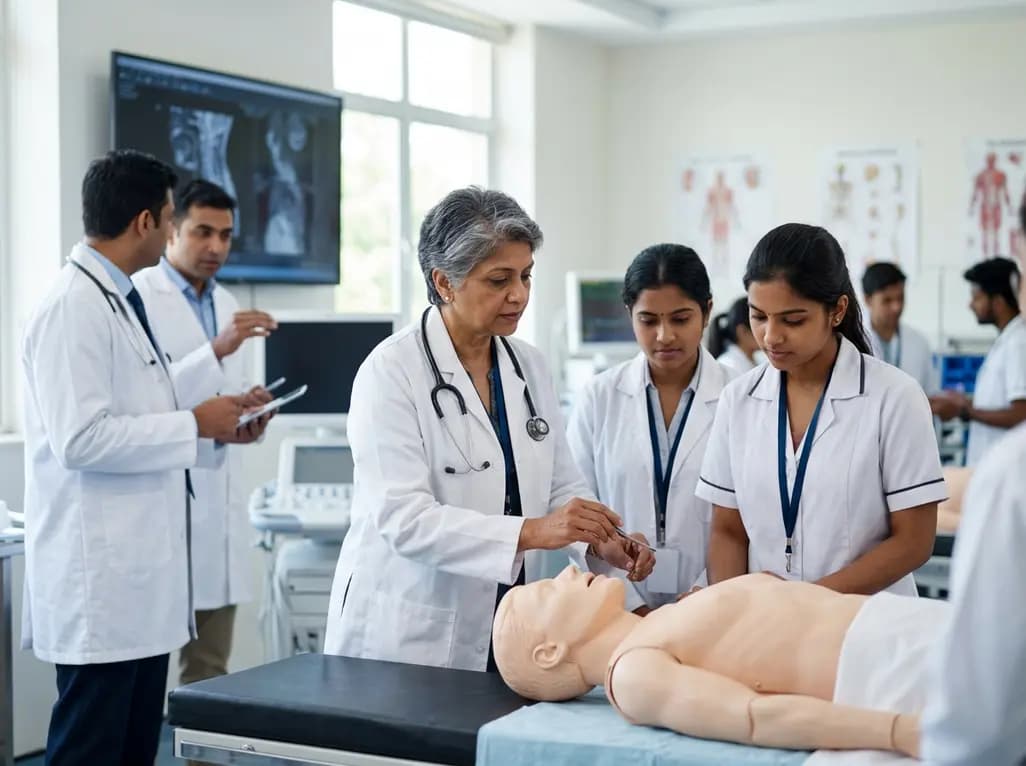
The National Medical Commission (NMC) and the Indian Council of Medical Research (ICMR) have announced a significant joint initiative, inviting proposals for medical education research in 2026. This collaborative effort seeks to bolster the quality and effectiveness of medical training across India. Moreover, this call for proposals presents a vital opportunity for institutions and individual investigators to contribute to the evolution of healthcare education, aligning with national priorities for producing highly competent medical professionals. Therefore, medical colleges and research institutions nationwide should meticulously review the guidelines to participate in this transformative endeavor.
India's medical education landscape has undergone substantial reforms, primarily with the introduction of Competency-Based Medical Education (CBME) for undergraduate training. This framework, implemented by the National Medical Commission (NMC) in 2019, emphasizes not only clinical skills but also ethics and a strong research orientation among medical graduates. However, systemic mechanisms for strengthening and enhancing the quality of medical education, particularly through research, have been limited to a few institutions. Consequently, there is an urgent need for continuous enhancement of medical education, driven by robust, evidence-based research. Furthermore, this initiative aims to support studies that develop and evaluate novel approaches, thereby strengthening the quality of medical education across all levels: undergraduate, postgraduate, and doctoral programs. Effectively, this initiative is pivotal for creating a new generation of research-oriented healthcare professionals in India.
The primary objective of this joint ICMR-NMC initiative is to develop and evaluate innovative approaches for strengthening and enhancing the quality of medical education. Consequently, interventions that improve the quality of medical education are highly encouraged. These may include, but are not limited to, novel teaching-learning methodologies, the integration of digital technologies, strategies for competency enhancement, and improved assessment strategies. Additionally, proposals focusing on research integration and other interventions designed to enhance educational outcomes are also welcome. Investigators should consider how their projects can instill scientific knowledge, improve required competencies, and refine skills among undergraduate, postgraduate, and doctoral students. Therefore, a broad spectrum of innovative ideas is sought to enrich the learning experience and overall effectiveness of medical education.
This call for proposals is open to all medical colleges and institutions across India. Crucially, the Head of the institution must provide the necessary endorsement and administrative support for the proposed medical education research. Principal Investigators (PIs) must hold regular faculty positions in eligible medical institutions, possess relevant qualifications (MBBS/MD/MS/DM), and demonstrate prior research experience or efforts in medical education. All proposals must be submitted ONLINE ONLY through the ICMR Extramural Project Management System (e-PMS) (https://epms.icmr.org.in). Furthermore, applicants must ensure a detailed project proposal, curriculum vitae of the PI and Co-PIs, an institutional endorsement letter, and an ethical clearance certificate or proof of submission to IEC/Budget justification are submitted. This online-only approach streamlines the application process considerably.
The project duration for these grants can extend up to a maximum of 3 years for Anveshan/Small Grant proposals or 4 years for Nishayak Anveshan/Intermediate Grant proposals. Importantly, an additional period of up to 6 months may be considered for preparatory activities, though without additional costs. The selection process involves a thorough peer review, with each proposal evaluated by at least two independent expert reviewers utilizing standardized scoring criteria. Subsequently, the Project Selection Committee assigns final scores, taking into account all reviewer comments. Investigators must note that if similar projects are submitted by the same research team, only the last submitted proposal will be considered. Additionally, the PI must not have more than five ongoing research proposals or a total grant amount exceeding ₹25 crores from existing projects. This ensures equitable distribution of research opportunities across the country.
A critical aspect of this initiative is the expectation that the outcomes of funded studies will be published in indexed journals such as PubMed, Scopus, and Web of Science. Publishing in Indian journals, like the Indian Journal of Medical Research (IJMR), is particularly encouraged. It is mandatory for all publications stemming from this initiative to acknowledge both ICMR and NMC. This emphasis on publication ensures that valuable findings from medical education research are widely disseminated, contributing to the broader academic and medical community. Furthermore, the goal is to drive real-world improvements in teaching practices, curriculum design, and ultimately, patient care through evidence-based advancements in medical training. Therefore, researchers should plan for robust data analysis and timely dissemination of their results.
Applicants must meticulously follow the prescribed format for the project proposal, which is divided into Part-A and Part-B. Part-A requires details such as a specific, concise title, a structured summary (up to 500 words) covering background, problem statement, objectives, methodology, and expected outcomes, and relevant keywords. Furthermore, a detailed methodology section should outline the study design, area, subjects, interventions, comparisons, and primary/secondary outcome measures. Part-B focuses on the PI's preliminary work, the research team's skills and experience, institutional support, laboratory facilities, and detailed budget justifications. The budget should strictly adhere to ICMR guidelines, with clear justifications for all sub-headings including staff, equipment, contingency, consumables, and travel allowance. Adequate justification is paramount, as items lacking sufficient detail will be removed from the approved grant. This comprehensive approach ensures that only well-conceived and thoroughly planned projects receive funding, contributing meaningfully to the advancement of medical education in India.
Learn more about CBME Implementation ChallengesDisclaimer: This content is for informational and educational purposes only. It is not intended to be a substitute for professional medical advice, diagnosis, or treatment. Always seek the advice of your physician or other qualified health provider with any questions you may have regarding a medical condition. Refer to the latest local and national guidelines for clinical practice.
References

Read summarized clinical updates, watch expert medical content, and earn CME certifications right from your smartphone.
Open your smartphone camera to scan and install.





The Indian Council of Medical Research (ICMR) and the National Medical Commission (NMC) have launched a joint initiative in 2026, inviting research proposals to strengthen and enhance the quality of medical education. This crucial program seeks innovative approaches to refine medical training across undergraduate, postgraduate, and doctoral levels.
3 months ago

Review how tailored exercise programs benefit frail older patients with heart failure. Explore pathophysiological mechanisms, individualized training prescriptions, and strategies to overcome adherence barriers in clinical practice.
Today

Leucine Rich Bio has introduced South Asia's first comprehensive vaginal microbiome test, BugSpeaks. By profiling microbial dysbiosis, pathogens, and antimicrobial resistance, this next-generation diagnostic platform provides clinicians with deeper insights into recurrent infections, fertility, and reproductive health.
Today

In high-risk pulmonary embolism complicated by severe anemia and active uterine bleeding, systemic thrombolysis is contraindicated. Large-bore aspiration thrombectomy provides rapid hemodynamic rescue without fibrinolysis, supported by inferior vena cava filter placement and multidisciplinary critical care.
Today

This comparative study evaluates posterior labral tears with and without glenohumeral instability, highlighting distinct demographic patterns, MRI underestimation in stable shoulders, and successful arthroscopic repair outcomes.
Today

A clinical study demonstrates that early intervention with tocilizumab, either as monotherapy or bridged with corticosteroids, achieves significant proptosis reduction and resolves active inflammation in treatment-naive thyroid eye disease.
Today
