.webp&w=384&q=75)

Loading, please wait...
Loading, please wait...
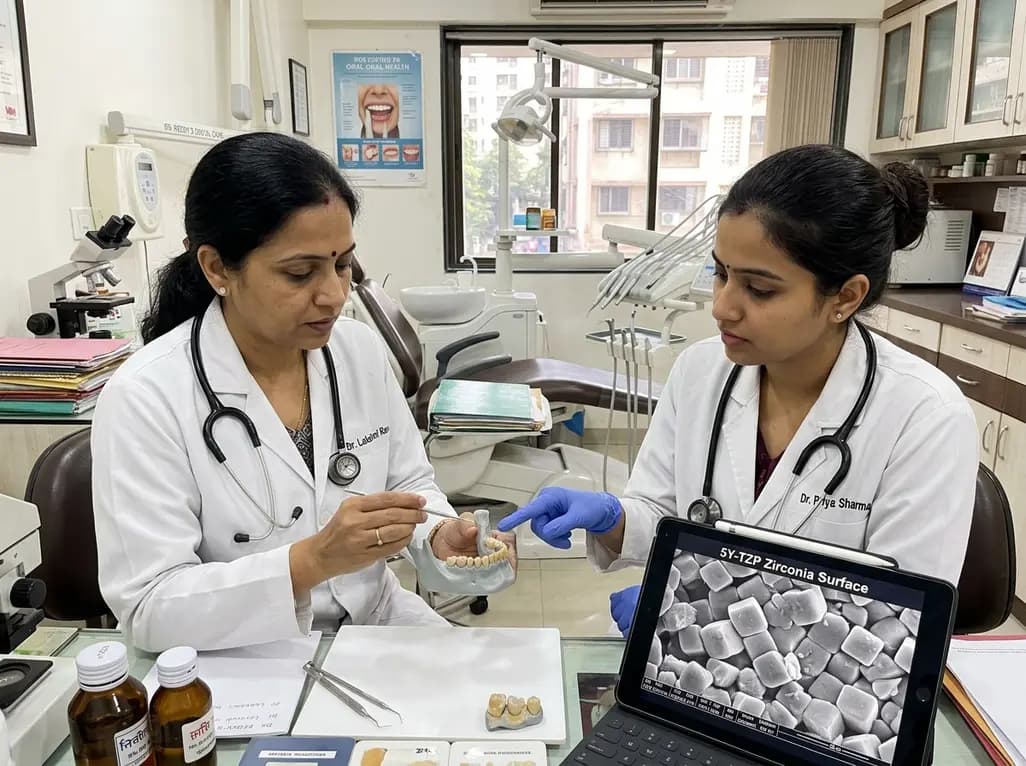
Modern prosthodontic practice increasingly relies on monolithic ceramics to combine aesthetic excellence with structural longevity. Among these materials, ultratranslucent 5Y-TZP zirconia has gained substantial popularity for aesthetic restorations. Dental practitioners value its remarkable optical translucency, which closely mimics natural tooth enamel without requiring fragile porcelain veneers. However, the oral environment continually exposes restorative ceramics to saliva, masticatory stresses, and thermal fluctuations. Consequently, clinicians must evaluate how aqueous environments affect high-yttria ceramics over time. Hydrothermal degradation remains a primary consideration in ceramic longevity. Therefore, understanding formulation-specific behaviors under humid conditions allows practitioners to select restorative materials that preserve both aesthetics and function.
Traditional dental zirconia predominantly consists of 3 mol% yttria-stabilized tetragonal zirconia polycrystals. Although these original formulations deliver exceptional flexural strength, high opacity limits their utility in anterior esthetic regions. To resolve this challenge, manufacturers developed ultratranslucent 5Y-TZP zirconia by incorporating approximately five mole percent yttria. This modification increases the isotropic cubic phase to over fifty percent. Because cubic crystals exhibit optical isotropy, light scatters far less at grain boundaries. As a result, restorations fabricated from 5Y-TZP display remarkable light transmittance and natural depth. Furthermore, eliminating veneering porcelain markedly reduces the clinical risk of chipping. Nevertheless, this elevated cubic phase content alters the transformation toughening mechanism that protects traditional zirconia from failure. In addition, practitioners must consider whether these translucent microstructures resist moisture exposure as effectively as earlier generations. Thus, evaluating specific commercial formulations remains essential for predictable outcomes.
Hydrothermal degradation, commonly termed low-temperature degradation, involves the spontaneous transformation of tetragonal zirconia crystals into monoclinic phases in the presence of moisture. In conventional 3Y-TZP ceramics, water radicals penetrate the crystal lattice, causing localized expansion, microcracking, and premature wear. However, researchers investigating ultratranslucent 5Y-TZP zirconia observe a distinctly different degradation pathway. Because cubic structures remain thermodynamically stable at mouth temperatures, they do not undergo traditional tetragonal-to-monoclinic shifts under hydrothermal stress. Advanced analytical methods, including X-ray diffraction and Raman spectroscopy, confirm that 5Y-TZP avoids macroscopic monoclinic transformation even after prolonged autoclaving. Instead, hydrothermal aging induces progressive surface hydration and nanoscale chemical alterations. Water molecules primarily interact with yttrium cations and grain boundary interfaces rather than destabilizing the bulk crystalline matrix. Consequently, the core structural integrity remains intact during artificial aging. Therefore, clinicians can appreciate that 5Y-TZP ceramics resist catastrophic phase breakdown, although surface-level phenomena still warrant attention.
Although all 5Y-TZP ceramics share high cubic phase concentrations, individual commercial brands perform differently under hydrothermal challenge. Recent comparative analyses demonstrate that formulation subtleties dramatically influence hydrolytic resistance. Specifically, high-strength baseline zirconias and select lightly shaded ultratranslucent formulations maintain superior surface smoothness throughout rigorous autoclaving. Conversely, pigment-rich ultratranslucent formulations often display heightened vulnerability to environmental moisture. Dental manufacturers introduce metallic oxide colorants, such as iron, cobalt, and erbium, to achieve lifelike tooth shades across multi-layered blanks. However, these dopants can segregate at grain boundaries during sintering. As a result, moisture in the oral cavity can interact with localized compositional defects, accelerating chemical dissolution along microscopic grain interfaces. In addition, lithium disilicate controls show significant surface alterations under equivalent hydrothermal conditions due to glass matrix corrosion. Therefore, the exact balance of stabilizing oxides, manufacturing impurities, and color pigments plays a decisive role in determining ceramic durability. Clinicians must recognize that commercial brands offer distinct microstructural stability profiles.
The microscopic changes occurring on ceramic surfaces during hydrothermal exposure produce tangible clinical consequences. When pigment-dense ultratranslucent ceramics undergo hydrolytic stress, atomic force microscopy reveals notable increases in surface roughness. Furthermore, progressive surface degradation alters material wettability and surface free energy, shifting measured water contact angles. From an optical perspective, surface degradation and chemical hydration affect light transmittance and reflectance across the restoration. Spectrophotometric analyses demonstrate subtle color shifts, designated as delta E values, following prolonged hydrothermal aging. Although these optical variations may sometimes remain within clinically acceptable thresholds, noticeable color shifts can compromise anterior reconstructions over time. Moreover, elevated nanoscale surface roughness promotes bacterial adhesion, potentially increasing plaque accumulation and gingival inflammation. Similarly, roughened ceramic contours can accelerate abrasive wear on opposing natural enamel during mastication. Consequently, prosthodontists must acknowledge that hydrothermal aging alters more than just mechanical parameters; it directly impacts the biological and esthetic performance of monolithic restorations.
Understanding formulation-dependent hydrothermal degradation empowers dental practitioners to make evidence-based decisions during treatment planning. Ultratranslucent 5Y-TZP zirconia remains an outstanding restorative choice for single anterior crowns, cosmetic veneers, and selected short-span bridges where esthetic demands predominate. However, clinicians should carefully evaluate the specific brand and shade distribution required for high-moisture environments. For posterior restorations bearing heavy occlusal forces, higher-strength 3Y-TZP or hybrid multilayered systems often provide a more balanced combination of fracture toughness and surface durability. In addition, meticulous finishing and polishing protocols are mandatory following any occlusal adjustment in the clinic. Clinicians must avoid aggressive chairside grinding without adequate water cooling, because localized thermal stress accelerates surface microcracking and moisture susceptibility. Furthermore, applying intraoral diamond polishing pastes recreates a dense, smooth glaze layer that mitigates hydrolytic attack. By combining informed material selection with careful polishing, practitioners can maximize the clinical lifespan, color stability, and periodontal compatibility of monolithic zirconia prostheses.
Ultratranslucent 5Y-TZP zirconia does not experience typical low-temperature degradation characterized by macroscopic tetragonal-to-monoclinic phase transformation. Because it contains over fifty percent isotropic cubic phase, the crystal lattice remains thermodynamically stable under humid conditions. However, hydrothermal exposure still triggers nanoscale surface hydration and chemical grain boundary alterations. Consequently, while the bulk prosthesis maintains structural integrity without catastrophic failure, surface roughness and optical properties can undergo formulation-dependent changes over time.
Pigment-rich zirconia formulations incorporate metallic dopants like iron, manganese, or erbium oxides to achieve natural shade gradients. During thermal sintering, these coloring agents often segregate along microstructural grain boundaries instead of dissolving completely into the crystal lattice. When exposed to an aqueous environment, these pigmented boundary regions experience accelerated chemical dissolution and hydrolytic breakdown. Therefore, heavily shaded materials develop greater surface roughness, altered wettability, and slight optical instability compared to unshaded blanks.
Clinicians can minimize hydrothermal surface degradation by following strict finishing protocols and selecting application-specific formulations. After completing chairside occlusal or interproximal adjustments, practitioners must avoid dry grinding, which generates localized microcracks. Instead, clinicians should use copious water irrigation followed by sequential diamond-impregnated polishers to restore high surface luster. Moreover, applying intraoral glaze pastes and ensuring adequate regular oral hygiene prevents plaque-mediated acidic corrosion, maintaining smooth ceramic surfaces and protecting opposing natural dentition.
Disclaimer: This content is for informational and educational purposes only... Refer to the latest local and national guidelines for clinical practice.
References

Read summarized clinical updates, watch expert medical content, and earn CME certifications right from your smartphone.
Open your smartphone camera to scan and install.





A recent study evaluates the hydrothermal degradation of ultratranslucent 5Y-TZP zirconia, revealing that while cubic phases prevent macroscopic phase transformation, formulation variations and pigments can induce microscopic surface roughness and hydrolytic aging in dental restorations.
Today

The Food Safety and Standards Authority of India has issued draft regulations prohibiting the sale and manufacture of non-dairy imitation substitutes as paneer. This nationwide regulatory action aims to eliminate consumer deception, protect dietary protein quality, and curtail lipid-related metabolic risks.
Today
A novel green-synthesized nanocarrier uses ellagic acid to crosslink chitosan for localized cisplatin delivery in cervical cancer. Preclinical results demonstrate extended vaginal retention, potent cytotoxicity, ROS-driven apoptosis, and superior tumor regression compared with traditional crosslinkers.
Today

Managing refractory hypoxemia after cardiothoracic surgery becomes perilous when prolonged air leak limits positive-pressure ventilation. This case-based review details how high-flow nasal cannula, paired with awake rehabilitation, enabled successful extubation and avoided invasive re-intubation.
Today

A longitudinal study reveals that patients undergoing staged bilateral hip arthroscopy experience progressive contralateral labral deterioration during surgical intervals. However, structural degradation does not compromise 2-year postoperative clinical outcomes or patient-reported satisfaction scores.
Today
SWEDEPAD-1 trial insights show paclitaxel-coated devices do not improve long-term limb salvage in patients with chronic limb-threatening ischemia and tissue loss. While one-year reinterventions decreased, the devices were linked to a higher risk of major amputation at three months.
Today
