.webp&w=384&q=75)

Loading, please wait...
Loading, please wait...

Recent regulatory evaluations across India have brought scrutiny of hospital consumable prices to the forefront of national healthcare policy. The Union Ministry of Health and Family Welfare has commenced formal stakeholder discussions with private hospital chains and medical device manufacturers. Consequently, officials seek to establish practical guidelines that curtail extreme retail markups on routine disposable items. Inpatient care frequently requires essential supplies such as intravenous infusion sets, catheters, and disposable syringes. However, patients often face substantial financial strain due to unchecked pricing variations. Therefore, policymakers are actively reviewing regulatory frameworks to ensure equitable healthcare access for all citizens. Meanwhile, healthcare leaders recognise that systemic pricing reforms will fundamentally reshape private hospital administration and patient affordability nationwide.
The current regulatory intervention gained significant momentum following an extensive investigation by the Maharashtra Food and Drug Administration. Under state leadership, inspectors conducted targeted surveys across healthcare facilities in major metropolitan regions. Specifically, the regulatory audit examined actual wholesale purchase invoices and compared them against printed maximum retail prices. The resulting data revealed astronomical markups escalating up to 2,841 percent on routine inpatient supplies. For instance, private medical institutions acquired standard intravenous infusion sets for approximately eleven rupees. Yet, these identical items carried a printed retail price of 325 rupees on patient invoices. Furthermore, investigators observed that standard ten-millilitre syringes purchased for less than seven rupees retailed at over 57 rupees. In addition, urinary catheters procured for twenty-nine rupees reached consumer bills at 310 rupees. As a result, state authorities formally notified the Department of Pharmaceuticals and the National Pharmaceutical Pricing Authority. Regulators emphasised that vulnerable hospitalised patients cannot negotiate prices during acute emergencies. Therefore, consumer advocacy groups strongly supported immediate structural intervention to curb exploitative retail billing practices.
The substantial disparity in hospital consumable prices stems largely from historical gaps in statutory pricing oversight. Under current drug pricing orders, the central government strictly caps prices for scheduled essential medicines. However, non-scheduled formulations and disposable medical consumables remain outside this direct formulaic price ceiling. Consequently, manufacturers and distributors can establish inflated retail prices at their discretion. Healthcare experts point out that hospitals often leverage bulk institutional purchasing power to secure deep wholesale discounts. Nevertheless, facilities frequently bill these disposables to patients at maximum retail prices. Thus, the hospital captures an immense trade margin rather than passing savings to consumers. Moreover, clinical leaders from premier institutions have underscored that unchecked commercialisation compromises patient trust. While healthcare enterprises must generate reasonable operating returns, excessive markups cross ethical boundaries. In response, Union Health Minister JP Nadda directed pharmaceutical authorities to convene comprehensive consultative meetings. Additionally, policymakers aim to establish transparent pricing benchmarks that eliminate arbitrary markups without jeopardising commercial supply continuity.
To rectify widespread pricing distortions, the central administration is actively evaluating trade margin rationalisation as a core policy instrument. Trade margin rationalisation caps the allowable percentage difference between a manufacturer's first sale price and final retail cost. Previously, the National Pharmaceutical Pricing Authority successfully deployed this regulatory mechanism during public health emergencies. For example, authorities placed trade margin caps on oxygen concentrators, pulse oximeters, and blood glucose monitors. Consequently, retail prices dropped significantly, making life-saving monitoring tools affordable for millions of households. Industry associations representing domestic medical device manufacturers have voiced decisive support for expanding this approach to hospital consumables. Ethical manufacturers note that artificially high printed prices penalise compliant suppliers and distort fair competition. Furthermore, trade margin rationalisation provides an evidence-based method that respects manufacturing innovation while preventing opportunistic retail markups. By calculating margins from the first point of sale, regulators can establish predictable economic guardrails across supply chains. As a result, procurement becomes transparent, and patients receive fair, cost-reflective billing for disposables.
From a clinical perspective, excessive consumable pricing directly impacts therapeutic adherence and the physician-patient relationship. In acute inpatient wards and intensive care units, clinicians routinely order multiple disposables each day. For instance, critical care protocols necessitate frequent arterial blood samplings, regular infusion line changes, and specialised respiratory circuits. When hospitals apply tenfold markups to each item, out-of-pocket expenses escalate rapidly. Consequently, families experiencing severe financial toxicity may request premature discharge against medical advice or decline essential supportive interventions. Such decisions severely undermine clinical outcomes and elevate inpatient mortality risks. Furthermore, medical practitioners often bear the brunt of patient dissatisfaction regarding inflated final bills, despite having zero influence over administrative pricing. Ethical medical practice requires clinicians to advocate for patient welfare beyond bedside diagnostics. Therefore, standardising consumable expenses protects vulnerable patients from exploitation during critical illness. Additionally, transparent billing fosters mutual trust between treating physicians and their patients, reinforcing essential medical ethics. Moreover, honest cost accounting ensures that clinical teams deliver compassionate care without creating devastating household debt.
While capping markups protects patients, regulatory authorities must also evaluate genuine operational costs that healthcare institutions incur. Private hospital networks correctly assert that handling medical devices involves expenses beyond mere wholesale procurement. Specifically, clinical institutions must maintain continuous cold chains, guarantee sterile storage conditions, and retain biomedical engineers for quality assurance. In addition, hospitals absorb significant financial losses resulting from expired stock, damaged sterile packaging, and hazardous biomedical waste disposal. Therefore, healthcare providers argue that a blanket price ceiling must not compromise institutional viability or patient safety standards. A well-designed regulatory framework should differentiate routine commodity disposables from high-technology, maintenance-heavy implants. Moreover, comprehensive stakeholder consultations allow policymakers to establish realistic margin thresholds that reflect true handling overheads. Ultimately, sustainable policy design harmonises healthcare affordability with the financial health of hospitals. Meanwhile, ongoing monitoring ensures that cost controls do not deter technological adoption or lower clinical quality benchmarks. By curbing predatory pricing while permitting reasonable operational margins, India can build an ethical, resilient healthcare ecosystem that serves both providers and patients equitably.
Q1: Why did the Maharashtra FDA flag hospital consumable prices to central pricing authorities?
The Maharashtra Food and Drug Administration conducted surveys across private healthcare facilities and discovered extreme markups reaching up to 2,841 percent on routine inpatient disposables. Standard items like intravenous infusion sets, catheters, and syringes were procured at minimal wholesale rates but billed at massive printed maximum retail prices. Consequently, the state regulator alerted central authorities to curb unchecked commercial markups and safeguard vulnerable patients from unexpected financial distress.
Q2: How does trade margin rationalisation differ from traditional drug price capping?
Traditional price regulation under the Drugs Prices Control Order establishes a rigid ceiling price for scheduled essential medications. In contrast, trade margin rationalisation limits the allowable markup percentage between the manufacturer's first point of sale and the final retail price. Therefore, this mechanism prevents predatory distributor margins while accommodating varying production costs and technological innovations. It promotes transparent market competition, prevents artificial inflation of printed prices, and ensures fair costs for hospitalised patients.
Q3: What clinical and economic challenges might private hospitals face under new price controls?
Private hospitals maintain that consumable handling involves substantial operational costs beyond wholesale acquisition. Facilities must fund continuous cold-chain maintenance, biomedical engineering oversight, sterile inventory storage, and hazardous waste disposal protocols. Furthermore, hospitals absorb the economic losses of expired or damaged supplies. If price caps are set unrealistically low without considering administrative handling costs, smaller nursing homes may struggle with operational viability or face supply shortages, potentially impacting emergency inpatient readiness and patient care quality.
Disclaimer: This content is for informational and educational purposes only. It does not constitute medical advice or replace professional judgment. Refer to the latest local and national guidelines for clinical practice.
References

Read summarized clinical updates, watch expert medical content, and earn CME certifications right from your smartphone.
Open your smartphone camera to scan and install.





Following an investigation by the Maharashtra FDA uncovering markups up to 2,841 percent on routine medical disposables, the Indian government has initiated stakeholder talks on trade margin rationalisation to protect patients from excessive inpatient billing while maintaining supply chain viability.
Today

The Central Council for Research in Ayurvedic Sciences emphasizes that integrating traditional medicine with mainstream healthcare requires scientific rigor. Enhanced pharmacovigilance networks, adverse drug reaction monitoring, and validated clinical trials remain pivotal to elevating clinical credibility.
Today
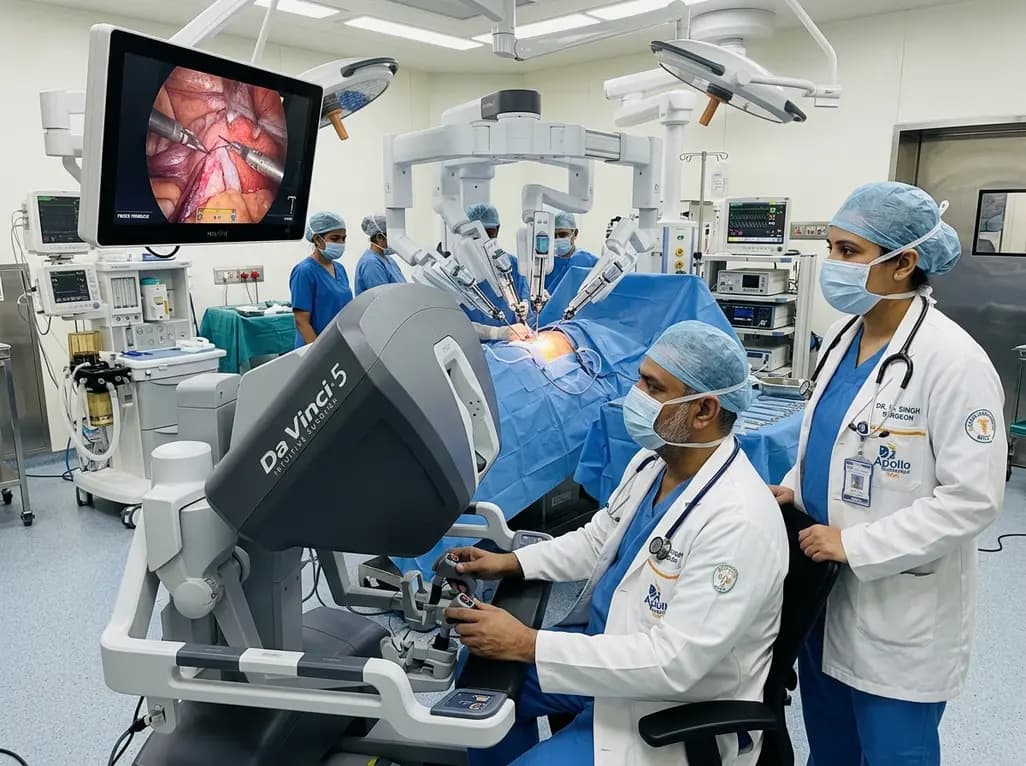
India expands its minimally invasive surgical landscape as Intuitive unveils its fifth-generation robotic platform. Equipped with real-time force feedback and immense computing performance, this innovation assists clinical specialists across urology, gynecology, and general surgery in optimizing operative care.
Today

Large-scale biobank research demonstrates that low-grade systemic inflammation quietly remodels ventricular architecture years before cardiovascular symptoms appear. Learn how emerging biomarkers like GlycA and targeted anti-inflammatory pathways could reshape preventive cardiovascular screening and clinical risk evaluation.
Today

Systematic review comparing labral repair and reconstruction in primary hip arthroscopy shows comparable short- to mid-term patient-reported outcomes, with lower THA conversion after repair but superior outcomes for reconstruction in patients aged 40 and older.
Today

A preclinical study reveals that alpinetin significantly alters glimepiride pharmacokinetics by inhibiting CYP2C9. This drug-herb interaction enhances hypoglycemic potency and underscores critical safety concerns regarding severe hypoglycemia in diabetic management.
Today
