.webp&w=384&q=75)

Loading, please wait...
Loading, please wait...

The Union Ministry of Health and Family Welfare has initiated high-level dialogues to re-evaluate hospital consumable prices across India. Recently, Union Minister JP Nadda directed pharmaceutical authorities to address alarming disparities between trade procurement rates and printed retail prices. Consequently, federal authorities seek a balanced mechanism that protects vulnerable citizens while preserving healthcare viability.
Government oversight has intensified after state regulators exposed wide discrepancies in medical supply billing. Specifically, the Maharashtra Food and Drug Administration submitted extensive documentation to the National Pharmaceutical Pricing Authority regarding arbitrary retail pricing. Federal health officials quickly convened meetings with hospital federations and device manufacturers to deliberate on corrective interventions. In addition, administrative reviews revealed that non-scheduled consumables operate without price ceilings under the current Drugs Prices Control Order of 2013. This regulatory vacuum allows upstream suppliers to print elevated maximum retail figures that bear little connection to direct manufacturing expenses. Furthermore, healthcare experts argue that patients cannot easily compare rates or decline essential supplies during acute emergencies. Therefore, the central government intends to formulate structured guidelines that restrict excessive trade margins. By curbing arbitrary distributor markups, policymakers hope to alleviate cumulative out-of-pocket expenses for hospitalized individuals. Moreover, regulatory leaders emphasize that clinical facilities must adopt transparent billing practices rather than relying on inflated markups for ancillary operational revenue. These discussions mark a decisive shift toward holistic price governance across Indian medical institutions.
The push for policy reform gained momentum after field surveys revealed staggering markups on everyday consumables. In particular, Maharashtra FDA Commissioner Tukaram Mundhe documented price variations reaching up to 2,841 percent in regional private hospitals. For example, investigators discovered intravenous infusion sets procured at eleven rupees but billed at an MRP of 325 rupees. Similarly, disposable syringes purchased for less than seven rupees carried printed prices exceeding fifty-seven rupees. Catheters displayed equally dramatic price inflations, jumping from twenty-nine rupees at trade procurement to over three hundred rupees on final invoices. As a result, hospitalized patients unknowingly absorb massive cost escalations on products that cost mere fractions to produce. Academic leaders, including AIIMS Kalyani President Dr YK Gupta, confirmed that internal research demonstrates ten-fold to twenty-fold price variations on identical items. Furthermore, clinical investigations indicate that these high markups occur upstream before products ever enter ward inventories. Consequently, patients lack bargaining power and must pay whatever the billing desk presents. Ultimately, exposing these pricing mechanics has dismantled the notion that high retail tags reflect superior material quality or sterile manufacturing.
While consumer advocacy groups demand immediate price caps, healthcare providers face complex economic considerations. Hospital federations, such as Nathealth, argue that procurement figures do not represent the total expense of clinical delivery. Specifically, tertiary care centers incur substantial indirect costs to maintain round-the-clock emergency inventories, cold-chain storage, and sterile integrity. In addition, institutions invest heavily in biomedical engineering personnel, stringent batch traceability, and hazardous waste disposal systems. However, industry representatives acknowledge that routine commodity items, like standard gloves and basic infusion tubing, require clear pricing boundaries. When private hospitals rely on inflated consumable markups to cross-subsidize unviable room tariffs, patient trust suffers severe damage. Families often interpret hefty final bills as direct physician profiteering rather than institutional overhead recovery. Therefore, medical leaders advocate for an evidence-based framework that differentiates basic commoditized items from complex technological equipment. Restructuring internal hospital accounting toward transparent professional services can help rebuild public trust. Consequently, modern hospitals must balance financial stability with ethical clinical obligations, ensuring that operational sustainability does not compromise patient affordability.
Trade margin rationalisation has emerged as the preferred regulatory instrument to curb unreasonable profiteering. Instead of imposing rigid manufacturing price ceilings, this mechanism limits the allowable percentage markup across the distribution chain. Specifically, the regulatory cap applies to the difference between the landed import or ex-factory price and the final printed retail price. During the COVID-19 pandemic, the National Pharmaceutical Pricing Authority successfully utilized this approach on pulse oximeters and oxygen concentrators. That intervention substantially lowered consumer costs without triggering supply chain shortages or driving reputable manufacturers out of the market. Furthermore, domestic medical device manufacturers have voiced strong support for trade margin rationalisation. Organizations such as the Association of Indian Medical Device Industry note that distorted pricing structures penalize ethical producers. Responsible manufacturers often lose market share to competitors who artificially inflate retail tags to offer lucrative margins to distributors. Therefore, establishing transparent trade margin boundaries creates a level playing field for domestic enterprises. In addition, standardizing trade margins enables public insurance schemes and third-party administrators to calculate predictable reimbursement rates for inpatient admissions.
The impending regulatory intervention signals a broader restructuring of healthcare delivery and hospital financial governance across India. Recently, parliamentary panels on health strongly recommended statutory price ceilings for major clinical interventions and private inpatient treatments. However, policymakers recognize that price rationalisation must not unintentionally compromise patient safety or clinical innovation. As a result, the Department of Pharmaceuticals plans extensive consultations before notifying formal amendments to the pricing schedule. In parallel, hospital administrators must proactively audit their internal pharmacy supply chains and transition toward value-based clinical care. Clinicians also welcome this transparency, as clearer billing structures shield medical professionals from unfair public allegations of commercial exploitation. Furthermore, when hospitals unbundle consumable charges from procedural excellence, patients develop greater confidence in clinical recommendations. In the long run, rationalizing consumable markups aligns Indian healthcare with global best practices and universal health coverage priorities. Ultimately, coordinated action between central regulators, clinical federations, and device innovators will establish a sustainable healthcare ecosystem. This collaborative strategy ensures that cutting-edge therapies remain accessible without imposing crushing financial hardships on vulnerable families.
Q1: Why are hospital consumable prices currently facing intense regulatory review in India?
State authorities uncovered exorbitant markups reaching 2,841 percent on routine supplies, including syringes and infusion sets. These disparities revealed that printed retail prices far exceed trade procurement costs. Consequently, the Union Health Ministry and pricing regulators initiated urgent discussions. They aim to curb excessive margins, prevent patient exploitation, and establish fair pricing standards across private inpatient facilities nationwide. Furthermore, these structured interventions will safeguard affordability without compromising clinical supply quality.
Q2: How does trade margin rationalisation differ from direct price ceiling regulation?
Direct price capping sets a statutory ceiling on selling costs, which can inadvertently discourage innovation or reduce market supply. In contrast, trade margin rationalisation restricts the allowable percentage markup added between landed import costs and final retail prices. This flexible approach allows producers to recover legitimate manufacturing expenses. Meanwhile, it prevents distributors and hospitals from levying irrational markups on vulnerable admitted patients.
Q3: How will rationalized consumable pricing affect private hospitals and practicing clinicians?
Rationalized pricing will require private hospitals to restructure operations away from supply markups toward transparent clinical service fees. While hospitals must adjust billing templates, this transition protects clinicians from public distrust and accusations of financial exploitation. Furthermore, standardized pricing facilitates smoother claims processing with health insurers and minimizes disputed hospital bills. Ultimately, it preserves institutional integrity while maintaining patient safety and high clinical standards.
Disclaimer: This content is for informational and educational purposes only. It does not constitute medical advice or replace professional judgment. Refer to the latest local and national guidelines for clinical practice.
References

Read summarized clinical updates, watch expert medical content, and earn CME certifications right from your smartphone.
Open your smartphone camera to scan and install.





Following alarming findings by the Maharashtra FDA showing markups exceeding 2,800 percent on essential hospital consumables, the Union Health Ministry has stepped in. The Centre has opened inter-agency talks with stakeholders to evaluate trade margin rationalisation and prevent patient exploitation in healthcare.
Today

The Central Council for Research in Ayurvedic Sciences emphasizes that integrating traditional medicine with mainstream healthcare requires scientific rigor. Enhanced pharmacovigilance networks, adverse drug reaction monitoring, and validated clinical trials remain pivotal to elevating clinical credibility.
Today
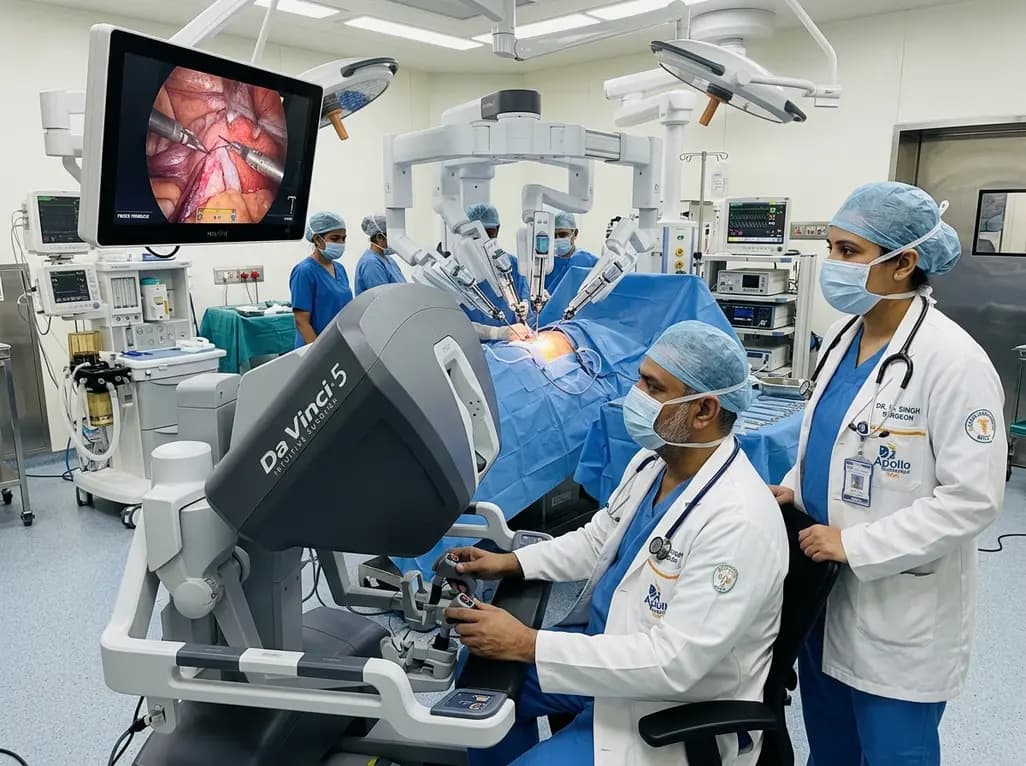
India expands its minimally invasive surgical landscape as Intuitive unveils its fifth-generation robotic platform. Equipped with real-time force feedback and immense computing performance, this innovation assists clinical specialists across urology, gynecology, and general surgery in optimizing operative care.
Today

Large-scale biobank research demonstrates that low-grade systemic inflammation quietly remodels ventricular architecture years before cardiovascular symptoms appear. Learn how emerging biomarkers like GlycA and targeted anti-inflammatory pathways could reshape preventive cardiovascular screening and clinical risk evaluation.
Today

Systematic review comparing labral repair and reconstruction in primary hip arthroscopy shows comparable short- to mid-term patient-reported outcomes, with lower THA conversion after repair but superior outcomes for reconstruction in patients aged 40 and older.
Today

A preclinical study reveals that alpinetin significantly alters glimepiride pharmacokinetics by inhibiting CYP2C9. This drug-herb interaction enhances hypoglycemic potency and underscores critical safety concerns regarding severe hypoglycemia in diabetic management.
Today
