.webp&w=384&q=75)

Loading, please wait...
Loading, please wait...

Extreme heatwaves present a major threat to public health across South Asia. Specifically, a recent study published in Frontiers in Environmental Health highlights the devastating toll of heatwave mortality in India. The researchers estimate that a single day of extreme heat causes approximately 3,400 excess deaths nationally. Furthermore, this number surges to nearly 30,000 deaths during a five-day heatwave event. Consequently, these findings emphasize the critical need for proactive clinical and policy interventions.
To understand this crisis, researchers Piyush Narang and Ashok Gadgil analyzed district-level mortality data. Previously, granular data on how extreme temperatures impact local communities remained largely inaccessible. Therefore, the team adapted epidemiological findings from ten major Indian cities to project national risks. Their model integrates district-level civil registration data and recent population projections. Consequently, the results show that heat risks are highly concentrated. For example, the state of Uttar Pradesh alone accounts for over 8,000 excess deaths during a five-day heatwave. Meanwhile, individual districts like Ahmedabad, Jaipur, and Surat each face more than 250 excess deaths per event. As a result, local healthcare facilities must prepare for sudden surges in heat-related emergencies.
The study reveals a profound economic imbalance in vulnerability. Specifically, a 2.3-fold disproportion exists between the mortality burden and economic capacity in high-burden states. These five states—Uttar Pradesh, Bihar, Madhya Pradesh, Rajasthan, and Gujarat—account for 66% of excess deaths. However, they contribute only 29% of India’s GDP. Therefore, the states with the least fiscal capacity face the greatest public health threat. This reality has direct implications for how the government allocates adaptation funds. Currently, federal funding often follows population size or administrative capacity. Instead, the authors argue that federal investments must prioritize high-burden, low-GDP states to build resilient healthcare systems.
Q1: What does the term 'excess deaths' mean in this study?
Specifically, excess deaths refer to the difference between actual deaths and expected deaths based on historical data.
Q2: Which Indian states bear the highest burden of heatwave mortality?
Collectively, Uttar Pradesh, Bihar, Madhya Pradesh, Rajasthan, and Gujarat experience the highest mortality burden. Consequently, they account for 66% of the country's heat-induced excess deaths.
Q3: How do economic capacity and heatwave vulnerability correlate in India?
Notably, there is a 2.3-fold disproportion between mortality burden and economic capacity. Therefore, low-income states with limited fiscal resources face much higher heatwave mortality risks.
Disclaimer: This content is for informational and educational purposes only. It does not constitute medical advice or replace professional judgment. Refer to the latest local and national guidelines for clinical practice.
References

Read summarized clinical updates, watch expert medical content, and earn CME certifications right from your smartphone.
Open your smartphone camera to scan and install.





A new study reveals that a single day of extreme heat causes 3,400 excess deaths in India, highlighting severe climate vulnerabilities and health disparitie...
4 months ago
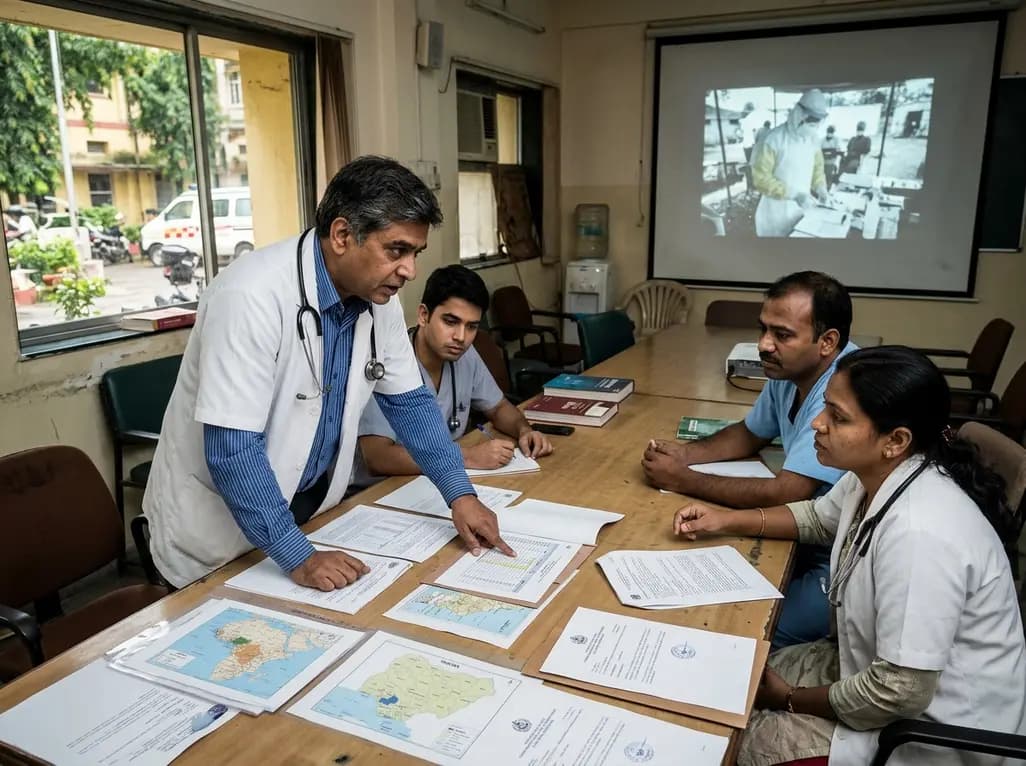
Following Nigeria's first recorded Ebola case linked to regional travel, the Africa CDC has convened an emergency ministerial summit. This alert underscores critical clinical priorities for healthcare professionals, including differentiating early viral infection from malaria, implementing barrier nursing, and triage.
Today

Leucine Rich Bio has introduced South Asia's first comprehensive vaginal microbiome test, BugSpeaks. By profiling microbial dysbiosis, pathogens, and antimicrobial resistance, this next-generation diagnostic platform provides clinicians with deeper insights into recurrent infections, fertility, and reproductive health.
Today

Review how tailored exercise programs benefit frail older patients with heart failure. Explore pathophysiological mechanisms, individualized training prescriptions, and strategies to overcome adherence barriers in clinical practice.
Today

This comparative study evaluates posterior labral tears with and without glenohumeral instability, highlighting distinct demographic patterns, MRI underestimation in stable shoulders, and successful arthroscopic repair outcomes.
Today

A clinical study demonstrates that early intervention with tocilizumab, either as monotherapy or bridged with corticosteroids, achieves significant proptosis reduction and resolves active inflammation in treatment-naive thyroid eye disease.
Today
