.webp&w=384&q=75)

Loading, please wait...
Loading, please wait...
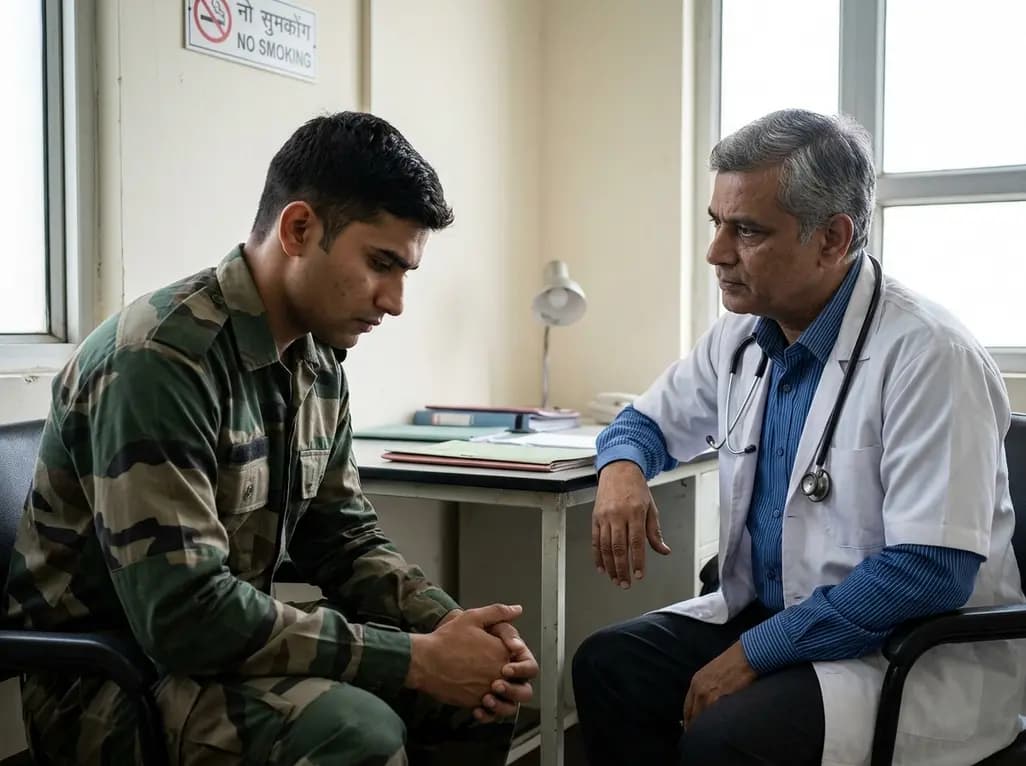
Post-traumatic stress disorder remains a significant psychiatric challenge among military personnel and veterans exposed to extreme operational stressors. Clinicians frequently encounter multifaceted emotional distress in these individuals, where trauma-related moral conflicts exacerbate psychiatric morbidity. Exploring the nuances of guilt in combat-related PTSD offers crucial insights into disease progression and treatment resistance. Recent investigations demonstrate that guilt is not a monolithic symptom. Instead, distinct cognitive and affective appraisals—specifically action-guilt and survivor-guilt—differentially shape psychiatric presentations. When clinicians identify how specific guilt constructs interact with depressive symptoms, they can deliver more targeted interventions. Consequently, understanding these cognitive dimensions helps refine diagnostic evaluations and improves long-term rehabilitation trajectories for affected veterans.
Trauma exposure in military environments generates complex moral and emotional dilemmas. Survivors often develop profound feelings of remorse regarding their operational experiences. Clinical researchers categorize trauma-related guilt into distinct phenomenological subtypes, most notably action-guilt and survivor-guilt. Action-guilt arises when an individual believes that their specific actions, decisions, or perceived omissions directly caused harm, loss of life, or moral violation. For example, a soldier may experience acute distress over pulling a trigger or failing to prevent a tactical error.
In contrast, survivor-guilt manifests when an individual endures a catastrophic event while peers or comrades perish. In these instances, the distress stems not from a specific harmful act, but rather from the perceived unfairness of personal survival. Individuals grappling with survivor-guilt often question their worthiness to live when others made the ultimate sacrifice.
Furthermore, both subtypes generate severe emotional distress, but they activate distinct cognitive appraisals and coping mechanisms. Action-guilt typically triggers internal condemnation, profound self-blame, and feelings of moral failure. Conversely, survivor-guilt frequently involves existential despair, unresolved grief, and relational estrangement. Recognizing these distinctions is vital because each subtype interacts differently with core post-traumatic symptom clusters and comorbid mood disorders.
To investigate the precise mechanisms linking guilt, depression, and trauma severity, researchers conducted a focused secondary analysis of clinical trial data. The investigation evaluated sixty-one combat veterans with diagnosed post-traumatic stress disorder. Clinicians utilized standardized, validated psychometric instruments to capture the multidimensional nature of affective disturbance and trauma sequelae.
Specifically, investigators administered the Clinician-Administered PTSD Scale to determine overall symptom severity as well as subscale severity across classic trauma clusters. The assessment protocol evaluated both action-guilt and survivor-guilt through structured diagnostic items. Concurrently, clinicians measured depressive symptom severity using the Quick Inventory of Depressive Symptomatology.
Researchers then executed hierarchical regression analyses to determine the unique predictive power of each guilt subtype. In addition, statistical mediation analyses clarified whether depressive symptoms accounted for the observed links between guilt dimensions and specific trauma manifestations. By controlling for potential confounding factors, the analytical model rigorously isolated the unique contributions of action-guilt versus survivor-guilt. Consequently, the study design established robust empirical evidence regarding how distinct moral appraisals exacerbate psychiatric morbidity in combat survivors.
The statistical findings revealed that both action-guilt and survivor-guilt independently predict overall trauma symptom severity. However, when researchers scrutinized individual symptom clusters, distinct patterns emerged. Only action-guilt independently predicted the severity of avoidance and emotional numbing symptoms. Survivor-guilt did not demonstrate a direct independent association with this specific symptom cluster once researchers accounted for comorbid factors.
Avoidance and emotional numbing represent particularly debilitating components of trauma psychopathology. Veterans who experience intense action-guilt frequently engage in behavioral and cognitive avoidance to suppress painful memories of perceived personal wrongdoing. They often isolate themselves from interpersonal connections, abandon meaningful activities, and report profound emotional detachment from loved ones.
Moreover, this pervasive emotional constriction serves as a maladaptive psychological defense against severe remorse and moral anguish. Because action-guilt directly implicates personal agency and moral responsibility, the resulting psychological tension drives intense efforts to escape trauma triggers. Therefore, veterans exhibiting elevated action-guilt are at substantial risk for severe functional impairment and chronic interpersonal alienation. Identifying this specific relationship allows clinicians to anticipate profound avoidance patterns in patients presenting with self-directed combat remorse.
A critical insight from recent research is the pivotal role of depression in explaining trauma dynamics. Statistical mediation analysis revealed that depressive symptom severity mediates the relationship between action-guilt and overall post-traumatic symptom severity. More specifically, depression serves as an essential pathway through which action-guilt exacerbates avoidance and emotional numbing.
When service members experience intense remorse over combat actions, they frequently develop deep cognitive distortions centered on worthlessness and self-reproach. These maladaptive thoughts catalyze depressive episodes, which in turn amplify emotional blunting, anhedonia, and social withdrawal. Consequently, the severe avoidance behaviors observed in veterans with action-guilt do not arise solely from fear conditioning. Instead, they stem significantly from depressive despair and profound affective flattening.
Furthermore, this mediation pathway underscores the deep interconnectedness of affective disturbance and trauma psychopathology. Without concurrent depressive symptoms, the direct impact of action-guilt on emotional numbing is substantially reduced. Thus, clinicians must recognize that post-traumatic avoidance often represents a depressive coping mechanism rather than isolated fear-based evasion. Addressing depressive symptoms directly can disrupt this debilitating cascade and reduce overall trauma severity.
These empirical findings carry significant clinical implications for mental health professionals treating combat-related trauma. Standard exposure-based therapies primarily target fear extinction and anxiety habituation. However, fear-focused protocols may fail to address the complex moral and depressive elements driven by action-guilt. If clinicians overlook internal moral conflicts, patients may achieve minimal relief from pervasive avoidance and emotional numbing.
Consequently, comprehensive diagnostic assessments must explicitly differentiate between action-guilt and survivor-guilt during initial clinical intakes. Clinicians should routinely administer targeted screening tools for moral injury alongside standard post-traumatic assessments. When patients endorse substantial action-guilt, treatment plans should integrate cognitive restructuring strategies that address perceived responsibility, contextual constraints, and moral pain.
In addition, because depressive symptoms mediate the connection between action-guilt and avoidance, aggressive management of mood disturbance is paramount. Clinicians should deploy evidence-based pharmacotherapy, such as selective serotonin reuptake inhibitors, alongside targeted psychotherapy to alleviate depressive symptoms. Reducing depressive severity weakens the link between action-guilt and emotional detachment, thereby facilitating greater engagement in trauma-focused therapeutic work.
Modern trauma psychiatry increasingly emphasizes specialized psychotherapeutic modalities to manage moral injury and trauma-related guilt. Therapies such as Trauma-Informed Guilt Reduction Therapy offer structured cognitive-behavioral frameworks specifically designed for these complex presentations. Through these protocols, patients systematically evaluate operational circumstances, reconsider erroneous hindsight bias, and explore balanced appraisals of intent versus outcome.
Furthermore, clinicians can incorporate values-based interventions and self-forgiveness exercises into individual therapy sessions. These therapeutic strategies encourage veterans to channel remorse into prosocial behaviors, constructive community engagement, and restorative actions. Similarly, group therapy formats allow veterans to share combat experiences with peers, thereby neutralizing toxic isolation and challenging catastrophic self-blame.
Moreover, multidisciplinary care teams should maintain ongoing longitudinal monitoring of both depressive symptoms and moral distress. Integrating psychiatric oversight with specialized cognitive interventions ensures comprehensive management of overlapping symptom domains. By tailoring treatment to the specific nuances of guilt and affective disturbance, clinicians can foster genuine emotional healing and promote long-term recovery in traumatized veterans.
Action-guilt arises when an individual believes their specific actions or omissions caused direct harm, loss, or moral violations during combat. In contrast, survivor-guilt stems from surviving a traumatic event while comrades perished, centering on perceived unfairness and existential distress rather than direct personal wrongdoing or tactical failure.
Depression acts as a key statistical mediator between action-guilt and post-traumatic symptom severity. Action-guilt fosters severe self-reproach and worthlessness, precipitating depressive episodes. In turn, depressive symptoms directly drive emotional numbing, social withdrawal, and avoidance behaviors, explaining why action-guilt intensifies overall trauma-related functional impairment.
Evidence-based modalities include Trauma-Informed Guilt Reduction Therapy and cognitive processing therapy tailored for moral injury. These approaches systematically examine contextual constraints and hindsight bias. Clinicians also combine targeted pharmacotherapy for depressive symptoms with values-based restorative actions and self-forgiveness exercises to reduce emotional distress.
Disclaimer: This content is for informational and educational purposes only and is intended for healthcare professionals. It should not be used as a substitute for professional clinical judgment, diagnosis, or treatment. Refer to the latest local and national guidelines for clinical practice.
References

Read summarized clinical updates, watch expert medical content, and earn CME certifications right from your smartphone.
Open your smartphone camera to scan and install.





A secondary analysis of combat veterans reveals that action-guilt and survivor-guilt independently predict PTSD severity. Action-guilt uniquely drives avoidance and emotional numbing through depressive symptoms, emphasizing the need for targeted psychiatric and moral injury interventions.
4 weeks back

Following 37,899 reported cases and 9 deaths, Odisha has scaled up active case detection, rapid diagnostic testing, and vector control across high-burden districts. Here is a comprehensive clinical breakdown of the state's aggressive containment protocols, diagnostic pathways, and targeted field management.
Today

Endometriosis affects millions of women across India, yet diagnostic delays frequently exceed five years. Recent multi-centre genomic research has identified 21 novel genetic regions, notably on chromosome 13, establishing crucial population-specific insights to transform clinical screening and therapeutic strategies.
Today

Radiofrequency catheter ablation of the cavotricuspid isthmus successfully terminates typical atrial flutter. This article reviews the mechanisms driving coronary sinus electrogram changes, wavefront activation pathways, and clinical criteria to verify bidirectional block during electrophysiology studies.
Today

A study comparing four knee flexion strength tests after ACL reconstruction using hamstring tendon autografts reveals marked variability in limb symmetry indices. Clinicians must recognize that different strength testing modalities yield divergent return-to-sport clearance rates.
Today

Discover how to identify superimposed entrapment neuropathy in diabetic patients. This review details clinical evaluation, surgical decompression evidence, and a structured algorithm for primary care referrals to prevent ulcers and preserve limb function.
Yesterday
